

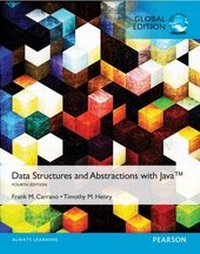
Data Structures and Abstractions with Java, Global Edition
Description

Data Structures and Abstractions with Java is suitable for one- or two-semester courses in data structures (CS-2) in the departments of Computer Science, Computer Engineering, Business, and Management Information Systems.
This is the most student-friendly data structures text available that introduces ADTs in individual, brief chapters - each with pedagogical tools to help students master each concept. Using the latest features of Java, this unique object-oriented presentation makes a clear distinction between specification and implementation to simplify learning, while providing maximum classroom flexibility.
Teaching and Learning Experience
This book will provide a better teaching and learning experience-for you and your students. It will help:
- Aid comprehension and facilitate teaching with an approachable format and content organisation: Material is organised into small segments that focus a reader's attention and provide greater instructional flexibility.
- Keep your course current with updated material: Content is refreshed throughout the book to reflect the latest advancements and to refine the pedagogy. All of the Java code is Java 8 compatible.
- Support learning with student-friendly pedagogy: In-text and online features help students master the material.
The full text downloaded to your computer
With eBooks you can:
- search for key concepts, words and phrases
- make highlights and notes as you study
- share your notes with friends
eBooks are downloaded to your computer and accessible either offline through the Bookshelf (available as a free download), available online and also via the iPad and Android apps.
Upon purchase, you'll gain instant access to this eBook.
Time limit
The eBooks products do not have an expiry date. You will continue to access your digital ebook products whilst you have your Bookshelf installed.
All prices
More details
Other editions
Additional editions
Persons
Timothy M. Henry has a Bachelor of Science Degree in Mathematics from the U.S. Coast Guard Academy, a Master of Science Degree in Computer Science from Old Dominion University, and was awarded a PhD in Applied Math Sciences from the University of Rhode Island. He began his IT career as an officer in the U.S. Coast Guard, and among his early tours, he was the Information Resources Manager (what is today a CIO) at the Coast Guard's training centre in Yorktown, VA.
Content
- Introduction
- Chapter 1: Bags
- Chapter 2: Bag Implementations That Use Arrays
- Chapter 3: A Bag Implementation That Links Data
- Chapter 4: The Effciency of Algorithms
- Chapter 5: Stacks
- Chapter 6: Stack Implementations
- Chapter 7: Recursion
- Chapter 8: An Introduction to Sorting
- Chapter 9: Faster Sorting Methods
- Chapter 10: Queues, Deques, and Priority Queues
- Chapter 11: Queue, Deque, and Priority Queue Implementations
- Chapter 12: Lists
- Chapter 13: A List Implementation That Uses an Array
- Chapter 14: A List Implementation That Links Data
- Chapter 15: Iterators for the ADT List
- Chapter 16: Sorted Lists
- Chapter 17: Inheritance and Lists
- Chapter 18: Searching
- Chapter 19: Dictionaries
- Chapter 20: Dictionary Implementations
- Chapter 21: Introducing Hashing
- Chapter 22: Hashing as a Dictionary Implementation
- Chapter 23: Trees
- Chapter 25: A Binary Search Tree Implementation
- Chapter 26: A Heap Implementation
- Chapter 27: Balanced Search Trees
- Chapter 28: Graphs
- Chapter 29: Graph Implementations
