

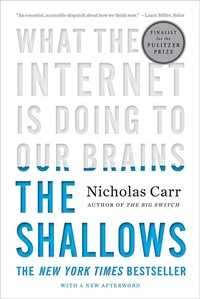
The Shallows
What the Internet Is Doing to Our Brains
Published on 6. June 2011
280 pages
978-0-393-07936-4 (ISBN)
Description

Finalist for the 2011 Pulitzer Prize in General Nonfiction: "Nicholas Carr has written a Silent Spring for the literary mind.”—Michael Agger, Slate
"Is Google making us stupid?” When Nicholas Carr posed that question, in a celebrated Atlantic Monthly cover story, he tapped into a well of anxiety about how the Internet is changing us. He also crystallized one of the most important debates of our time: As we enjoy the Net's bounties, are we sacrificing our ability to read and think deeply? Now, Carr expands his argument into the most compelling exploration of the Internet's intellectual and cultural consequences yet published. As he describes how human thought has been shaped through the centuries by "tools of the mind”—from the alphabet to maps, to the printing press, the clock, and the computer—Carr interweaves a fascinating account of recent discoveries in neuroscience by such pioneers as Michael Merzenich and Eric Kandel. Our brains, the historical and scientific evidence reveals, change in response to our experiences. The technologies we use to find, store, and share information can literally reroute our neural pathways. Building on the insights of thinkers from Plato to McLuhan, Carr makes a convincing case that every information technology carries an intellectual ethic—a set of assumptions about the nature of knowledge and intelligence. He explains how the printed book served to focus our attention, promoting deep and creative thought. In stark contrast, the Internet encourages the rapid, distracted sampling of small bits of information from many sources. Its ethic is that of the industrialist, an ethic of speed and efficiency, of optimized production and consumption—and now the Net is remaking us in its own image. We are becoming ever more adept at scanning and skimming, but what we are losing is our capacity for concentration, contemplation, and reflection. Part intellectual history, part popular science, and part cultural criticism, The Shallows sparkles with memorable vignettes—Friedrich Nietzsche wrestling with a typewriter, Sigmund Freud dissecting the brains of sea creatures, Nathaniel Hawthorne contemplating the thunderous approach of a steam locomotive—even as it plumbs profound questions about the state of our modern psyche. This is a book that will forever alter the way we think about media and our minds.More details
Language
English
Place of publication
United States
Product notice
Windows
ISBN-13
978-0-393-07936-4 (9780393079364)
Copyright in bibliographic data and cover images is held by Nielsen Book Services Limited or by the publishers or by their respective licensors: all rights reserved.
Schweitzer Classification
Other editions
Additional editions
Book
05/2011
WW Norton & Co
€31.13
Article exhausted; check for reprint
Book
06/2010
WW Norton & Co
€28.50
Shipment within 15-20 days
Person
Nicholas Carr is the author of The Shallows, a Pulitzer Prize finalist, and five other acclaimed books. A former executive editor of the Harvard Business Review, he writes for the Atlantic, the New York Times, and the Wall Street Journal. He lives in Oregon.
Content
- Intro
- ALSO BY NICHOLAS CARR
- Title Page
- Copyright
- Dedication
- Contents
- Epigraph
- Prologue THE WATCHDOG AND THE THIEF
- One HAL AND ME
- Two THE VITAL PATHS
- a digression on what the brain thinks about when it thinks about itself
- Three TOOLS OF THE MIND
- Four THE DEEPENING PAGE
- a digression on lee de forest and his amazing audion
- Five A MEDIUM OF THE MOST GENERAL NATURE
- Six THE VERY IMAGE OF A BOOK
- Seven THE JUGGLER'S BRAIN
- a digression on the buoyancy of IQ scores
- Eight THE CHURCH OF GOOGLE
- Nine SEARCH, MEMORY
- a digression on the writing of this book
- Ten A THING LIKE ME
- Epilogue HUMAN ELEMENTS
- Afterword
- Notes
- Further Reading
- Acknowledgments
