

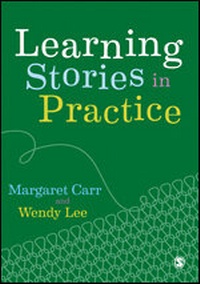
Learning Stories in Practice
1st Edition
Published on 17. May 2019
192 pages
978-1-5264-8033-0 (ISBN)
Description

Margaret Carr and Wendy Lee have often been asked for a follow-on practical companion to their seminal 2012 book Learning Stories; a complimentary book that provides practical advice for teachers who are embarking on a 'narrative assessments-for-learning' journey. After much anticipation that book is here at last!
Packed with a wide range of full-colour examples of real life learning stories from all over the world this practical guide is influenced by their ongoing work with teachers across many countries and the thoughtful comments and questions that teachers have asked during conversations at conferences, lectures and professional development programmes. They have turned these conversations with teachers and students into key ideas, and a practical framework on how to initiate and create good learning stories and why they are valuable.
They show you how to write stories that capture the magic and excitement of each young child's journey through the early years and how to develop a deep professional understanding of the learning that takes place during this special and influential time in their lives.
Packed with a wide range of full-colour examples of real life learning stories from all over the world this practical guide is influenced by their ongoing work with teachers across many countries and the thoughtful comments and questions that teachers have asked during conversations at conferences, lectures and professional development programmes. They have turned these conversations with teachers and students into key ideas, and a practical framework on how to initiate and create good learning stories and why they are valuable.
They show you how to write stories that capture the magic and excitement of each young child's journey through the early years and how to develop a deep professional understanding of the learning that takes place during this special and influential time in their lives.
More details
Language
English
Place of publication
London
United Kingdom
Target group
College/higher education
ISBN-13
978-1-5264-8033-0 (9781526480330)
Copyright in bibliographic data and cover images is held by Nielsen Book Services Limited or by the publishers or by their respective licensors: all rights reserved.
Schweitzer Classification
Other editions
Additional editions
Margaret Carr | Wendy Lee
Learning Stories in Practice
Book
05/2019
1st Edition
SAGE Publications Ltd
€89.90
Shipment within 15-20 days
Persons
Margaret Carr is a Professor of Education at the Wilf Malcolm Institute of Educational Research at the University of Waikato, in Hamilton, New Zealand. Before she joined the Faculty of Education at Waikato, she was a geographer at Victoria University in Wellington, New Zealand, where there was a strong focus by the professors on social and cultural change. This formed a background for her interest in the role of education in society, and in Hamilton she gained a qualification in early childhood education and worked as a kindergarten teacher before becoming a lecturer in education at the university. Her PhD thesis was entitled 'Technological Practice in Early Childhood as a Dispositional Milieu'. New Zealand has provided a number of opportunities for professors to research with early childhood teachers on topics chosen by the teachers, and Margaret has frequently published with teachers. Learning Stories as an assessment practice was developed for the 1996 Te Whariki bicultural curriculum (later revised in 2017); the development of narrative assessment is told in the 2001 Sage book, Assessment in Early Childhood Settings: Learning Stories, and further developed in the 2012 Sage book Learning Stories: Constructing Learner Identities in Early Education. The latter book was co-authored with Wendy Lee, and this partnership has combined academic and professional wisdom in many publications and presentations over many years.
Wendy Lee is passionate about Early Childhood Education (ECE) in New Zealand and has developed a deep interest in issues related to the curriculum and leadership. She is a strong advocate for Learning Stories and the power of documentation to strengthen learner identity of children. Over the past 50 years, her career has focused on building strong, reflective and robust learning communities through her roles as teacher, unionist, lecturer, community development worker, city councillor, manager, professional development facilitator and researcher. Today, as director of the Educational Leadership Project Ltd she and her team provide training and advice to ECE centres throughout New Zealand and in a wide range of other countries. Over the past 20 years, she has had the privilege of collaborating with Professor Margaret Carr on a number of ECE research projects, including co-directing the National Early Childhood Assessment and Learning Exemplar Project. This produced the Kei Tua o te Pae books on assessment for improving learning in the NZ ECE sector. As the influence of research in the area of Learning Stories and Assessment in New Zealand grows and extends more into ECE practice, Wendy has been increasingly requested to present its influence to a wider international audience including teachers in Ireland, England, Scotland, Germany, Japan, Belgium, the USA, Kazakhstan, Canada, Australia and China.
Wendy Lee is passionate about Early Childhood Education (ECE) in New Zealand and has developed a deep interest in issues related to the curriculum and leadership. She is a strong advocate for Learning Stories and the power of documentation to strengthen learner identity of children. Over the past 50 years, her career has focused on building strong, reflective and robust learning communities through her roles as teacher, unionist, lecturer, community development worker, city councillor, manager, professional development facilitator and researcher. Today, as director of the Educational Leadership Project Ltd she and her team provide training and advice to ECE centres throughout New Zealand and in a wide range of other countries. Over the past 20 years, she has had the privilege of collaborating with Professor Margaret Carr on a number of ECE research projects, including co-directing the National Early Childhood Assessment and Learning Exemplar Project. This produced the Kei Tua o te Pae books on assessment for improving learning in the NZ ECE sector. As the influence of research in the area of Learning Stories and Assessment in New Zealand grows and extends more into ECE practice, Wendy has been increasingly requested to present its influence to a wider international audience including teachers in Ireland, England, Scotland, Germany, Japan, Belgium, the USA, Kazakhstan, Canada, Australia and China.
Content
Chapter One: Introduction
Chapter Two: Being Formative
Chapter Three: Being Fair
Chapter Four: Recognising Powerful Frameworks
Chapter Five: Managing Ambiguity
Chapter Six: Sharing Responsibility with the Learners
Chapter Seven: Developing Partnerships with Families
Chapter Eight: Constructing Progress
Chapter Nine: A Learning Story Workshop
Chapter Two: Being Formative
Chapter Three: Being Fair
Chapter Four: Recognising Powerful Frameworks
Chapter Five: Managing Ambiguity
Chapter Six: Sharing Responsibility with the Learners
Chapter Seven: Developing Partnerships with Families
Chapter Eight: Constructing Progress
Chapter Nine: A Learning Story Workshop
