

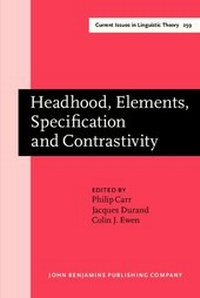
Headhood, Elements, Specification and Contrastivity
Phonological papers in honour of John Anderson
1st Edition
Published on 18. March 2005
XXVIII, 405 pages
978-90-272-9469-2 (ISBN)
Description

The papers in this volume focus on notions which are central to the work of John M. Anderson - the founder of Dependency Phonology - and to phonological theory: the idea of structural analogy between phonology and syntax; the head/dependent relation; the idea that phonological representations are best conceived of in terms of a set of privative elements (rather than as binary-valued features); and the related notions of contrastivity and specification (and non-specification). An important issue dealt with is the relationship between specification and derivationality, and the question whether derivations are necessary in phonological theory. Many of the contributions provide sound empirical support for the appeal to elements and to headhood at all levels of phonological analysis. The book will be of interest to anyone interested in current issues in phonological theory.
More details
Other editions
Additional editions
Philip Carr | Jacques Durand | Colin J. Ewen
Headhood, Elements, Specification and Contrastivity
Phonological papers in honour of John Anderson
Book
03/2005
John Benjamins Publishing Co
€116.60
Shipment within 10-15 days
Persons
Content
- HEADHOOD, ELEMENTS, SPECIFICATION AND CONTRASTIVITY
- Editorial page
- Tiitle page
- LCC data
- Contents
- John M. Anderson. A brief profile of the man and his career in linguistics
- John M. Anderson: Publications 1968-2004
- List of contributors
- Introduction. The structure of phonological representations
- Philip Carr, Jacques Durand and Colin J. Ewen
- Salience, headhood and analogies
- Philip Carr
- 1. Introduction
- 2. Anderson and the generative tradition
- 3. Structural analogy
- 4. An analogy between phonology and semantics
- 5. Salience and individual pathways in acquisition
- 6. Conclusion
- Old English I-umlaut: A unitary sound change?
- Fran Colman
- 1. Background
- 2. West Saxon IU formulated
- 3. West Saxon IU reformulated
- 4. Anglian IU
- 5. Kentish IU
- 6. Conclusion
- Old English breaking and syllable structure
- Mike Davenport
- 1. Introduction
- 2. Old English Breaking: an outline
- 3. The OEB environments
- 4. The OEB environment and syllable structure
- 5. Double trouble: OEB and geminates
- 6. Double or quits: word-final /x/ again
- Tense/Lax, the vowel system of English and phonological theory
- Jacques Durand
- 1. Introduction
- 2. Three approaches to vowel systems: a brief historical sketch
- 3. Tense/lax in English and phonetic evidence
- 4. Revisiting length in English
- 5. Is there a place for the feature tense/lax in English?
- 6. Conclusion
- Headedness and defective distributions in Polish
- Edmund Gussmann
- Vowel reduction as information loss
- John Harris
- 1. Introduction
- 2. Centrifugal and centripetal reduction
- 3. Vowel reduction in functional Optimality Theory
- 4. Vowel reduction as information loss in the speech signal
- 5. Vowel reduction as information loss in phonology
- 6. Teleology of vowel reduction: attention vs. effort
- Tone and dependency in Yorùbá
- Phil Harrison
- 1. Introduction
- 2. [L] and phonetic signatures
- 3. Yorùbá prosodic constituents
- 4. The form and content of Yorùbá nuclear domains
- 5. Typological context: other languages and universality
- 6. The sound of prosody
- Sharing makes us stronger
- Patrick Honeybone
- 1. Introduction
- 2. Prosody, melody and segmental structure
- 3. Processes, environments, inhibition and strength
- 4. Lenition inhibition: generalisations and proposals
- 5. Case studies of process inhibition
- 6. Conclusions
- The molecular structure of phonological segments
- Harry van der Hulst
- 1. Introduction
- 2. Manner
- 3. Place
- 4. Laryngeal
- 5. Nasality
- 6. Incomplete structures
- 7. Complex segments
- 8. Some correspondences with Government Phonology
- 9. Conclusions
- Appendices
- Representation and the role of underspecification in declarative phonology
- Ken Lodge
- 1. Introduction
- 2. Declarative Phonology
- 3. Spin-offs underspecification
- 4. Postscript
- Heads I win, tails you lose
- April McMahon
- 1. Optimality Theory: an embarrassment of riches
- 2. Prosody, melody and evolution
- 3. Extending the argument: prosody, melody and acquisition
- 4. Prosodic conditioning of melody and melodic conditioning of prosody
- 5. An evolutionary perspective
- How a phonological theory of headedness can account for strong vs. weak phonetic alternants
- Nancy A. Ritter
- 1. Introduction
- 2. v and its phonetic realisations around the world
- 3. Hungarian v: a case study for Head-Driven Phonology
- 4. Conclusions
- The aperture particle |a| its role and functions
- Sanford Schane
- 1. The elements of particle phonology
- 2. Some vowel systems
- 3. The functions of |a|
- 4. Some vowel processes affecting height, laxness and RTR
- 5. Particle phonology and markedness
- 6. Conclusion
- Towards a Taw-based phonological representation of place
- Jørgen Staun
- 1. Preamble: aims and assumptions
- 2. The basic components
- 3. The vowel space
- 4. Consonantal place
- 5. Closing remarks
- References
- Language index
- Name index
- Subject index
- The Series Current Issues in Linguistic Theory
