

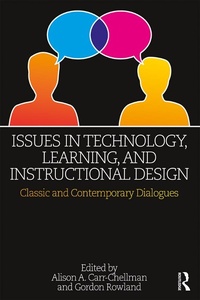
Issues in Technology, Learning, and Instructional Design
Classic and Contemporary Dialogues
Published on 1. December 2016
231 pages
978-1-317-48430-1 (ISBN)
Description

In Issues in Technology, Learning, and Instructional Design, some of the best-known scholars in those fields produce powerful, original dialogues that clarify current issues, provide context and theoretical grounding, and illuminate a framework for future thought. Position statements are introduced and then responded to, covering a remarkably broad series of topics across educational technology, learning, and instructional design, from tool use to design education to how people learn. Reminiscent of the well-known Clark/Kozma debates of the 1990s, this book is a must-have for professionals in the field and can also be used as a textbook for graduate or advanced undergraduate courses.
Reviews / Votes
Carr-Chellman and Rowland bring together over fifty contemporary scholars in our field to share their perspectives on critical, theoretical, and practitioner issues. The dialogue format is easy to read, rich with research-based references, and likely to be recognized as a new seminal work for the discipline. A must read!-Kay A. Persichitte, Ph.D., Professor, University of Wyoming
This book focuses on current important issues in the instructional design and technology field. Carr-Chellman and Rowland have captured a variety of viewpoints from several leading scholars. Reading the book will stimulate thought and dialogue among IDT professionals.
-James D. Klein, Walter Dick Distinguished Professor of Instructional Systems, Florida State University
More details
Language
English
Place of publication
London
United Kingdom
Publishing group
Taylor & Francis Ltd
Target group
College/higher education
Illustrations
1 s/w Photographie bzw. Rasterbild, 6 s/w Zeichnungen, 7 s/w Abbildungen, 2 s/w Tabellen
2 Tables, black and white; 6 Line drawings, black and white; 1 Halftones, black and white; 7 Illustrations, black and white
File size
1,60 MB
ISBN-13
978-1-317-48430-1 (9781317484301)
Copyright in bibliographic data and cover images is held by Nielsen Book Services Limited or by the publishers or by their respective licensors: all rights reserved.
Schweitzer Classification
Other editions
Additional editions

Alison A. Carr-Chellman | Gordon Rowland
Issues in Technology, Learning, and Instructional Design
Classic and Contemporary Dialogues
Book
12/2016
1st Edition
Routledge
€240.40
Shipment within 10-20 days
Alison A. Carr-Chellman | Gordon Rowland
Issues in Technology, Learning, and Instructional Design
Classic and Contemporary Dialogues
Book
12/2016
1st Edition
Routledge
€72.50
Shipment within 10-20 days
Persons
Alison A. Carr-Chellman is Dean of the College of Education at the University of Idaho.
Gordon Rowland is Professor of Communications at Ithaca College.
Gordon Rowland is Professor of Communications at Ithaca College.
Content
Introduction
Part 1: The Nature of Design
The Relationship of Instructional Design to the Broad Field of Design by Patrick Parrish
Response by Harold Nelson
Rejoinder by Patrick Parrish
Toward Understanding the Nature of Design by Brenda Bannan
Response by Andrew S. Gibbons
Rejoinder by Brenda Bannan
Guerrilla Design: How Can We Accommodate Against-the-Grain Thinking in Our Practice? by Brent Wilson
Response by Barbara L. Martin
Rejoinder by Brent G. Wilson
Design Beyond Content: Extending the Value of Educational Technology; an Examination of the Role or the Anti-Role of Content in Educational Technology by Brad Hokanson
Response by Peter Samuelson Wardrip
Rejoinder by Brad Hokanson
The Systems Approach to Instructional Development by Michael Molenda
Response by Thomas Argondizza
Rejoinder by Michael Molenda
Instructional Design Models and the Expertise Required to Practice True Instructional Design by Robert Maribe Branch
Response by Lloyd P. Rieber
Rejoinder by Robert Maribe Branch
Part 2: Preparing Designers
Introduction to Part 2
Developing Design Expertise by Kathleen Fortney
Response by Elizabeth Boling
Rejoinder by Kathleen Fortney
Design Education as a Site for Educating Disciplines by Kennon M. Smith
Response by Atsusi Hirumi
Rejoinder by Kennon M. Smith
Necessary Ingredients for the Education of Designers by Irene Visscher-Voerman
Response by Monica Tracey
Rejoinder by Irene Visscher-Voerman
Teaching the Complex Performance of Instructional Design: Why We Cannot Use the (Existing) Tools of Instructional Design by Elizabeth Boling
Response by M. David Merrill
Rejoinder by Elizabeth Boling
My Hope for the Future of Instructional Technology by M. David Merrill
Response by Tonia A. Dousay
Rejoinder by M. David Merrill
Preparing Instructional Designers by Monica W. Tracey
Response by Brad Hokanson
Rejoinder by Monica W. Tracey
Part 3: Context
Introduction to Part 3
Education is Completely Broken by Roger C. Schank
Response by Kyle Peck
Rejoinder by Roger C. Schank
Paradigm Change: Its Time Is Now by Charles M. Reigeluth
Response by Roger C. Schank
Rejoinder by Charles M. Reigeluth
The Unbalancing of Corporate Systems: The Neuroscience of Intellect vs. Wisdom by Anthony Marker
Response by Rob Foshay
Rejoinder by Anthony Marker
Women in Educational Technology by Audrey Watters
Response by Rose Marra
Part 4: Technology
Introduction to Part 4
The Learner-Centered Paradigm of Instruction by Charles M. Reigeluth
Response by Stephen W. Harmon
Rejoinder by Charles M. Reigeluth
Learning From and With Media and Technology by Thomas C. Reeves
Response by Wilhelmina C. Savenye
Rejoinder by Thomas C. Reeves
Building Educational Technologies to Scale in Schools by Rob Foshay
Response by MJ Bishop
Rejoinder by Rob Foshay
For the Foreseeable Future, Instructional Technology Devices and Products-No Matter How Well Designed-Will Not Eliminate the Need for Human Teachers by Ward Mitchell Cates and Thomas C. Hammond
Response by Sugata Mitra
Rejoinder by Ward Mitchell Cates and Thomas C. Hammond
What's Next for E-Learning? By John Savery
Response by Clark Quinn
Rejoinder by John Savery
Any Time, Any Place, Any Pace ... by Kathryn Kennedy and Joseph R. Friedhoff
Response by Victoria Raish
Rejoinder by Kathryn Kennedy and Joseph R. Friedhoff
Part 5: Learning Science
Introduction to Part 5
Points of Contact: Educational Technology and the Learning Sciences by Andrew S. Gibbons
Response by Jason Yip
Rejoinder by Andy Gibbons
Bring Design to Design-Based Research by Gordon Rowland
Response by Heather Toomey Zimmerman
Rejoinder by Gordon Rowland
Participatory Design by Jason Yip
Response by Thomas C. Reeves
Rejoinder by Jason Yip
Conclusion
Part 1: The Nature of Design
The Relationship of Instructional Design to the Broad Field of Design by Patrick Parrish
Response by Harold Nelson
Rejoinder by Patrick Parrish
Toward Understanding the Nature of Design by Brenda Bannan
Response by Andrew S. Gibbons
Rejoinder by Brenda Bannan
Guerrilla Design: How Can We Accommodate Against-the-Grain Thinking in Our Practice? by Brent Wilson
Response by Barbara L. Martin
Rejoinder by Brent G. Wilson
Design Beyond Content: Extending the Value of Educational Technology; an Examination of the Role or the Anti-Role of Content in Educational Technology by Brad Hokanson
Response by Peter Samuelson Wardrip
Rejoinder by Brad Hokanson
The Systems Approach to Instructional Development by Michael Molenda
Response by Thomas Argondizza
Rejoinder by Michael Molenda
Instructional Design Models and the Expertise Required to Practice True Instructional Design by Robert Maribe Branch
Response by Lloyd P. Rieber
Rejoinder by Robert Maribe Branch
Part 2: Preparing Designers
Introduction to Part 2
Developing Design Expertise by Kathleen Fortney
Response by Elizabeth Boling
Rejoinder by Kathleen Fortney
Design Education as a Site for Educating Disciplines by Kennon M. Smith
Response by Atsusi Hirumi
Rejoinder by Kennon M. Smith
Necessary Ingredients for the Education of Designers by Irene Visscher-Voerman
Response by Monica Tracey
Rejoinder by Irene Visscher-Voerman
Teaching the Complex Performance of Instructional Design: Why We Cannot Use the (Existing) Tools of Instructional Design by Elizabeth Boling
Response by M. David Merrill
Rejoinder by Elizabeth Boling
My Hope for the Future of Instructional Technology by M. David Merrill
Response by Tonia A. Dousay
Rejoinder by M. David Merrill
Preparing Instructional Designers by Monica W. Tracey
Response by Brad Hokanson
Rejoinder by Monica W. Tracey
Part 3: Context
Introduction to Part 3
Education is Completely Broken by Roger C. Schank
Response by Kyle Peck
Rejoinder by Roger C. Schank
Paradigm Change: Its Time Is Now by Charles M. Reigeluth
Response by Roger C. Schank
Rejoinder by Charles M. Reigeluth
The Unbalancing of Corporate Systems: The Neuroscience of Intellect vs. Wisdom by Anthony Marker
Response by Rob Foshay
Rejoinder by Anthony Marker
Women in Educational Technology by Audrey Watters
Response by Rose Marra
Part 4: Technology
Introduction to Part 4
The Learner-Centered Paradigm of Instruction by Charles M. Reigeluth
Response by Stephen W. Harmon
Rejoinder by Charles M. Reigeluth
Learning From and With Media and Technology by Thomas C. Reeves
Response by Wilhelmina C. Savenye
Rejoinder by Thomas C. Reeves
Building Educational Technologies to Scale in Schools by Rob Foshay
Response by MJ Bishop
Rejoinder by Rob Foshay
For the Foreseeable Future, Instructional Technology Devices and Products-No Matter How Well Designed-Will Not Eliminate the Need for Human Teachers by Ward Mitchell Cates and Thomas C. Hammond
Response by Sugata Mitra
Rejoinder by Ward Mitchell Cates and Thomas C. Hammond
What's Next for E-Learning? By John Savery
Response by Clark Quinn
Rejoinder by John Savery
Any Time, Any Place, Any Pace ... by Kathryn Kennedy and Joseph R. Friedhoff
Response by Victoria Raish
Rejoinder by Kathryn Kennedy and Joseph R. Friedhoff
Part 5: Learning Science
Introduction to Part 5
Points of Contact: Educational Technology and the Learning Sciences by Andrew S. Gibbons
Response by Jason Yip
Rejoinder by Andy Gibbons
Bring Design to Design-Based Research by Gordon Rowland
Response by Heather Toomey Zimmerman
Rejoinder by Gordon Rowland
Participatory Design by Jason Yip
Response by Thomas C. Reeves
Rejoinder by Jason Yip
Conclusion
