

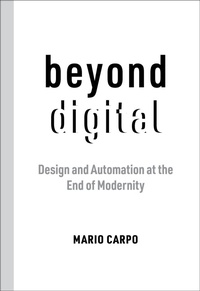
Beyond Digital
Design and Automation at the End of Modernity
Published on 18. April 2023
208 pages
978-0-262-37339-5 (ISBN)
Description

Recasting computational design: a new modern agenda for a post-industrial, post-pandemic world.
Mass production was the core technical logic of industrial modernity: for the last hundred years, architects and designers have tried to industrialize construction and standardize building materials and processes in the pursuit of economies of scale. But this epochal march of modernity is now over. In Beyond Digital, Mario Carpo reviews the long history of the computational mode of production, showing how the merger of robotic automation and artificial intelligence will stop and reverse the modernist quest for scale. Today's technologies already allow us to use nonstandard building materials as found, or as made, and assemble them in as many nonstandard, intelligent, adaptive ways as needed: the microfactories of our imminent future will be automated artisan shops.
The post-industrial logic of computational manufacturing has been known and theorized for some time. By tracing its theoretical and technical sources, and reviewing the design theories that accompanied its rise, Carpo shows how the computational project, long under the sway of powerful antimodern ideologies, is now being recast by the urgency of the climate crisis, which has vindicated its premises-and by the global pandemic, which has tragically proven its viability. Looking at the work of a new generation of designers, technologists, and producers, Beyond Digital offers a new modern agenda for our post-industrial future.
Mass production was the core technical logic of industrial modernity: for the last hundred years, architects and designers have tried to industrialize construction and standardize building materials and processes in the pursuit of economies of scale. But this epochal march of modernity is now over. In Beyond Digital, Mario Carpo reviews the long history of the computational mode of production, showing how the merger of robotic automation and artificial intelligence will stop and reverse the modernist quest for scale. Today's technologies already allow us to use nonstandard building materials as found, or as made, and assemble them in as many nonstandard, intelligent, adaptive ways as needed: the microfactories of our imminent future will be automated artisan shops.
The post-industrial logic of computational manufacturing has been known and theorized for some time. By tracing its theoretical and technical sources, and reviewing the design theories that accompanied its rise, Carpo shows how the computational project, long under the sway of powerful antimodern ideologies, is now being recast by the urgency of the climate crisis, which has vindicated its premises-and by the global pandemic, which has tragically proven its viability. Looking at the work of a new generation of designers, technologists, and producers, Beyond Digital offers a new modern agenda for our post-industrial future.
More details
Other editions
Additional editions
Book
04/2023
MIT Press
€28.00
Available immediately
Person
Mario Carpo is the Reyner Banham Professor of Architectural History at the Bartlett-UCL in London and Professor of Architectural Theory at the University of Applied Arts (die Angewandte) in Vienna. He is the author of Architecture in the Age of Printing (2001), The Second Digital Turn (2017), and other books.
Content
1 Ways of Making 1
1.1 Hand-Making 4
1.2 Mechanical Machine-Making 6
1.3 Digital Making 12
1.4 Beyond the Anthropocene: A New Economy without Scale 16
1.5 The Collapse of the Modern Way of Making 20
1.6 The Teachings of the Pandemic 24
2 The Future of Automation: Designers Redesign Robotics 35
2.1 Florence, 1450: The Invention of Notational Work 39
2.2 America, 1909-1913: Notational Work Goes Mainstream 42
2.3 Taylor's Reinforced Concrete as a Social Project 47
2.4 The Automation of Notational Work 52
2.5 First Steps toward Post-Notational Automation 63
3 A Tale of Two Sciences, or The Rise of the Anti-Modern Science of Computation 79
3.1 The Two Sciences 82
3.2 Modern Architecture and Postmodern Complexity 93
3.3 Architects, Computers, and Computer Science 94
3.4 Degenerate Complexism and the Second Coming of AI 112
3.5 The Limits of AI 2.0 118
3.6 Machine Learning and the Automation of Imitation 120
3.7 Sorry: There Won't Be a Third Digital Turn Driven by AI 126
4 The Post-Human Chunkiness of Computational Automation 129
4.1 Mechanical Assembly as the Style of Dissent 132
4.2 Modernist Modularity, Postmodernist Collage, and Deconstructivist Aggregation 140
Epilogue: Being Post-Digital 155
Acknowledgments 163
Notes 165
Index 191
1.1 Hand-Making 4
1.2 Mechanical Machine-Making 6
1.3 Digital Making 12
1.4 Beyond the Anthropocene: A New Economy without Scale 16
1.5 The Collapse of the Modern Way of Making 20
1.6 The Teachings of the Pandemic 24
2 The Future of Automation: Designers Redesign Robotics 35
2.1 Florence, 1450: The Invention of Notational Work 39
2.2 America, 1909-1913: Notational Work Goes Mainstream 42
2.3 Taylor's Reinforced Concrete as a Social Project 47
2.4 The Automation of Notational Work 52
2.5 First Steps toward Post-Notational Automation 63
3 A Tale of Two Sciences, or The Rise of the Anti-Modern Science of Computation 79
3.1 The Two Sciences 82
3.2 Modern Architecture and Postmodern Complexity 93
3.3 Architects, Computers, and Computer Science 94
3.4 Degenerate Complexism and the Second Coming of AI 112
3.5 The Limits of AI 2.0 118
3.6 Machine Learning and the Automation of Imitation 120
3.7 Sorry: There Won't Be a Third Digital Turn Driven by AI 126
4 The Post-Human Chunkiness of Computational Automation 129
4.1 Mechanical Assembly as the Style of Dissent 132
4.2 Modernist Modularity, Postmodernist Collage, and Deconstructivist Aggregation 140
Epilogue: Being Post-Digital 155
Acknowledgments 163
Notes 165
Index 191
