

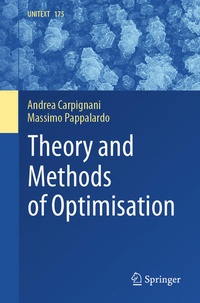
Theory and Methods of Optimisation
Description

This book originates from the graduate course Theory and Methods of Optimisation taught at the University of Pisa and is primarily intended for students seeking a rigorous yet accessible introduction to optimisation techniques. While designed with graduate students in mind, the text is largely self-contained and may also be approached by motivated undergraduates with a solid foundation in mathematical analysis, linear algebra, and the basic topology of Euclidean spaces. Key results from differential calculus and topology are recalled throughout, ensuring that the material remains accessible without compromising mathematical depth.
Structured in three parts, the text offers a coherent progression from foundational theory to algorithmic methods. The first part provides an introduction to convex analysis; the second covers the theory of linear and nonlinear programming; and the third presents key classical algorithms, including the simplex method and gradient-based techniques. Each chapter builds on previous material, with methods presented in detail, including pseudocode and full convergence proofs.
Throughout, the book combines theoretical rigour with applied insight. Every result is proved, and numerous worked examples illustrate the methods in action. This dual emphasis gives the work the character of both a rigorous theoretical text and a practical guide to mathematical optimisation.
The book serves both as an introduction and as a comprehensive reference for those interested in applying mathematical models to real-world problems. It will be especially valuable to young researchers in applied mathematics looking to understand the theoretical underpinnings of optimisation methods as well as to those working on the practical implementation of such techniques.
More details
Other editions
Additional editions
Persons
Andrea Carpignani graduated from the University of Pisa in March 2005, with a dissertation focused on the applications of stochastic calculus to partial differential equations. His academic interests are measure theory and integration, convex and functional analysis, probability, mathematical statistics, and data science. Following four years as a teaching assistant at the University of Pisa, Andrea Carpignani pursued a career in secondary and further education, teaching Mathematics and Physics in the province of Florence. Since relocating to the United Kingdom in 2017, he has taught mathematics at secondary, post-16, and further education levels, undertaking roles including Subject Specialist for Key Stage 5 Mathematics, Head of Mathematics, and currently Key Stage 5 Coordinator at the Radcliffe School in Milton Keynes.
Massimo Pappalardo is a full professor of Operations Research. After graduation "cum laude" in Mathematics at the University of Pisa, he did his Ph.D. in Mathematics. Since 1988, he was first an associate professor and then, a full professor of Operations Research. He has taught in the Faculty of Engineering, in the Faculty of Science and in the Faculty of Economics. He was the director of the Department of Applied Mathematics, President of the degree course in Computer Science and President of the "Academic Quality Control". In 2023, he was awarded the order of the cherub, the highest honour of the University of Pisa for full professors. His scientific interests lie in optimisation, variational analysis and equilibrium problems both from a theoretical and applicative point of view. He is the author of more than 80 papers in international journals. He wrote two didactical books and a research book in the Springer Operations Research series.
Content
Part I. Convex Analysis.- Chapter 1. Convex sets.- Chapter 2. Convex functions.- Part II. Theory of Optimisation.- Chapter 3. Introduction to Mathematical Programming.- Chapter 4. Linear programming.- Chapter 5. Non-linear Programming.- Chapter 6. Lagrangian Duality.- Part III. Methods of Optimisation.- Chapter 7. Algorithms and Their Convergence.- Chapter 8. The Simplex Method.- Chapter 9. Unconstrained Problems.- Chapter 10. Constrained Problems.
