

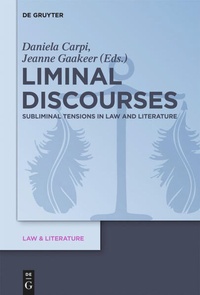
Liminal Discourses
Description

The past few decades in legal and literary studies have challenged the boundaries raised by the different concepts of law and literature espoused by a great variety of theorists. Law's traditionally assumed disciplinary autonomy has been challenged by those who have pursued interdisciplinary methods of research. In particular, the concept of the sublime has moved out of the strictly philosophical and literary fields and crossed the borders between disciplines, finding an application also in the juridical field. On one hand, this volume proposes that the ethical aspect involved in the legal sublime is to contain the arrogance of the law. On the other hand, the volume draws attention to the "and" of interdisciplinary literary-legal studies and offers new daring comparisons between philosophical fields and between apparently distant historical periods.
More details
Other editions
Additional editions
Complete work / Part of the work
Persons
Content
2 - Introduction 2: On the Threshold and Beyond: An introductory Observation [Seite 21]
3 - Representing Law: Narrative Practices, Poetic Devices, Visual Signs and the Aesthetics of the Common Law Mind [Seite 33]
4 - Bare Law Between Two Lives: Jose Saramago and Cornelia Vismann on Naming, Filing and Cancelling [Seite 43]
5 - Liminal Tensions in Public to Private Conceptions of Justice: Nussbaum, Woolf and the Struggle for identity [Seite 59]
6 - "Under the Force of the Law": Communal imagination and the Constitutional Sublime in Walter Scott's The Bride of Lammermoor [Seite 79]
7 - Moll Flanders, Ordinary's Accounts and Old Bailey Proceedings [Seite 101]
8 - Ariel and Caliban as Law-conscious Servants Longing for Legal Personhood [Seite 119]
9 - Altered Bodies, Fragmented Selves: Reconstructing the Subject in Fay Weldon's The Cloning of Joanna May [Seite 135]
10 - The Business of Law and Literature: to Compose an Order, to imagine Man [Seite 155]
11 - Renaissance into Postmodernism: Anticipations of Legal Unrest [Seite 183]
