

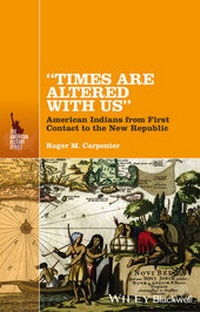
"Times Are Altered with Us"
Description

More details
Other editions
Additional editions
Person
Content
Introduction
In addition to standing on its own, whether as one of several core readings or as supplementary (and hopefully engaging) reading for a larger survey of United States or Native American history, this book also will complement two other works about Native American history originally published by Harlan Davidson in this American History Series, now published by Wiley Blackwell. Philip Weeks' "Farewell, My Nation": The American Indian and the United States in the Nineteenth Century (third edition forthcoming) provides an overview of Native Americans during the tumultuous nineteenth century, while the second edition of Peter Iverson's and Wade Davies's "We Are Still Here": American Indians since 1890 discusses the American Indian experience in the twentieth and early twenty-first centuries, and, as the title emphasizes, notes that American Indians did not simply disappear with the closing of the frontier.
"Times Are Altered with Us" takes its title from remarks made by an Onondaga leader in the early phases of the American Revolution; yet the ideas expressed in his comment can be applied to the native experience in the first three decades of contact with Europeans. "Times Are Altered with Us" begins with the settlement of the Americas by the ancestors of Native Americans, and ends just about where "Farewell, My Nation" picks up. The notion that native people settled the Americas can be somewhat controversial, in that many Native Americans assert that they have always occupied this continent; archaeologists and anthropologists, however, argue otherwise. Nevertheless, this work attempts to tell the story of the interactions between the original inhabitants of North America and European explorers, missionaries, and colonizers from Cristóbal Colón's landfall on a Caribbean island in 1492 to the first years of the American Republic. In covering such a vast expanse of time, and the myriad experiences and interactions between Native Americans and Europeans, an author is forced by necessity to pick and choose what he or she believes to be the most important and consequential events.
It is difficult for anyone living today to appreciate the magnitude of change that contact between the two "old worlds" of Europe and the Americas ushered in. Two civilizations, wholly unaware of each other, began a process that would change the course of history. I am aware that the phrase "change the course of history" has become cliché: nearly every author of a work of history, or producer of a documentary that purports to portray the past, tends to use the term or a variation thereof. That said, in this case the phrase is an understatement. The difficulty in appreciating the magnitude of how contact between Europe and the Americas changed the world lies in that its results are now part of the cultural milieu in which we find ourselves immersed; the consequences of contact affect each of us in our daily lives, right down to the food we eat. It is difficult to imagine, for example, present-day American culture without maize (corn). It is consumed by the cattle that are transformed into our fast-food hamburgers and it is present in our automobiles' gas tanks as an additive (ethanol). The potato, a plant native to South America, has also become the everyday. Taken to Europe, it fed the continent's peasant populations over the last three centuries, and was re-exported to North America. Of course, it is also consumed as fries to complement our quarter-pounders, and perhaps more commonly, as chips.
In a very real and tragic sense, however, the largely unwitting importation of diseases from Europe and Africa did more than any other factor to change things for the peoples of the Americas. European missionaries and explorers would see the effects of these pathogens among native people first-hand, and they would describe mortality rates that range from 50 to 90 percent. It remains difficult, however, to assign an exact number as to how many native people died as result of diseases introduced by Europeans: this is because no one knows what the population of the Americas was at contact. While there is still disagreement among scholars, an estimate of 15 million people living north of the Rio Grande appears to be gaining acceptance. While it never will be possible for us to know with certainty how many people lived in the Americas in 1492, the late historian Francis Jennings did place the debate in its proper context. The numbers aside, Jennings noted, it was obvious that not long after the initial encounters North America had become a widowed land. The Pilgrims who landed in New England in 1620 certainly saw the effects of a disease epidemic: unharvested maize rotting in the fields, deteriorating wigwams, and, most tellingly, human remains lying above ground. Slightly more than a half-century later, the French explorer La Salle described the present-day American Southeast as a largely depopulated wilderness, yet more than a century before him, chroniclers of the De Soto expedition saw a very different landscape, taking note of its large villages and vast cornfields. In short, in the 130 years between the expeditions of De Soto and La Salle, the Indian population had declined and the landscape had been altered, not only because of De Soto's depredations, but because of the diseases his expedition had left in its wake.
Perhaps the greatest frustration for any scholar in writing Native American history is the elusiveness of the Native voice. Europeans wrote the vast majority of the historical sources for the first 300 years of contact and thereby seized control of the narrative. It is true that sources often contain remarks attributed to Native Americans, but we have to keep in mind that even then the Native voice is somewhat muted - since it must pass through cultural and linguistic filters. Indeed, some historians now assert that, at times, European translators present at treaty negotiations did not always keep a faithful record of what native people said. Historical accounts by missionaries are often tainted, not only by the difficulties in translation, but by the need of the authors to demonstrate to prospective readers that they were making headway in converting the "barbarians" of the Americas to whatever brand of Christianity they espoused.
In composing this book, I have attempted to use the terms "tribe," "nation," and "band" almost interchangeably, to try to avoid redundancy. I have also attempted to use the names of Indian nations that are most often familiar to readers. The tendency in academia - one with which I agree - is to attempt to use the names that native people called and in some cases still call themselves.
I have divided this book into a dozen chapters. Chapter 1 provides a capsule view of the Americas prior to contact between Indian peoples and Europeans. Among these key developments are the migration of the ancestors of Native Americans from Asia (which in itself is somewhat controversial), the development of maize agriculture, and the ongoing (and I believe irresolvable) disputes concerning pre-contact native populations.
Chapters 2, 3, and 4 deal with native contacts with the major European powers. Chapter 2 focuses primarily on Spanish exploration in North America, covering the wanderings of Alvar Núñez Cabeza de Vaca and subsequent expeditions led by Hernándo de Soto and Francisco Vasquez de Coronado. It also discusses the permanent Spanish settlements of New Mexico and the Pueblo Revolt of 1680. Chapter 3 examines contact between native people and the French, from Jacques Cartier's voyages in the 1530s, Samuel de Champlain's governance of New France, and the establishment of Louisiana at the very end of the seventeenth century. It also examines the missionary activities of the Jesuits. Drawing on their experience in Canada, the French (and the Jesuit order for that matter) took a different approach than did the Spanish toward native people in Louisiana. Chapters 4 and 5 both discuss relations between Native American peoples and English colonists. Chapter 4 treats relations between the English and native people in the Southeast, while Chapter 5 examines interactions between the two groups in New England.
Chapter 6 focuses mainly on the so-called Iroquois Wars, but it also discusses Dutch interactions with Native Americans. The Dutch receive relatively lighter coverage for several reasons - besides overall limitations of space. Chief among these is that the Dutch presence in the Americas, while important, was temporally limited; the colony of New Netherland barely existed for four decades. Second, while the Dutch constantly engaged in commercial interactions with Native Americans, their knowledge about them was extremely narrow. Indeed, Dutch traders at Fort Orange simply referred to all non-Mohawk Iroquoian speakers as Senecas, conflating the westernmost of the Iroquois Five Nations with all the others. But the most important portion of the chapter deals with the Iroquois and their wars against other native peoples that lasted until the end of the seventeenth century, and their positioning themselves as a force between the French and English for much of the eighteenth century.
Chapters 7, 8, and 9 discuss relations and conflict between native people and...
