

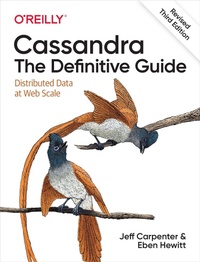
Cassandra: The Definitive Guide, (Revised) Third Edition
Description

Imagine what you could do if scalability wasn''t a problem. With this hands-on guide, you''ll learn how the Cassandra database management system handles hundreds of terabytes of data while remaining highly available across multiple data centers. This revised third edition--updated for Cassandra 4.0 and new developments in the Cassandra ecosystem, including deployments in Kubernetes with K8ssandra--provides technical details and practical examples to help you put this database to work in a production environment.
Authors Jeff Carpenter and Eben Hewitt demonstrate the advantages of Cassandra''s nonrelational design, with special attention to data modeling. Developers, DBAs, and application architects looking to solve a database scaling issue or future-proof an application will learn how to harness Cassandra''s speed and flexibility.
- Understand Cassandra''s distributed and decentralized structure
- Use the Cassandra Query Language (CQL) and cqlsh (the CQL shell)
- Create a working data model and compare it with an equivalent relational model
- Design and develop applications using client drivers
- Explore cluster topology and learn how nodes exchange data
- Maintain a high level of performance in your cluster
- Deploy Cassandra onsite, in the cloud, or with Docker and Kubernetes
- Integrate Cassandra with Spark, Kafka, Elasticsearch, Solr, and Lucene
More details
Other editions
Additional editions
Content
- Intro
- Copyright
- Table of Contents
- Foreword
- Preface
- Why Apache Cassandra?
- Is This Book for You?
- What's in This Book?
- New for the Third Edition
- Note on the Revised Third Edition
- Conventions Used in This Book
- Using Code Examples
- O'Reilly Interactive Katacoda Scenarios
- O'Reilly Online Learning
- How to Contact Us
- Acknowledgments
- Chapter 1. Beyond Relational Databases
- What's Wrong with Relational Databases?
- A Quick Review of Relational Databases
- Transactions, ACID-ity, and Two-Phase Commit
- Schema
- Sharding and Shared-Nothing Architecture
- Web Scale
- The Rise of NoSQL
- Summary
- Chapter 2. Introducing Cassandra
- The Cassandra Elevator Pitch
- Cassandra in 50 Words or Less
- Distributed and Decentralized
- Elastic Scalability
- High Availability and Fault Tolerance
- Tuneable Consistency
- Brewer's CAP Theorem
- Row-Oriented
- High Performance
- Where Did Cassandra Come From?
- Is Cassandra a Good Fit for My Project?
- Large Deployments
- Lots of Writes, Statistics, and Analysis
- Geographical Distribution
- Hybrid Cloud and Multicloud Deployment
- Getting Involved
- Summary
- Chapter 3. Installing Cassandra
- Installing the Apache Distribution
- Extracting the Download
- What's in There?
- Building from Source
- Additional Build Targets
- Running Cassandra
- Setting the Environment
- Starting the Server
- Stopping Cassandra
- Other Cassandra Distributions
- Running the CQL Shell
- Basic cqlsh Commands
- cqlsh Help
- Describing the Environment in cqlsh
- Creating a Keyspace and Table in cqlsh
- Writing and Reading Data in cqlsh
- Running Cassandra in Docker
- Summary
- Chapter 4. The Cassandra Query Language
- The Relational Data Model
- Cassandra's Data Model
- Clusters
- Keyspaces
- Tables
- Columns
- CQL Types
- Numeric Data Types
- Textual Data Types
- Time and Identity Data Types
- Other Simple Data Types
- Collections
- Tuples
- User-Defined Types
- Summary
- Chapter 5. Data Modeling
- Conceptual Data Modeling
- RDBMS Design
- Design Differences Between RDBMS and Cassandra
- Defining Application Queries
- Logical Data Modeling
- Hotel Logical Data Model
- Reservation Logical Data Model
- Physical Data Modeling
- Hotel Physical Data Model
- Reservation Physical Data Model
- Evaluating and Refining
- Calculating Partition Size
- Calculating Size on Disk
- Breaking Up Large Partitions
- Defining Database Schema
- Cassandra Data Modeling Tools
- Summary
- Chapter 6. The Cassandra Architecture
- Data Centers and Racks
- Gossip and Failure Detection
- Snitches
- Rings and Tokens
- Virtual Nodes
- Partitioners
- Replication Strategies
- Consistency Levels
- Queries and Coordinator Nodes
- Hinted Handoff
- Anti-Entropy, Repair, and Merkle Trees
- Lightweight Transactions and Paxos
- Memtables, SSTables, and Commit Logs
- Bloom Filters
- Caching
- Compaction
- Deletion and Tombstones
- Managers and Services
- Cassandra Daemon
- Storage Engine
- Storage Service
- Storage Proxy
- Messaging Service
- Stream Manager
- CQL Native Transport Server
- System Keyspaces
- Summary
- Chapter 7. Designing Applications with Cassandra
- Hotel Application Design
- Cassandra and Microservice Architecture
- Microservice Architecture for a Hotel Application
- Identifying Bounded Contexts
- Identifying Services
- Designing Microservice Persistence
- Extending Designs
- Secondary Indexes
- Materialized Views
- Reservation Service: A Sample Microservice
- Design Choices for a Java Microservice
- Deployment and Integration Considerations
- Services, Keyspaces, and Clusters
- Data Centers and Load Balancing
- Interactions Between Microservices
- Summary
- Chapter 8. Application Development with Drivers
- DataStax Java Driver
- Development Environment Configuration
- Connecting to a Cluster
- Statements
- Simple Statements
- Prepared Statements
- Query Builder
- Object Mapper
- Asynchronous Execution
- Driver Configuration
- Metadata
- Debugging and Monitoring
- DataStax Python Driver
- DataStax Node.js Driver
- DataStax C# Driver
- Other Cassandra Drivers
- Summary
- Chapter 9. Writing and Reading Data
- Writing
- Write Consistency Levels
- The Cassandra Write Path
- Writing Files to Disk
- Lightweight Transactions
- Batches
- Reading
- Read Consistency Levels
- The Cassandra Read Path
- Read Repair
- Range Queries, Ordering and Filtering
- Paging
- Deleting
- Summary
- Chapter 10. Configuring and Deploying Cassandra
- Cassandra Cluster Manager
- Creating a Cluster
- Adding Nodes to a Cluster
- Dynamic Ring Participation
- Node Configuration
- Seed Nodes
- Snitches
- Partitioners
- Tokens and Virtual Nodes
- Network Interfaces
- Data Storage
- Startup and JVM Settings
- Planning a Cluster Deployment
- Cluster Topology and Replication Strategies
- Sizing Your Cluster
- Selecting Instances
- Storage
- Network
- Cloud Deployment
- Amazon Web Services
- Google Cloud Platform
- Microsoft Azure
- Summary
- Chapter 11. Monitoring
- Monitoring Cassandra with JMX
- Cassandra's MBeans
- Database MBeans
- Cluster-Related MBeans
- Internal MBeans
- Monitoring with nodetool
- Getting Cluster Information
- Getting Statistics
- Virtual Tables
- System Virtual Schema
- System Views
- Metrics
- Logging
- Examining Log Files
- Full Query Logging
- Summary
- Chapter 12. Maintenance
- Health Check
- Common Maintenance Tasks
- Flush
- Cleanup
- Repair
- Rebuilding Indexes
- Moving Tokens
- Adding Nodes
- Adding Nodes to an Existing Data Center
- Adding a Data Center to a Cluster
- Handling Node Failure
- Repairing Failed Nodes
- Replacing Nodes
- Removing Nodes
- Upgrading Cassandra
- Backup and Recovery
- Taking a Snapshot
- Clearing a Snapshot
- Enabling Incremental Backup
- Restoring from Snapshot
- SSTable Utilities
- Maintenance Tools
- Netflix Priam
- DataStax OpsCenter
- Cassandra Sidecars
- Cassandra Kubernetes Operators
- Summary
- Chapter 13. Performance Tuning
- Managing Performance
- Setting Performance Goals
- Benchmarking and Stress Testing
- Monitoring Performance
- Analyzing Performance Issues
- Tracing
- Tuning Methodology
- Caching
- Key Cache
- Row Cache
- Chunk Cache
- Counter Cache
- Saved Cache Settings
- Memtables
- Commit Logs
- SSTables
- Hinted Handoff
- Compaction
- Concurrency and Threading
- Networking and Timeouts
- JVM Settings
- Memory
- Garbage Collection
- Summary
- Chapter 14. Security
- Authentication and Authorization
- Password Authenticator
- Using CassandraAuthorizer
- Role-Based Access Control
- Encryption
- SSL, TLS, and Certificates
- Node-to-Node Encryption
- Client-to-Node Encryption
- JMX Security
- Securing JMX Access
- Security MBeans
- Audit Logging
- Summary
- Chapter 15. Migrating and Integrating
- Knowing When to Migrate
- Adapting the Data Model
- Translating Entities
- Translating Relationships
- Adapting the Application
- Refactoring Data Access
- Maintaining Consistency
- Migrating Stored Procedures
- Planning the Deployment
- Migrating Data
- Zero-Downtime Migration
- Bulk Loading
- Common Integrations
- Managing Data Flow with Apache Kafka
- Searching with Apache Lucene, SOLR, and Elasticsearch
- Analyzing Data with Apache Spark
- Summary
- Index
- About the Authors
- Colophon
