

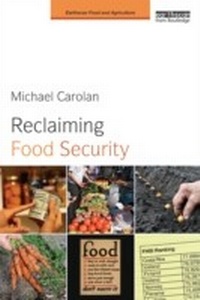
Reclaiming Food Security
1st Edition
Published on 17. April 2013
216 pages
978-1-135-06766-3 (ISBN)
Description

In this challenging work, the author argues that the goal of any food system should not simply be to provide the cheapest calories possible. A secure food system is one that affords people and nations - in both the present and future - the capabilities to prosper and lead long, happy, and healthy lives. For a variety of reasons, food security has come to be synonymous with cheap calorie security. On this measure, the last fifty years have been a remarkable success.
But the author shows that these cheap calories have also come at great cost, to the environment, individual and societal well-being, human health, and the food sovereignty of nations. The book begins by reviewing the concept of food security, particularly as it has been enacted within agrifood and international policy over the last century. After proposing a coherent definition the author then assesses empirically whether these policies have actually made us and the environment any better off. One of the many ways the author accomplishes this task is by introducing the Food and Human Security Index (FHSI) in an original attempt to better measure and quantify the affording qualities of food systems. A FHSI score is calculated for 126 countries based on indicators of objective and subjective well-being, nutrition, ecological sustainability, food dependency, and food system market concentration. The final FHSI ranking produces many counter-intuitive results. Why, for example, does Costa Rica top the ranking, while the United States comes in at number fifty-five?
The author concludes by arguing for the need to reclaim food security by returning the concept to something akin to its original spirit, identified earlier in the book. While starting at the level of the farm the concluding chapter focuses most of its attention beyond the farm gate, recognizing that food security is more than just about issues surrounding production. For example, space is made in this chapter to address the important question of, "What can we eat if not GDP?" We need, the author contends, a thoroughly sociological rendering of food security: a position that views food security not as a thing - or an end in itself - but as a process that ought to make people and the Planet better off.
But the author shows that these cheap calories have also come at great cost, to the environment, individual and societal well-being, human health, and the food sovereignty of nations. The book begins by reviewing the concept of food security, particularly as it has been enacted within agrifood and international policy over the last century. After proposing a coherent definition the author then assesses empirically whether these policies have actually made us and the environment any better off. One of the many ways the author accomplishes this task is by introducing the Food and Human Security Index (FHSI) in an original attempt to better measure and quantify the affording qualities of food systems. A FHSI score is calculated for 126 countries based on indicators of objective and subjective well-being, nutrition, ecological sustainability, food dependency, and food system market concentration. The final FHSI ranking produces many counter-intuitive results. Why, for example, does Costa Rica top the ranking, while the United States comes in at number fifty-five?
The author concludes by arguing for the need to reclaim food security by returning the concept to something akin to its original spirit, identified earlier in the book. While starting at the level of the farm the concluding chapter focuses most of its attention beyond the farm gate, recognizing that food security is more than just about issues surrounding production. For example, space is made in this chapter to address the important question of, "What can we eat if not GDP?" We need, the author contends, a thoroughly sociological rendering of food security: a position that views food security not as a thing - or an end in itself - but as a process that ought to make people and the Planet better off.
Reviews / Votes
"Never again should we use the phrase 'food security' - in the classroom, in the literature, or at the dinner table - without invoking Carolan's meaning in his aptly titled Reclaiming Food Security: not just simply meeting calorie needs but fostering well-being in current and future generations."- Christine M. Porter, Assistant Professor of Public Health and Food Dignity Project Director, University of Wyoming"Carolan challenges the prevailing assumptions about food security and, in so doing, recovers the true spirit of the term by reconnecting it to human welfare. Rich in detail, broad in scope, and thoroughly engaging to read. Genuinely refreshing scholarship" - Colin Sage, University College Cork, Republic of Ireland
"A brilliant, bold and path breaking intervention into world food politics. This easy to read book changes how we must think about and work on food security. The conceptual and analytic tool of the Food and Human Security Index compellingly brings social sense back into the food security debate. A powerful, empirically grounded, thought experiment directed at enacting different human and food futures." - Richard Le Heron, University of Auckland
"Carolan questions current assumptions, especially the agro-industrial and food systems based on providing the cheapest calories possible, with devastating effects on the environment, small holders and health. He argues that a secure food system enables people both present and future to prosper and lead long, happy and healthy lives." - David Lorimer, Network Review
"(Reclaiming Food Security) provides an excellent introduction for both undergraduate and graduate students to a more critical approach to 'food security'. For educators the creative use of statistics is great classroom material and serves as a good entry point into the more complicated and sometimes contradictory relationships present in contemporary food systems. Most importantly, the FHSI introduced in this volume provides a strong foundation-and can be seen as a versatile thinking tool-for a reorientation of 'food security' into a direction that is more responsive to human and environmental needs than has previously been the case." - Justa Hopma, Agriculture and Human Values, Aberystwyth University
More details
Series
Language
English
Place of publication
London
United Kingdom
Publishing group
Taylor & Francis Ltd
Target group
College/higher education
Illustrations
60 s/w Abbildungen, 15 s/w Tabellen
15 Tables, black and white; 60 Illustrations, black and white
File size
2,91 MB
ISBN-13
978-1-135-06766-3 (9781135067663)
Copyright in bibliographic data and cover images is held by Nielsen Book Services Limited or by the publishers or by their respective licensors: all rights reserved.
Schweitzer Classification
Other editions
Additional editions
Michael S. Carolan
Reclaiming Food Security
Book
04/2013
1st Edition
Routledge
€205.40
Shipment within 15-20 days
Michael S. Carolan
Reclaiming Food Security
Book
04/2013
1st Edition
Routledge
€63.10
Shipment within 15-20 days
Person
Michael Carolan is a Professor at Colorado State University, USA, and Chair of its Department of Sociology. Some of his recent books include The Real Cost of Cheap Food (Routledge), The Sociology of Food and Agriculture (Routledge), and Society and the Environment: Pragmatic Solutions to Ecological Issues (Westview Press).
Content
1. Introduction Part 1: A Failed Project 2. Food Security: A Brief History Part 2: Pieces Missed 3. Well-being and Nutrition 4. Sustainability 5. Food Sovereignty, Safety and Access Part 3: Looking Forward 6. The Food and Human Security Index 7. Lessons Learned
