

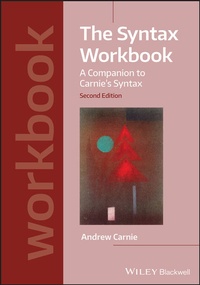
The Syntax Workbook
Description

Syntax: A Generative Introduction, Fourth Edition,is the leading textbook for undergraduate courses in the syntax, covering foundational topics such as universal grammar, parts of speech, constituency, trees, structural relations, binding theory, x-bar theory, and movement, as well as advanced subjects such as control theory, ellipsis, polysynthesis, incorporation, non-configurationality,and Merge. Written by Syntax author Andrew Carnie, The Syntax Workbook has been purposefully designed to support and complement the use of Syntax in the undergraduate classroom. The Syntax Workbookis the perfect companionto the author's seminal textbook and contains updated practice material for every section of the text. This workbook:
* Includes exercises, practice questions, data analysis, and knowledge application questions for each section in Syntax: A Generative Introduction, Fourth Edition
* Features exercises and questions with full answers and explanations to assist students in learning to apply theory to practice
* Has been authored by leading figure in syntax Andrew Carnie to support classroom usage of Syntax: A Generative Introduction, Fourth Edition
* Works in concert with a student companion website, offering a robust selection of learning tools for the classroom
Ideal for undergraduate courses in syntax,Syntax: A Generative Introduction, Fourth Edition, and The Syntax Workbook, Second Edition, together offer a perfect combination of thorough coverage and valuable practice. The workbook can be purchased on its own or in a set with the textbook.
Available as a set with Syntax: A Generative Introduction, 4th Edition
More details
Other editions
Additional editions
Person
Andrew Carnie is Vice Provost for Graduate Education, Dean of the Graduate College, and Professor of Linguistics at the University of Arizona, USA. He specializes in generative syntactic theory with an emphasis on constituency, VSO languages, copular constructions, and the Celtic Languages. He is the author of numerous publications, including Constituent Structure, Modern Syntax, and Syntax: A Generative Introduction, Fourth Edition, and is the co-editor of The Routledge Handbook of Syntax.
Content
Preface and Acknowledgments vii
Part 1 Preliminaries 1
1 Generative Grammar 3
2 Parts of Speech 11
3 Constituency, Trees, and Rules 21
4 Structural Relations 61
5 Binding Theory 71
Part 2 The Base 79
6 X-bar Theory 81
7 Extending X-bar Theory to Functional Categories 137
8 Constraining X-bar: Theta Theory 165
9 Theta Grids and Functional Categories 175
Part 3 Movement 185
10 Head-to-Head Movement 187
11 DP Movement 199
12 Wh-movement and Locality Constraints 217
13 A Unified Theory of Movement 235
Part 4 Advanced Topics 239
14 Ditransitives 241
15 Raising, Control, and Empty Categories 251
16 Ellipsis 263
17 Advanced Topics in Binding Theory 269
18 Polysynthesis, Incorporation, and Non-configurationality 271
19 Merge 275
References 279
Index 281
