

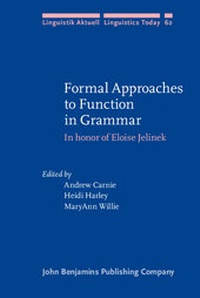
Formal Approaches to Function in Grammar
In honor of Eloise Jelinek
1st Edition
Published on 20. March 2003
XII, 378 pages
978-90-272-9690-0 (ISBN)
Description

The contributions making up this volume in honor of Eloise Jelinek are written from a formalist perspective that deals with stereotypically functionalist questions about language. Jelinek's pioneering work in formalist syntax has shown that autonomous syntax need not exist in a vacuum. Her work has highlighted the importance of incorporating the effects of discourse and information structure on the syntactic representation. This book aims to invoke Jelinek's work either in substance or spirit. The focus is on Jelinek's influential Pronominal Argument Hypothesis as an "non-configurational" language; the influence of discourse-related interface phenomena on syntactic structure; the syntactic analysis of the grammaticalization; interactions between morphology, phonology and phonetics; and foundational issues about the link between formal grammar and function of language, as well as the methodological issues underlying the different approaches to linguistics.
More details
Other editions
Additional editions
Andrew Carnie | Heidi Harley | MaryAnn Willie
Formal Approaches to Function in Grammar
In honor of Eloise Jelinek
Book
03/2003
John Benjamins Publishing Co
€137.80
Shipment within 10-15 days
Persons
Content
- Formal Approaches to Function in Grammar
- Editorial page
- Title page
- LCC page
- Picture
- Table of contents
- Contributors
- Acknowledgments
- Introduction
- Notes
- Part I: The Pronominal Argument Hypothesis
- On the significance of Eloise Jelinek's Pronominal Argument Hypothesis
- Concluding remarks
- Notes
- Categories and pronominal arguments
- Doubling by Agreement in Slave (Northern Athapaskan)
- Conclusions
- Notes
- Quasi objects in St'át'imcets
- Conclusion
- Abbreviations
- Notes
- Agreement, dislocation, and partial configurationality
- Conclusion
- Notes
- Part II: Interfaces
- Multiple multiple questions
- Final remarks
- Notes
- Attitude evaluation in complex NPs
- Concluding remark
- Notes
- Topic-Focus articulation and degrees of salience in the Prague Dependency Treebank
- Notes
- Word order and discourse genre in Tohono O'odham
- Conclusion
- Notes
- The prosody of interrogative and focus constructions in Navajo
- Conclusion
- Notes
- Subject number agreement, grammaticalization, and transitivity in the Cupeño verb construction
- Conclusion
- Notes
- Lexical irregularity in OT
- Conclusion
- Notes
- Rapid perceptibility as a factor underlying universals of vowel inventories
- Conclusions
- Notes
- Part III: Foundational issues
- Argument hierarchies and the mapping principle
- Conclusion
- Notes
- Focus movement and the nature of uninterpretable features
- Conclusion
- Notes
- Merge
- Conclusion
- Notes
- Phonotactics and probabilistic ranking
- Conclusion
- Notes
- Deconstructing functionalist explanations of linguistic universals
- Note
- References
- Name index
- Subject index
- Current issues in the series LINGUISTIK AKTUELL/LINGUISTICS TODAY
