

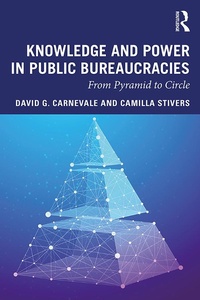
Knowledge and Power in Public Bureaucracies
From Pyramid to Circle
1st Edition
Published on 8. July 2019
232 pages
978-1-000-00103-7 (ISBN)
Description

Ever since Max Weber and Frederick Taylor, public organizations have been told that effective practice lies in maximizing rationality through science. Yet science-based management reforms have had only marginal impact on performance. People in entry-level positions possess knowledge from direct experience of the work, management knowledge is often science-based and distanced from the work, and appointed top executives struggle to join bureaucratic rationality with political exigencies. Knowledge and Power in Public Bureaucracies: From Pyramid to Circle offers fresh thinking about public organizations, arguing that conflicting forms of knowledge may be found within the bureaucratic pyramid.
Answering the question of why management reforms over the past century have failed on their own terms, this book examines the existence of conflicting forms of knowledge within public bureaucracies, how these contradictory perspectives interact (or fail to interact), and the ways in which these systems preserve managerial efforts to control workers. Authors Carnevale and Stivers argue that bureaucratic rationality is not the "one best way," as Taylor promised, and indeed, there is no one best way or model that can be deployed in all situations. The bureaucratic pyramid can, however, be made more effective by paying attention to circular processes that are widespread within the hierarchy, the authors argue, describing such circular processes as "facework." This book will serve as an ideal supplement to introductory public administration and organizational theory courses, as well as courses for mid-career professionals, helping to frame their work experiences.
Answering the question of why management reforms over the past century have failed on their own terms, this book examines the existence of conflicting forms of knowledge within public bureaucracies, how these contradictory perspectives interact (or fail to interact), and the ways in which these systems preserve managerial efforts to control workers. Authors Carnevale and Stivers argue that bureaucratic rationality is not the "one best way," as Taylor promised, and indeed, there is no one best way or model that can be deployed in all situations. The bureaucratic pyramid can, however, be made more effective by paying attention to circular processes that are widespread within the hierarchy, the authors argue, describing such circular processes as "facework." This book will serve as an ideal supplement to introductory public administration and organizational theory courses, as well as courses for mid-career professionals, helping to frame their work experiences.
Reviews / Votes
In a time in which work is dominated by advanced technology, performance management, and data fetishism, Carnevale and Stivers remind us of the phenomena residing within the minds, hearts, hands, and mouths of the worker that is rarely fully appreciated or known by others separated from the work. Knowledge and Power in Public Bureaucracies: From Pyramid to Circle lays bare a deep sense of the knowledge and identity crisis facing organizations and presents a path forward by arguing that judgement and wisdom are made virtuous when managers and workers are in partnership. This book has application across many disciplines and is essential for those currently in or thinking about a career in the public sector.Nicholas C. Zingale, Cleveland State University, USA
Carnevale and Stivers' Knowledge and Power in Public Bureaucracies: From Pyramid to Circle is of a type along with Scott's Seeing Like a State. Both specify technical/cognitive knowledge (techne) separately from experiential/embodied knowledge (metis). The contribution made by Carnevale and Stivers, however, is to situate these distinct ways of knowing within the bureaucratic hierarchy to explain why management reforms fail. Until management speaks a language identifiable by public servants on the front lines, reforms that attempt to control the front line and make it legible to the C-suite will continue to fail. This book puts to rest, once and for all, the argument that government should run like a business.
Sharon Mastracci, University of Utah, USA
More details
Edition
1. Auflage
Language
English
Place of publication
London
United Kingdom
Publishing group
Taylor & Francis Ltd
Target group
College/higher education
Illustrations
4 Illustrations, black and white
ISBN-13
978-1-000-00103-7 (9781000001037)
Copyright in bibliographic data and cover images is held by Nielsen Book Services Limited or by the publishers or by their respective licensors: all rights reserved.
Schweitzer Classification
Other editions
Additional editions
Book
07/2019
1st Edition
Routledge
€69.30
Shipment within 15-20 days
Book
07/2019
1st Edition
Routledge
€231.60
Shipment within 15-20 days
Persons
David G. Carnevale is a professor emeritus from the University of Oklahoma. He is former international union director for AFSCME-AFL-CIO, operations administrator of the California State Employees Association, and executive director of the Maine State Employees Association. He is author of Trustworthy Government: Leadership and Management Strategies for Building Trust and High Performance, and Organization Development in the Public Sector. Dr Carnevale is a practiced mediator and a Vietnam veteran.
Camilla Stivers spent two decades as a staff member in community-based publicly funded organizations. She taught public and nonprofit administration at The Evergreen State College, Olympia, Washington, and the Levin College of Urban Affairs at Cleveland State University, where she held the Albert A. Levin chair in public service and urban studies. She is the author or co-author of six additional books. She is a fellow of the National Academy of Public Administration and a former associate editor of Public Administration Review.
Camilla Stivers spent two decades as a staff member in community-based publicly funded organizations. She taught public and nonprofit administration at The Evergreen State College, Olympia, Washington, and the Levin College of Urban Affairs at Cleveland State University, where she held the Albert A. Levin chair in public service and urban studies. She is the author or co-author of six additional books. She is a fellow of the National Academy of Public Administration and a former associate editor of Public Administration Review.
Content
Introduction
Part I: The Pyramid
Chapter 1: The Failure of Management Reforms: A History
Chapter 2: Knowing in the Public Organization: The Pyramid of Knowledges
Chapter 3: What Workers Know: Felt Sense at the Front Line
Chapter 4: What Managers Know: The Power of the Concept
Chapter 5: What Executives Know: Expertise at "Being Governmental"
Part II: The Pyramid in Action
Chapter 6: The VA Case: Knowledge and Power in a Service Bureaucracy
Sequel: The Engagement Board
Attachment: The VA Summit Planning Form
Epilogue: The Knowledge Approach to Research
Part III: The Circle
Chapter 7: Introduction: From Pyramid to Circle: The Power of Facework
Chapter 8: The Logic of Reasonableness: Experience, Judgment and Dialogue in
Administrative Practice
Chapter 9: The Dialogic Circle, Conflict Resolution and Collective Bargaining
Chapter 10: Circles of Trust in Public Pyramids
Chapter 11: Authentic Ethics in the Bureaucracy
Chapter 12: Competing Knowledges and Public Service Education
Part I: The Pyramid
Chapter 1: The Failure of Management Reforms: A History
Chapter 2: Knowing in the Public Organization: The Pyramid of Knowledges
Chapter 3: What Workers Know: Felt Sense at the Front Line
Chapter 4: What Managers Know: The Power of the Concept
Chapter 5: What Executives Know: Expertise at "Being Governmental"
Part II: The Pyramid in Action
Chapter 6: The VA Case: Knowledge and Power in a Service Bureaucracy
Sequel: The Engagement Board
Attachment: The VA Summit Planning Form
Epilogue: The Knowledge Approach to Research
Part III: The Circle
Chapter 7: Introduction: From Pyramid to Circle: The Power of Facework
Chapter 8: The Logic of Reasonableness: Experience, Judgment and Dialogue in
Administrative Practice
Chapter 9: The Dialogic Circle, Conflict Resolution and Collective Bargaining
Chapter 10: Circles of Trust in Public Pyramids
Chapter 11: Authentic Ethics in the Bureaucracy
Chapter 12: Competing Knowledges and Public Service Education
