

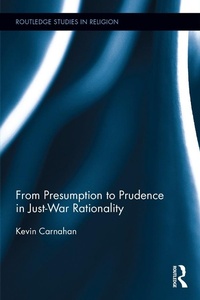
From Presumption to Prudence in Just-War Rationality
Published on 14. July 2017
212 pages
978-1-351-99945-8 (ISBN)
Description

For the last several decades, the Just-War debate amongst theologians has been dominated by two accounts of moral rationality. One side assumes a presumption against harm (PAH), and the other identifies with a presumption against injustice (PAI). From Presumption to Prudence in Just-War Rationality argues that the time has come to leave behind these two viewpoints in favour of a prudentially grounded approach to Just-War thinking.
In Parts 1 and 2 of the book, Kevin Carnahan offers immanent critiques of the PAI and PAH positions. In Part 3, utilising Paul's treatment of the atonement and use of the idea of the imitation of Christ, he lays out an alternative to the ways in which theologians in favour of the PAI or PAH have construed the Christian narrative. In Part 4, Carnahan then develops a neo-Aristotelian account of prudence as a higher order virtue governing the interpretation of moral reality. Drawing on this account, he explores what Just-War rationality would look like if it were prudentially grounded. The work concludes with a case study on noncombatancy in the 2011 Israeli bombardment of Gaza.
This book offers a compelling new perspective on this important and pertinent subject. As such, academics and students in Religion, Theology, Philosophy, Ethics and Political Theory will all find it an invaluable resource on Just-War theory.
In Parts 1 and 2 of the book, Kevin Carnahan offers immanent critiques of the PAI and PAH positions. In Part 3, utilising Paul's treatment of the atonement and use of the idea of the imitation of Christ, he lays out an alternative to the ways in which theologians in favour of the PAI or PAH have construed the Christian narrative. In Part 4, Carnahan then develops a neo-Aristotelian account of prudence as a higher order virtue governing the interpretation of moral reality. Drawing on this account, he explores what Just-War rationality would look like if it were prudentially grounded. The work concludes with a case study on noncombatancy in the 2011 Israeli bombardment of Gaza.
This book offers a compelling new perspective on this important and pertinent subject. As such, academics and students in Religion, Theology, Philosophy, Ethics and Political Theory will all find it an invaluable resource on Just-War theory.
Reviews / Votes
"From Presumption to Prudence in Just-War Rationality moves the debate about PAI and PAH forward in interesting ways, and assists in the process of de-centering this particular conversation to make room for new and creative thinking about the ethics of warfare. It is a text for specialists and those conversant with the just war tradition, and would be particularly interesting to discuss in upper level or graduate courses in philosophical and theological virtue ethics."- Anna Floerke Schneid, Duquesne University, Pennsylvania
"Kevin Carnahan is one of an increasing number of voices that detect a rift in just war thinking between two alternative visions of the tradition, namely those resting on a presumption against harm (PAH) and on a presumption against injustice (PAI) [...] Carnahan offers an insightful remedy to the perceived stalemate in recent debates between these two, in the form of a virtue-oriented approach."
- Jeremy S. Stirm
More details
Series
Language
English
Place of publication
London
United Kingdom
Publishing group
Taylor & Francis Ltd
Target group
College/higher education
Illustrations
2 s/w Tabellen
2 Tables, black and white
File size
0,92 MB
ISBN-13
978-1-351-99945-8 (9781351999458)
Copyright in bibliographic data and cover images is held by Nielsen Book Services Limited or by the publishers or by their respective licensors: all rights reserved.
Schweitzer Classification
Other editions
Additional editions
Kevin Carnahan
From Presumption to Prudence in Just-War Rationality
Book
12/2019
1st Edition
Routledge
€53.22
Shipment within 15-20 days
Kevin Carnahan
From Presumption to Prudence in Just-War Rationality
Book
07/2017
1st Edition
Routledge
€215.41
Shipment within 10-20 days

Kevin Carnahan
From Presumption to Prudence in Just-War Rationality
Book
06/2017
Routledge
Unfortunately, price unknown
Article exhausted; check different version
Person
Kevin Carnahan is Associate Professor of Philosophy & Religion at Central Methodist University, USA. He has written one book and multiple articles on the subject of Just War and is currently a co-editor for the Journal of the Society of Christian Ethics.
Content
Introduction; 1 The Limits of Moral Clarity: Against the PAI; 2 An Unbearable Burden: Against the PAH; 3 The Imitation of Christ and the Resort To Violence; 4 Prudence and Just-War Thinking; Conclusion
