

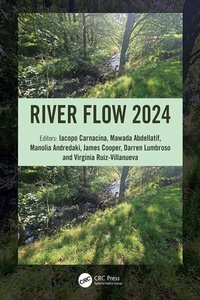
River Flow 2024
Proceedings of the 12th International Conference on Fluvial Hydraulics, Liverpool, UK, 2nd- 6th September, 2024
Published on 28. April 2025
1226 pages
978-1-040-41146-9 (ISBN)
Description

River Flow 2024 features keynote lectures and contributed papers presented at the 12th International Conference on Fluvial Hydraulics, held from September 2nd to 6th, 2024, in Liverpool.
River Flow 2024 provides an overview of the latest experimental, theoretical, and computational findings on fundamental river flow and transport processes, river morphology, and morphodynamics. It also addresses the impacts of hydraulic structures on flow regimes, river morphology, and ecology; sustainable river engineering practices, including stream restoration and re-naturalization; and the effects of climate change, including extreme flood events. Additionally, the conference covers topics such as sediment, pollutant, and microplastic dynamics in rivers; fluid mechanics, numerical modelling, and two-phase flow; monitoring techniques and artificial intelligence; and natural flood management, vegetation, wood, and river restoration.
River Flow 2024 aims to present ongoing and the state-of-the-art in river research and engineering, targeting academics and practitioners in hydraulics, hydrology, and environmental engineering. Organized under the auspices of the Committee on Fluvial Hydraulics of the International Association for Hydro-Environment Engineering and Research (IAHR), the River Flow conference series has gained international recognition as one of the most reputable events in the fluvial hydraulics community, attracting a large and loyal audience of river researchers and engineers. Thanks to the Stephen E. Coleman Award for the best research paper from a young academic and for its mission focused towards promoting knowledge transfer and idea exchange, it has also become a point of reference for the early career researcher and younger academics, with the master classes at the centre of it. The 12th edition also featured the "Networking and Mentoring Event: Embracing Gender Equity and Diversity" to enable all the member of the community to maximise their opportunity withing the sector.
River Flow 2024 provides an overview of the latest experimental, theoretical, and computational findings on fundamental river flow and transport processes, river morphology, and morphodynamics. It also addresses the impacts of hydraulic structures on flow regimes, river morphology, and ecology; sustainable river engineering practices, including stream restoration and re-naturalization; and the effects of climate change, including extreme flood events. Additionally, the conference covers topics such as sediment, pollutant, and microplastic dynamics in rivers; fluid mechanics, numerical modelling, and two-phase flow; monitoring techniques and artificial intelligence; and natural flood management, vegetation, wood, and river restoration.
River Flow 2024 aims to present ongoing and the state-of-the-art in river research and engineering, targeting academics and practitioners in hydraulics, hydrology, and environmental engineering. Organized under the auspices of the Committee on Fluvial Hydraulics of the International Association for Hydro-Environment Engineering and Research (IAHR), the River Flow conference series has gained international recognition as one of the most reputable events in the fluvial hydraulics community, attracting a large and loyal audience of river researchers and engineers. Thanks to the Stephen E. Coleman Award for the best research paper from a young academic and for its mission focused towards promoting knowledge transfer and idea exchange, it has also become a point of reference for the early career researcher and younger academics, with the master classes at the centre of it. The 12th edition also featured the "Networking and Mentoring Event: Embracing Gender Equity and Diversity" to enable all the member of the community to maximise their opportunity withing the sector.
More details
Edition
Digital original
Language
English
Place of publication
London
United Kingdom
Publishing group
Taylor & Francis Ltd
Target group
College/higher education
Professional and scholarly
Edition type
Digital original
File size
848,84 MB
ISBN-13
978-1-040-41146-9 (9781040411469)
Copyright in bibliographic data and cover images is held by Nielsen Book Services Limited or by the publishers or by their respective licensors: all rights reserved.
Schweitzer Classification
Other editions
Additional editions
Iacopo Carnacina | Mawada Abdellatif | Manolia Andredaki
River Flow 2024
Proceedings of the 12th International Conference on Fluvial Hydraulics, Liverpool, UK, 2nd- 6th September, 2024
Book
04/2025
1st Edition
CRC Press
€519.95
The article will not be published
Persons
Iacopo Carnacina is a Reader in Water and Environmental Engineering in the School of Civil Engineering and Built Environment at Liverpool John Moores University. He has extensive experience in large-scale numerical modelling of storm surges, fluvial and pluvial flooding, and experimental and field studies of two-phase flows, block ramps, the interaction between hydraulic structures, sediment, and localized erosion processes. His research also focuses on the interaction between bridges and floating debris, particularly their impact on scouring and hydrodynamic loadings. Additionally, he investigates the applicability of low-carbon materials for river and coastal erosion protection. Among others, he has led and collaborated on national and international research projects, including low-carbon breakwater protection systems, pico-hydropower turbine design, and the application of nature-based solutions using bio-based materials to enhance the sustainability of hydraulic infrastructure. He has served as a visiting professor in Peru, regularly acts as a reviewer for major national and international research councils and is an academic editor for Advances in Civil Engineering.
Manolia Andredaki is a Senior Lecturer in Water Engineering at Liverpool John Moores University. Her research spans two interconnected areas: particulate flows, focusing on suspended sediment transport and deposition, and multiphase flows for green engineering applications. In the latter, she investigates gas/liquid interface dynamics, phase-change heat transfer coupling between two-phase fluid and solid domains and droplet impact phenomena. Her research contributions have been published in leading journals including the International Journal of Heat and Mass Transfer, the International Journal of Multiphase Flow, Nature-Scientific Reports, and Physics of Fluids. She also serves as an Associate and Guest Editor for various international scientific journals, including Applied Sciences and Frontiers in Thermal Engineering. Dr Andredaki is a Member of the EPSRC Peer Review College and an Expert Evaluator for Horizon Europe.
Mawada Abdellatif is a Senior Lecturer in water engineering and environmental modelling at Liverpool John Moores University. She has been working in the UNESCO Chair in Water Resources (Sudan) for several years before joining Liverpool John Moores University ( UK) and is involved in numerous national and international projects related to water management, e.g., groundwater pollution, impacts of climate change on urban drainage system, and river water quality modelling, flood risk assessment. She has published widely in the area of hydrology and sustainability, reaching over 57 peer-reviewed journals, book chapters, and conference papers. And currently a member of the British Standard (BSI) committee (Hydrometry) and a member of the Royal Society's Newton International Fellowships.
Virginia Ruiz-Villanueva works as an Asst. Professor TT at the Institute of Geography of the University of Bern (Switzerland), where she leads the Unit of Geomorphology, Natural Hazards, and Risk Research. Virginia, a fluvial geomorphologist, investigates the physical processes shaping rivers and their catchments, focusing on flood dynamics, hillslope-channel interactions, and flow-sediment-large wood feedback. Her research integrates fieldwork, remote and near sensing and geoprocessing, and numerical modelling to analyse natural hazards and cascade processes in mountain environments. She aims to advance methods for monitoring and modelling fluvial systems, informing sustainable management strategies and environmental policies.
James Cooper, is a Professor of Hydrology in the School of Environmental Sciences at University of Liverpool. His research expertise lies in monitoring and forecasting environmental hazards within fluvial, hillslope and estuarine environments. A major focus of his work is the assessment of the climate resilience of critical infrastructure to these hazards, working with stakeholders to forecast weather-related risk and advise on mitigation. His more fundamental research focuses on the mechanics of flooding, erosion and the transport of contaminated sediment. This work has been published in over 80 papers in leading journals, involving more than 25 world-leading institutes. He has been Visiting Professor in six institutions in Japan, USA and Italy.
Darren Lumbroso is a Fellow of the Institution of Civil Engineers (FICE), a Chartered Engineer (CEng) and a Chartered Water and Environmental Manager (CWEM). He has a Doctor of Philosophy (PhD) in improving the emergency management of floods, a Master of Engineering (MEng) and a Master of Science (MSc). He has over 30 years' experience leading flood and water resources management, natural hazard, flood risk projects and studies, 24 of those years with HR Wallingford. He has worked in around 40 countries worldwide.
Manolia Andredaki is a Senior Lecturer in Water Engineering at Liverpool John Moores University. Her research spans two interconnected areas: particulate flows, focusing on suspended sediment transport and deposition, and multiphase flows for green engineering applications. In the latter, she investigates gas/liquid interface dynamics, phase-change heat transfer coupling between two-phase fluid and solid domains and droplet impact phenomena. Her research contributions have been published in leading journals including the International Journal of Heat and Mass Transfer, the International Journal of Multiphase Flow, Nature-Scientific Reports, and Physics of Fluids. She also serves as an Associate and Guest Editor for various international scientific journals, including Applied Sciences and Frontiers in Thermal Engineering. Dr Andredaki is a Member of the EPSRC Peer Review College and an Expert Evaluator for Horizon Europe.
Mawada Abdellatif is a Senior Lecturer in water engineering and environmental modelling at Liverpool John Moores University. She has been working in the UNESCO Chair in Water Resources (Sudan) for several years before joining Liverpool John Moores University ( UK) and is involved in numerous national and international projects related to water management, e.g., groundwater pollution, impacts of climate change on urban drainage system, and river water quality modelling, flood risk assessment. She has published widely in the area of hydrology and sustainability, reaching over 57 peer-reviewed journals, book chapters, and conference papers. And currently a member of the British Standard (BSI) committee (Hydrometry) and a member of the Royal Society's Newton International Fellowships.
Virginia Ruiz-Villanueva works as an Asst. Professor TT at the Institute of Geography of the University of Bern (Switzerland), where she leads the Unit of Geomorphology, Natural Hazards, and Risk Research. Virginia, a fluvial geomorphologist, investigates the physical processes shaping rivers and their catchments, focusing on flood dynamics, hillslope-channel interactions, and flow-sediment-large wood feedback. Her research integrates fieldwork, remote and near sensing and geoprocessing, and numerical modelling to analyse natural hazards and cascade processes in mountain environments. She aims to advance methods for monitoring and modelling fluvial systems, informing sustainable management strategies and environmental policies.
James Cooper, is a Professor of Hydrology in the School of Environmental Sciences at University of Liverpool. His research expertise lies in monitoring and forecasting environmental hazards within fluvial, hillslope and estuarine environments. A major focus of his work is the assessment of the climate resilience of critical infrastructure to these hazards, working with stakeholders to forecast weather-related risk and advise on mitigation. His more fundamental research focuses on the mechanics of flooding, erosion and the transport of contaminated sediment. This work has been published in over 80 papers in leading journals, involving more than 25 world-leading institutes. He has been Visiting Professor in six institutions in Japan, USA and Italy.
Darren Lumbroso is a Fellow of the Institution of Civil Engineers (FICE), a Chartered Engineer (CEng) and a Chartered Water and Environmental Manager (CWEM). He has a Doctor of Philosophy (PhD) in improving the emergency management of floods, a Master of Engineering (MEng) and a Master of Science (MSc). He has over 30 years' experience leading flood and water resources management, natural hazard, flood risk projects and studies, 24 of those years with HR Wallingford. He has worked in around 40 countries worldwide.
Content
1. River Morphodynamics and Management 2. Fluid Mechanics, Numerical Modelling and Two-Phase Flow 3. Sediment, Pollutant and Microplastic Dynamics in Rivers 4. Monitoring Techniques and AI 5. Climate Change and Adaptation 6. Natural Flood Management, Vegetation, Wood and River Restoration 7. Hydraulic Structures and Impacts on Local and Catchment Sediment Transport, Flow Regime and Ecology
