

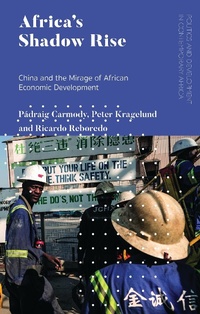
Africa's Shadow Rise
China and the Mirage of African Economic Development
1st Edition
Published on 17. September 2020
240 pages
978-1-78699-480-6 (ISBN)
Description

For years economists have spoken of 'Africa rising', and despite the global financial crisis, Africa continues to host some of the fastest growing economies in the world.
Africa's Shadow Rise however argues that the continent's apparent economic 'rise' is essentially a mirage, driven by developments elsewhere - most particularly the expansion in China's economy. While many African countries have experienced high rates of growth, much of this growth may prove to be unsustainable, and has contributed to environmental destruction and worsening inequality across the continent. Similarly, new economic relationships have produced new forms of dependency, as African nations increasingly find themselves tied to the fortunes of China and other emerging powers.
Drawing on in-depth fieldwork in southern Africa, Africa's Shadow Rise reveals how the shifting balance of global power is transforming Africa's economy and politics, and what this means for the future of development efforts in the region.
Shortlisted for the Business Council for Africa's African Business Book of the Year 2023!
Africa's Shadow Rise however argues that the continent's apparent economic 'rise' is essentially a mirage, driven by developments elsewhere - most particularly the expansion in China's economy. While many African countries have experienced high rates of growth, much of this growth may prove to be unsustainable, and has contributed to environmental destruction and worsening inequality across the continent. Similarly, new economic relationships have produced new forms of dependency, as African nations increasingly find themselves tied to the fortunes of China and other emerging powers.
Drawing on in-depth fieldwork in southern Africa, Africa's Shadow Rise reveals how the shifting balance of global power is transforming Africa's economy and politics, and what this means for the future of development efforts in the region.
Shortlisted for the Business Council for Africa's African Business Book of the Year 2023!
Reviews / Votes
The authors take a deep dive into China's economic activities in Africa using detailed case studies to make a significant contribution to the work around African development. * Anita Plummer, Howard University * 'A skilful exploration of the contradiction between euphoric "Africa Rising" narrative and reality of the increased number of Africans who continue to live in poverty. A critical and insightful analysis of China's roles in Africa's development. * Francis Owusu, Iowa State University * A provocative diagnosis of China's linkages with Africa, raising some profound questions as to the nature and direction of Chinese engagement in Africa. It will make a powerful contribution to the wider debate on Sino-African relations. * Ian Taylor, University of St Andrews * 'This must-read, timely book critically challenges the 'Africa rising' thesis. It charts both change in terms of the China-led commodity boom and diversification of dependency, but also troubling continuity through the lack of structural transformation. * Rory Honer, The University of Manchester *More details
Series
Edition
1. Auflage
Language
English
Place of publication
United Kingdom
Publishing group
Bloomsbury Publishing PLC
Target group
College/higher education
ISBN-13
978-1-78699-480-6 (9781786994806)
Copyright in bibliographic data and cover images is held by Nielsen Book Services Limited or by the publishers or by their respective licensors: all rights reserved.
Schweitzer Classification
Other editions
Additional editions
Padraig Carmody | Peter Kragelund | Ricardo Reboredo
Africa's Shadow Rise
China and the Mirage of African Economic Development
Book
09/2020
Zed Books Ltd
€102.80
Shipment within 3-4 weeks
Persons
Padraig Carmody teaches Geography at Trinity College Dublin, Ireland, where he directs the Masters in Development Practice and is a Senior Research Associate at the School of Tourism and Hospitality at the University of Johannesburg. His previous books include The New Scramble for Africa (2016), The Rise of the BRICS in Africa (Zed 2013).
Peter Kragelund is head of the Department of Social Sciences and Business, Roskilde University.
Ricardo Reboredo is a PhD candidate at Trinity College Dublin, Ireland His research interests include globalization, development, and Sino-African relations.
Peter Kragelund is head of the Department of Social Sciences and Business, Roskilde University.
Ricardo Reboredo is a PhD candidate at Trinity College Dublin, Ireland His research interests include globalization, development, and Sino-African relations.
Content
1. Africa Rising: Rhetoric or Reality?
2. Unpacking Sino-African Power Relations: Is Agency the Appropriate Analytical Lens?
3. China's Interests and Impacts in Southern Africa
4. Towards Convergence and Cooperation in the Global Development Finance Regime: The End of African Agency?
5. China's Impact on Local Economic Development: The Zambian Case
6. Resource-based Development via Local Content Policies? Institutional Impediments to Resource-led Development in Zambia
7. Debt Trap Diplomacy or Structural Transformation? The Belt and Road Initiative in Africa
Conclusion
2. Unpacking Sino-African Power Relations: Is Agency the Appropriate Analytical Lens?
3. China's Interests and Impacts in Southern Africa
4. Towards Convergence and Cooperation in the Global Development Finance Regime: The End of African Agency?
5. China's Impact on Local Economic Development: The Zambian Case
6. Resource-based Development via Local Content Policies? Institutional Impediments to Resource-led Development in Zambia
7. Debt Trap Diplomacy or Structural Transformation? The Belt and Road Initiative in Africa
Conclusion
