

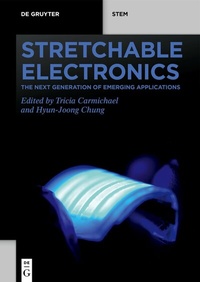
Stretchable Electronics
Description

Stretchable electronics is a dynamic field of research with the potential to revolutionize human health, robotics, cameras, energy storage, and even building construction. Electronics with rubber-like form factors can integrate with irregularly shaped moving substances in a seamless manner; electronic skins for prosthesis is a good example. The field of stretchable electronics has evolved and matured over the past 20 years, training generations of researchers in the development of novel materials and structures to enable robust integration of miniaturized electronic components. This book presents the work and perspective of this next generation of innovators and disruptors who are driving an exciting phase of diversification and growth in the field.
More details
Other editions
Additional editions
Persons
Prof. Tricia Breen Carmichael
Prof. Tricia Breen Carmichael is a Professor in the Department of Chemistry and Biochemistry at the University of Windsor. She received her PhD from the University of Windsor, and then spent two years as an NSERC postdoctoral fellow in the lab of Professor George M. Whitesides at Harvard University where she developed new methods for the 3D self-assembly of electrical connections. She then joined the IBM T.J. Watson Research Center in Yorktown Heights, New York as a Research Staff Member in the field of organic electronics. She currently leads a research program on stretchable and wearable electronic devices, with a focus on textile-based wearable electronics (e-textiles), wearable electroluminescent fabrics, and stretchable light-emitting devices and transparent conductors.
Prof. Hyun-Joong Chung
Hyun-Joong Chung is an Associate Professor of Chemical and Materials Engineering at the University of Alberta. He received B.S. from KAIST and Ph.D. from the University of Pennsylvania, where he studied the role of jamming nanoparticles in phase-separating polymer blends. After graduation, he worked on oxide semiconductors in Samsung Display, followed by postdoctoral training on stretchable bioelectronics at the University of Illinois at Urbana-Champaign. Currently, he leads an interdisciplinary research program on understanding physicochemical properties of gels and elastomers with or without functional additives and reinforcements, as well as on translating the fundamental understanding to biomedical device applications.
