

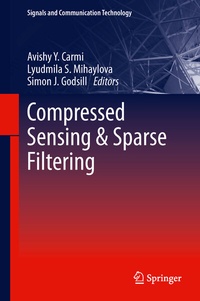
Compressed Sensing & Sparse Filtering
Description

This book is aimed at presenting concepts, methods and algorithms ableto cope with undersampled and limited data. One such trend that recently gained popularity and to some extent revolutionised signal processing is compressed sensing. Compressed sensing builds upon the observation that many signals in nature are nearly sparse (or compressible, as they are normally referred to) in some domain, and consequently they can be reconstructed to within high accuracy from far fewer observations than traditionally held to be necessary.
Apart from compressed sensing this book contains other related approaches. Each methodology has its own formalities for dealing with such problems. As an example, in the Bayesian approach, sparseness promoting priors such as Laplace and Cauchy are normally used for penalising improbable model variables, thus promoting low complexity solutions. Compressed sensing techniques and homotopy-type solutions, such as the LASSO, utilise l1-norm penalties for obtaining sparse solutions using fewer observations thanconventionally needed. The book emphasizes on the role of sparsity as a machinery for promoting low complexity representations and likewise its connections to variable selection and dimensionality reduction in various engineering problems.
This book is intended for researchers, academics and practitioners with interest in various aspects and applications of sparse signal processing.
Reviews / Votes
From the reviews:
"This book reports on the application of compressed sensing. . This book presents cutting-edge research on one of the newest signal processing disciplines. It should be of great value to research scientists in related fields, and it could help research and development engineers evaluate the impact these new methods could have in their work." (Vladimir Botchev, Computing Reviews, February, 2014)More details
Other editions
Additional editions
Content
Introduction to Compressed Sensing and Sparse Filtering.- The Geometry of Compressed Sensing.- Sparse Signal Recovery with Exponential-Family Noise.- Nuclear Norm Optimization and its Application to Observation Model Specification.- Nonnegative Tensor Decomposition.- Sub-Nyquist Sampling and Compressed Sensing in Cognitive Radio Networks.- Sparse Nonlinear MIMO Filtering and Identification.- Optimization Viewpoint on Kalman Smoothing with Applications to Robust and Sparse Estimation.- Compressive System Identification.- Distributed Approximation and Tracking using Selective Gossip.- Recursive Reconstruction of Sparse Signal Sequences.- Estimation of Time-Varying Sparse Signals in Sensor Networks.- Sparsity and Compressed Sensing in Mono-static and Multi-static Radar Imaging.- Structured Sparse Bayesian Modelling for Audio Restoration.- Sparse Representations for Speech Recognition.
