

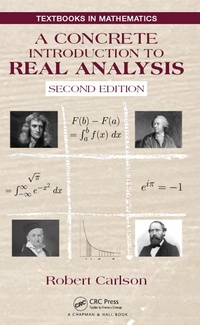
A Concrete Introduction to Real Analysis
2nd Edition
Published on 28. November 2017
310 pages
978-1-4987-7815-2 (ISBN)
Description

A Concrete Introduction to Analysis, Second Edition offers a major reorganization of the previous edition with the goal of making it a much more comprehensive and accessible for students.
The standard, austere approach to teaching modern mathematics with its emphasis on formal proofs can be challenging and discouraging for many students. To remedy this situation, the new edition is more rewarding and inviting. Students benefit from the text by gaining a solid foundational knowledge of analysis, which they can use in their fields of study and chosen professions.
The new edition capitalizes on the trend to combine topics from a traditional transition to proofs course with a first course on analysis. Like the first edition, the text is appropriate for a one- or two-semester introductory analysis or real analysis course. The choice of topics and level of coverage is suitable for mathematics majors, future teachers, and students studying engineering or other fields requiring a solid, working knowledge of undergraduate mathematics.
Key highlights:
Offers integration of transition topics to assist with the necessary background for analysis
Can be used for either a one- or a two-semester course
Explores how ideas of analysis appear in a broader context
Provides as major reorganization of the first edition
Includes solutions at the end of the book
The standard, austere approach to teaching modern mathematics with its emphasis on formal proofs can be challenging and discouraging for many students. To remedy this situation, the new edition is more rewarding and inviting. Students benefit from the text by gaining a solid foundational knowledge of analysis, which they can use in their fields of study and chosen professions.
The new edition capitalizes on the trend to combine topics from a traditional transition to proofs course with a first course on analysis. Like the first edition, the text is appropriate for a one- or two-semester introductory analysis or real analysis course. The choice of topics and level of coverage is suitable for mathematics majors, future teachers, and students studying engineering or other fields requiring a solid, working knowledge of undergraduate mathematics.
Key highlights:
Offers integration of transition topics to assist with the necessary background for analysis
Can be used for either a one- or a two-semester course
Explores how ideas of analysis appear in a broader context
Provides as major reorganization of the first edition
Includes solutions at the end of the book
Reviews / Votes
This is the second, revised edition of a textbook for a course that would typically follow an introductory calculus course in the standard American curriculum. The intended student readers would be those planning to continue with more advanced mathematics, or those in areas that require an understanding of mathematics from a conceptual perspective. While there are many texts with this focus, and libraries may already have several, this one is a bit different. It approaches the subject in an easy-to-read and intuitive manner, rather than in the more rigidly traditional "definition, theorem, proof" approach. It doesn't cover as much material as some other texts, since it approaches the topics through a historical, contextual lens. Even so, a library may wish to consider this book, even if it has an existing real analysis collection. It will appeal to the student who is struggling with the structured formalism of more traditional texts. Enhancing its utility for self-study, the book includes complete solutions to half of the exercises. It contains a short bibliography, mostly of classic mathematical analysis books.--D. Z. Spicer, University System of Maryland
More details
Series
Edition
2nd edition
Language
English
Place of publication
Philadelphia, PA
United States
Publishing group
Taylor & Francis Inc
Target group
College/higher education
Product notice
Reflowable
Illustrations
1 Tables, black and white; 28 Illustrations, black and white
File size
11,27 MB
ISBN-13
978-1-4987-7815-2 (9781498778152)
Copyright in bibliographic data and cover images is held by Nielsen Book Services Limited or by the publishers or by their respective licensors: all rights reserved.
Schweitzer Classification
Other editions
Additional editions
Robert Carlson
A Concrete Introduction to Real Analysis
Book
01/2023
2nd Edition
Chapman & Hall/CRC
€78.23
Shipment within 10-20 days
Robert Carlson
A Concrete Introduction to Real Analysis
Book
12/2017
2nd Edition
Chapman & Hall/CRC
€171.40
Shipment within 15-20 days
Person
Robert Carlson is professor of mathematics at the University of Colorado, Colorado Springs. He holds a Ph.D. in Mathematics from UCLA and has written extensively for several noted journals about graphs, differential equations, eigenvalue problems, and other mathematical topics. This is his third book.
Content
Real Numbers and Mathematical Proofs. Infinite Sequences. Infinite Series. Functions. Integrals. Variations on the Riemann Sums Theme. Taylor Series and Power Series. Appendix: Solutions to Select Problems.
