

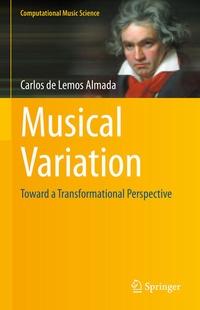
Musical Variation
Description

This book offers an in-depth analysis of musical variation through a systematic approach, heavily influenced by the principles of Grundgestalt and developed variations, both created by the Austrian composer Arnold Schoenberg (1874-1951). The author introduces a new transformational-derivative model and the theory that supports it, specifically crafted for the examination of tonal music.
The idea for this book emerged during a sabbatical at Columbia University, while the content is the product of extensive research conducted at the Federal University of Rio de Janeiro, resulting in the development of the Model of Derivative Analysis. This model places emphasis on the connections between musical entities rather than viewing them as separate entities. As a case study, the Intermezzo in A Major Op.118/2 by Brahms is selected for analysis.
The author's goal is to provide a formal and structured approach while maintaining the text's readability and appeal for both musicians and mathematicians in the field of music theory. The book concludes with the author's recommendations for further research.
More details
Other editions
Additional editions
Person
Carlos de Lemos Almada
is a composer and a Professor at the Federal University of Rio de Janeiro's School of Music (UFRJ). He holds a PhD and a Master's degree in Music from Federal University of Rio de Janeiro State (UNIRIO). Additionally, Almada has a degree in Mechanical Engineering from the Fluminense Federal University. He is author of books about popular-music arranging (2001), harmony (2009), and counterpoint (2013), as well as Schoenberg's Kammersymphony (2016) and Tom Jobim's harmony (2022).
Content
Part. I. Decontextualized Variation.- Chapter. 1. Basic concepts.- Chapter. 2. Decomposable variation.- Chapter. 3. Measurement of similarity.- Chapter. 4. Transformational operations.- Chapter. 5. Measurement of similarity.- Part II. Variation on time.- Chapter. 6. Grundgestalt.- Chapter. 7. Developing variation.- Part III. Analysis: Brahms -Intermezzo in A Major Op.118/2.- Chapter. 8. Formal, harmonic, and metric structure.- Chapter. 9. Derivative analysis.- Afterword.- Further Reading.- Part. IV. Appendices.- Appendix A. Variation in non-tonal contexts.- Appendix B. MDA.- Appendix. C. Algorithms.
