

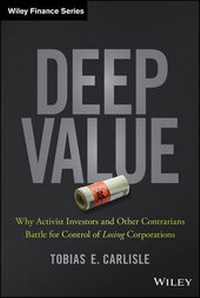
Deep Value
Description

More details
Other editions
Additional editions
Person
Content
Preface
“The directors of such [joint-stock] companies, however, being the managers rather of other people’s money than of their own, it cannot well be expected, that they should watch over it with the same anxious vigilance with which the partners in a private copartnery frequently watch over their own.”
—Adam Smith, The Wealth of Nations (1776)
Deep value is investment triumph disguised as business disaster. It is a simple, but counterintuitive idea: Under the right conditions, losing stocks—those in crisis, with apparently failing businesses, and uncertain futures—offer unusually favorable investment prospects. This is a philosophy that runs counter to the received wisdom of the market. Many investors believe that a good business and a good investment are the same thing. Many value investors, inspired by Warren Buffett’s example, believe that a good, undervalued business is the best investment. The research seems to offer a contradictory view. Though they appear intensely unappealing—perhaps because they appear so intensely unappealing—deeply undervalued companies offer very attractive returns. Often found in calamity, they have tanking market prices, receding earnings, and the equity looks like poison. At the extreme, they might be losing money and headed for liquidation. That’s why they’re cheap. As Benjamin Graham noted in Security Analysis, “If the profits had been increasing steadily it is obvious that the shares would not sell at so low a price. The objection to buying these issues lies in the probability, or at least the possibility, that earnings will decline or losses continue, and that the resources will be dissipated and the intrinsic value ultimately become less than the price paid.” This book is an investigation of the evidence, and the conditions under which losing stocks become asymmetric opportunities, with limited downside and enormous upside.
At its heart, deep value investing is simply the methodical application of timeless principles proven by over 80 years of research and practice. The intellectual basis for it is Graham’s Security Analysis, the foundational document for the school of investing now known as value investing. Through his genius and his experience, Graham understood intuitively what other researchers would demonstrate empirically over the eight decades since his book was first published: That stocks appear most attractive on a fundamental basis at the peak of their business cycle when they represent the worst risk-reward ratio, and least attractive at the bottom of the cycle when the opportunity is at its best. This has several implications for investors. First, the research, which we discuss in the book, shows that the magnitude of market price discount to intrinsic value—the margin of safety in value investing parlance—is more important than the rate of growth in earnings, or the return on invested capital, a measure of business quality. This seems contradictory to Buffett’s exhortation to favor “wonderful companies at fair prices”—which generate sustainable, high returns on capital—over “fair companies at wonderful prices”—those that are cheap, but do not possess any economic advantage.
In the book, we examine why Buffett, who was Graham’s most apt student, sometime employee, long-time friend, and intellectual heir, evolved his investment style away from Graham’s under the influence of his friend and business partner, Charlie Munger. We examine why Munger prompted Buffett to seek out the wonderful company, one that could compound growth while throwing off cash to shareholders. We analyze the textbook example of such a business to understand what makes it “wonderful,” and then test the theory to see whether buying stocks that meet Buffett’s criteria leads to consistent, market-beating performance over the long term. Do Buffett’s wonderful companies outperform without Buffett’s genius for qualitative business analysis, and, if so, what is the real cause? We know that a wonderful company will earn an average return if the market price reflects its fair value. To outperform, the price must be discounted—the wider the discount, or margin of safety, the better the return—or the business must be more wonderful than the market believes. Wonderful company investors must therefore determine both whether a superior business can sustain its unusual profitability, and the extent to which the stock price already anticipates its ability to do so. This is a difficult undertaking because, as we’ll see, it is the rare company that does so. And we don’t well understand what allows it to do so. In most cases competition works on high quality businesses to push their returns back to average, and some even become loss makers. What appears to be an unusually strong business tends to be one enjoying unusually favorable conditions, right at the pinnacle of its business cycle.
The problem for investors is not only that high growth and unusual profitability don’t persist. Exacerbating the problem in many cases is that the market overestimates the business’s potential, bidding the price of its stock too high relative to its potential. The stock of high quality companies is driven so high that long-term returns are impaired even assuming the high rates of growth and profitability persist. The corollary is also true: A company with an apparently poor business will generate an excellent return if the market price underestimates its fair value even assuming the low growth or profitability persists. These findings reveal an axiomatic truth about investing: investors aren’t rewarded for picking winners; they’re rewarded for uncovering mispricings—divergences between the price of a security and its intrinsic value. It is mispricings that create market-beating opportunities. And the place to look for mispricings is in disaster, among the unloved, the ignored, the neglected, the shunned, and the feared—the losers. This is the focus of the book.
If we want rapid earnings growth, and the accompanying stock price appreciation, the place to look for it is counterintuitive. It is more likely to be found in undervalued stocks enduring significant earnings compression and plunging market prices. How can this be so? The reason is a pervasive, enduring phenomenon known as mean reversion. It can be observed in fundamental business performance, security prices, stock markets, and economies. It returns high-growth stocks to earth, and pushes down exceptional returns on investment, while lifting moribund industries, and breathing new life into dying businesses. Though Graham described the exact mechanism by which mean reversion returned undervalued stocks to intrinsic value as “one of the mysteries of our business,” the micro-economic theory is well understood. High growth and high returns invite new entrants who compete away profitability, leading to stagnation, while losses and poor returns cause competitors to exit, leading to a period of high growth and profitability for those business that remain.
Though it is ubiquitous, we don’t intuitively recognize the conditions for mean reversion. Time and again investors, including value investors, ignore it and consequently reduce returns. We can show that a portfolio of deeply undervalued stocks will, on average, generate better returns, and suffer fewer down years, than the market. But rather than focus on the experience of the class of deeply undervalued stocks, we are distracted by the headlines. We overreact. We’re focus on the short-term impact of the crisis. We fixate on the fact that any individual stock appears more likely to suffer a permanent loss of capital. The reason is that even those of us who identify as value investors suffer from cognitive biases, and make behavioral errors. They are easy to make because the incorrect decision—rejecting the undervalued stock—feels right, while the correct decision—buying stocks with anemic, declining earnings—feels wrong. The research shows that our untrained instinct is to naïvely extrapolate out a trend—whether it be in fundamentals like revenues, earnings, or cash flows, or in stock prices. And when we extrapolate the fundamental performance of stocks with declining earnings, we conclude that the intrinsic value must become less than the price paid. These biases—ignorance of the base case and, by extension, mean reversion—are key contributors to the ongoing returns to deep value investment.
In the book we also examine how the public stock market, by making possible an involuntary exchange of management control, creates a means for disciplining underperforming managers, and improving poorly performing businesses. Where high-return businesses attract competitors, low-return businesses attract outside managers. Through acquisition, or activism, these external managers—typically financial buyers like private equity firms, activist investors, and liquidators—compete for control of corporate resources with underexploited potential in the market for corporate control. The principal-agent conflict—caused by the separation of ownership and management in publicly traded companies—leads management to put its own interests ahead of the shareholders. Activists seek to resolve this conflict by pressuring boards to remove underperforming managers, stop value-destroying mergers and acquisitions, optimize capital structures, or press for a sale of the company, and...
