

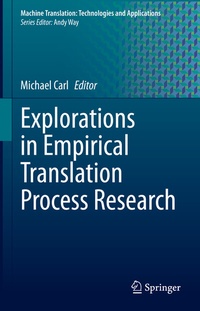
Explorations in Empirical Translation Process Research
Description

This book assembles fifteen original, interdisciplinary research chapters that explore methodological and conceptual considerations as well as user and usage studies to elucidate the relation between the translation product and translation/post-editing processes. It introduces numerous innovative empirical/data-driven measures as well as novel classification schemes and taxonomies to investigate and quantify the relation between translation quality and translation effort in from-scratch translation, machine translation post-editing and computer-assisted audiovisual translation.
The volume addresses questions in the translation of cognates, neologisms, metaphors, and idioms, as well as figurative and cultural specific expressions. It re-assesses the notion of translation universals and translation literality, elaborates on the definition of translation units and syntactic equivalence, and investigates the impact of translation ambiguity and translation entropy. The results and findings are interpreted in the context of psycho-linguistic models of bilingualism and re-frame empirical translation process research within the context of modern dynamic cognitive theories of the mind. The volume bridges the gap between translation process research and machine translation research. It appeals to students and researchers in the fields.
More details
Other editions
Additional editions
Person
Michael Carl is a Professor at Kent State University/USA and Director of the Center for Research and Innovation in Translation and Translation Technology (CRITT). He has published widely in the fields on machine translation, natural language processing and cognitive translation studies. His current research interest is related to the investigation of human translation processes and interactive machine translation.
