

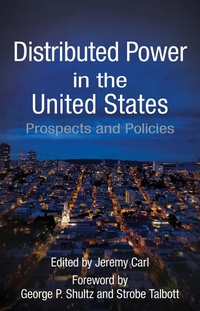
Distributed Power in the United States
Description

More details
Other editions
Additional editions
Persons
Jeremy Carl is a research fellow at the Hoover Institution and a member of the Shultz-Stephenson Task Force on Energy Policy, whose work focuses on energy and environmental policy, with an emphasis on energy security, climate policy, and global fossil fuel markets. In addition, he writes extensively on US-India relations and Indian politics. George P. Shultz is the Thomas W. and Susan B. Ford Distinguished Fellow at the Hoover Institution, and has had a distinguished career in government, in academia, and in business. He lives in San Francisco. Strobe Talbott is a foreign policy analyst and a diplomat. He is a former Deputy Secretary of State and a former journalist with Time magazine, and he is the president of the Brookings Institution think tank. He lives in Washington, DC.
Content
- Front Cover
- Book Title
- Contents
- Abbreviations
- List of Figures and Tables
- Foreword
- Executive Summary
- Acknowledgments
- Introduction
- Expert Forum
- Chapter 1: Overview of Distributed Power Systems
- 1.1 DPS in context
- 1.2 Definitions
- 1.3 Overview of DPS Technology
- 1.4 Functional Risks of DPS Technology
- 1.5 DPS Deployment Trends
- Expert Forum
- Chapter 2: Economic and Environmental Cost-Benefit Analysis of DPS
- 2.1 Costs and Benefits of Distributed Generation
- 2.2 Results of Cost-Benefit Comparison
- Expert Forum
- Chapter 3: Security-Related Benefits of DPS
- 3.1 Energy Security and the Civilian Grid
- 3.2 Energy Security in the U.S. Military
- 3.3 Summary
- Expert Forum
- Chapter 4: Current DPS Policy Landscape
- 4.1 Federal Legislation
- 4.2 State-Level Legislation
- 4.3 Local Rules
- 4.4 Other Recent Policy Initiatives
- 4.5 Summary Observations
- Expert Forum
- Chapter 5: Policy Research Findings
- 5.1 Drivers and Benefits of DPS
- 5.2 Costs and Barriers
- 5.3 Policymaker Roles
- 5.4 Policy Mechanisms
- 5.5 Other Major DPS-Related Issues
- Expert Forum
- Chapter 6: Conclusions and Recommendations
- 6.1 Summary of Findings
- 6.2 Recommendations
- Annex 1: Cost-Benefit Analysis Model Assumptions
- Annex 2: Stakeholder Survey
- Notes
- About the Authors
- About the Hoover Institution's Shultz-Stephenson Task Force on Energy Policy and the Brookings Energy Security Initiative
- Index
