

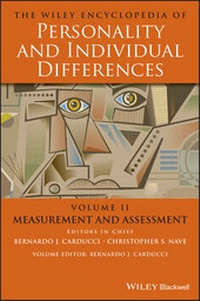
The Wiley Encyclopedia of Personality and Individual Differences, Measurement and Assessment
Description

The Encyclopedia of Personality and Individual Differences (EPID) is organized into four volumes that look at the many likenesses and differences between individuals. Each of these four volumes focuses on a major content area in the study of personality psychology and individuals' differences. The first volume, Models and Theories, surveys the significant classic and contemporary viewpoints, perspectives, models, and theoretical approaches to the study of personality and individuals' differences (PID). The second volume on Measurement and Assessment examines key classic and modern methods and techniques of assessment in the study of PID. Volume III, titled Personality Processes and Individuals Differences, covers the important traditional and current dimensions, constructs, and traits in the study of PID. The final volume discusses three major categories: clinical contributions, applied research, and cross-cultural considerations, and touches on topics such as culture and identity, multicultural identities, cross-cultural examinations of trait structures and personality processes, and more.
* Each volume contains approximately 100 entries on personality and individual differences written by a diverse international panel of leading psychologists
* Covers significant classic and contemporary personality psychology models and theories, measurement and assessment techniques, personality processes and individuals differences, and research
* Provides a comprehensive and in-depth overview of the field of personality psychology
The Encyclopedia of Personality and Individual Differences is an important resource for all psychology students and professionals engaging in the study and research of personality.
More details
Other editions
Additional editions
Persons
Bernardo J. Carducci, PhD, was professor of psychology at Indiana University Southeast where he taught classes on personality psychology and introductory psychology for 37 years, and was director of the IU Southeast Shyness Research Institute. He authored several books on shyness, including The Pocket Guide to Making Successful Small Talk: How to Talk to Anyone Anytime Anywhere About Anything and Shyness: A Bold New Approach. His text, Psychology of Personality: Viewpoints, Research, and Applications, is currently in its third edition.
Christopher Nave, PhD, is the Managing Director of the interdisciplinary Master of Behavioral and Decision Sciences program at the University of Pennsylvania. His areas of expertise include multi-method design, behavioral observation, personality stability, personality judgment and well-being. His publications have appeared in top academic journals and handbooks and have been featured in the popular press.
Content
Contributor Biographies xi
Theoretical and Methodological Issues in Personality Research: General Concerns and Considerations 1
Cross-Cultural Research, Methodological Issues of 13
Idiographic vs. Nomothetic Research 19
Longitudinal Research 25
Person-Situation Interactions 31
Researcher Biases 37
Unconscious Processes 43
Cognitive Methods in Personality Research 49
Experimental Approaches 55
Historiometry 61
Internet Research in Personality 67
Linguistic Analysis in Personality Research (including the Linguistic Inquiry and Word Count) 73
Personal Narratives 79
Personality Development Across the Lifespan 85
Personality in Non-Humans 91
Physical and Virtual Spaces 97
Psychobiography and Case Study Methods 103
Factor Analysis in Personality Research 109
Meta-analysis in Personality Research 113
Multiple Regression in Personality Research 119
Path Analysis in Personality Research 125
Size Effects in Personality Research 131
Structural Equation Modeling in Personality Research 137
Acculturation Considerations in Personality Assessment 143
Computer Adaptive Testing (CAT) 149
Culture-Free/Fair Intelligence Testing 153
Item Analysis 159
Reliability, Issues of 165
Issues of Response Styles 169
Responsibilities of Testing Professionals 175
Rights of Test-takers 181
Validity, Issues of 187
Aggressiveness, Assessment of 191
Anger and Hostility, Assessment of 197
Anxiety, Assessment of 203
Jealousy, Assessment of 209
Love and Attraction, Assessment of 215
Masculinity and Femininity 219
Narcissism, Assessment of 225
Optimism/Pessimism, Assessment of 231
Positive and Negative Affective States, Assessment of 237
Self-Esteem, Assessment of 243
Self-monitoring (to include the Self-Monitoring Scale), Assessment of 249
Self-regulation, Assessment of 255
Self-consciousness, Assessment of 261
Subjective Well-being, Assessment of 267
California Psychological Inventory (CPI) 273
Dimensional Assessment of Personality Pathology (DAPP) 279
Eysenck Personality Questionnaire-Revised 283
Millon Clinical Multiaxial Inventory (MCMI) 287
Minnesota Multiphasic Personality Inventory (MMPI) 293
Multidimensional Personality Questionnaire 309
Myers-Briggs Type Indicator 315
Nonverbal Personality Questionnaire (NPQ) 321
Objective-Analytic Test Battery (OA TB) 325
Personality Assessment Inventory (PAI) 329
Revised NEO Personality Inventory (NEO-PI-R) 335
Zuckerman-Kuhlman Personality Questionnaire (ZKPQ) 351
Projective Techniques, General Features and Methodological Issues 357
Assessing Implicit Motives 363
The Rorschach Test 367
Tell-Me-A-Story (TEMAS) 377
Thematic Apperception Test 381
Word-Related and Figure-Construction Projection Techniques 387
Behavioral Genetics, General Features and Methodological Issues 393
Biochemical Assessment 397
Human Genome Project and Personality 403
Model Fitting 409
Twin Studies in Personality Research 415
Behavioral Assessment Techniques, General Features and Methodological Issues 421
Behavioral Assessment Techniques of Personality in Children 427
Cognitive-Behavioral and Cognitive-Self-Report Assessment Techniques 433
Self-monitoring Behavioral Assessment Techniques 439
Assessment of Intelligence, General Features and Methodological Issues 447
Stanford-Binet Intelligence Scale: Fifth Edition 451
Wechsler Adult Intelligence Scale-IV (WAISC-IV) 457
Wechsler Intelligence Scale for Children (WISC) 465
Wechsler Preschool and Primary Scale of Intelligence (WPPSI) 473
Intelligence-Personality Association, Assessment of 477
Abilities, General Features and Methodological Issues 483
Assessment of Antisocial Behavior 487
Career and Vocational Interests and Abilities, Assessment of 493
Cognitive Aging, Assessment of 499
Creativity, Assessment of 503
Educational Ability Testing (GRE/MAT/MCAT/LSAT) 509
Emotional Intelligence, Assessment of 513
Genius, Assessment of 519
Mental Competency, Assessment of 523
The Wechsler Memory Scales (WMS-IV) 529
Anne Anastasi 533
Jens B. Asendorpf 543
James N. Butcher 547
Charles S. Carver 553
Lee J. Cronbach 557
Turhan Canli 563
Philip J. Corr 569
John M. (Jack) Digman 573
John E. Exner, Jr. 577
Oliver P. John 581
Henry A. Murray 587
Jack A. Naglieri 597
Warren T. Norman 601
William Revelle 605
Michael F. Scheier 611
Mark Snyder 617
David Wechsler 621
Index 625
Contributor Biographies
Natalie Abraham is a graduate from Spring Hill College. She earned her Bachelor of Science degree in psychology with a double minor in philosophy and health sciences. She plans to pursue a career in occupational therapy.
Stephanie L. Albertson is an assistant professor of criminology and criminal justice at Indiana University Southeast. Her research is interdisciplinary in the areas of criminology, criminal justice, and psychology. She has conducted research on the Chicago drug courts, community policing, and multi-jurisdictional task units. Her primary research focus is jury decision-making, capital jurors, and jury reform.
Mathias Allemand, PhD, is an assistant professor at the Department of Psychology and at the University Research Priority Program "Dynamics of Healthy Aging" of the University of Zurich. He directs a research group on personality dynamics and development across the lifespan. His primary interest lies in the understanding of the longitudinal patterns, mechanisms, and outcomes of personality change, dynamics, and development.
Catherine P. Allen is a PhD student in counseling psychology at the University of Central Arkansas. Her research interest is reducing recidivism in criminal populations with personality disorders.
Evan J. Anderson received his MS in counseling psychology from the University of Central Arkansas. He is currently a psychology instructor at the University of Central Arkansas in Conway, AR. Presently, he is co-developing a 12-week mentorship program for delinquent adolescents and serves within the Crime, Career, and Corrections Laboratory as a quantitative data analysis consultant.
Jennifer Andrews is an undergraduate student within the Department of Psychology at Central Washington University.
Damaris Aschwanden, PhD, is a postdoctoral researcher at the Department of Geriatrics in the College of Medicine at Florida State University. Her research focuses on the links between personality, cognitive abilities, dementia, and health.
Andrea L. Barbian-Shimberg is a professor in the Master of Arts in Professional Counseling program at the Liberty University in Lynchburg, Virginia, as well as, an adjunct professor in the Master of Arts in Professional Counseling program at the University of the Cumberlands in Williamsburg, Kentucky. In addition to her responsibilities as an educator, Dr. Barbian-Shimberg maintains a private counseling practice in Huntersville, North Carolina where she specializes in the treatment of eating disorders.
A. Alexander Beaujean is an associate professor of psychology and neuroscience at Baylor University and a Fellow of the American Academy of Assessment Psychology. His research interests include the study of individual differences, especially the structure and measurement of human cognitive ability. He is the author of Latent Variable Modeling in R: A Step-By-Step Guide (2014, Routledge) and co-authored with John Loehlin the fifth edition of Latent Variable Models: An Introduction to Factor, Path, and Structural Equation Analysis (2017, Routledge).
Emorie D. Beck is a doctoral student in the Department of Psychological and Brain Sciences, Washington University in St. Louis, USA. Her interests include the application of network science to personality structure and architecture.
Jacob Belkin (MBA, Shenandoah University, 2017) is currently a community-based counselor with the National Counseling Group and is pursuing a Master's in clinical counseling.
Sara Bender is an assistant professor in the Department of Psychology at Central Washington University. She teaches a variety of undergraduate psychology and graduate counselor education courses, including courses in personality. Her research interests include the provision of mental health services to underserved populations, clinical supervision, and online supervision.
Arlin James Benjamin, Jr. earned his PhD in social psychology from the University of Missouri-Columbia in 2000. He is currently an associate professor in the Department of Behavioral Sciences at the University of Arkansas-Fort Smith. His primary research interests include the effects of aggression-related situational cues (e.g. violent video games, weapon images) on aggressive cognitions, behaviors, and aggression-related attitudes, as well as individual differences predicting aggressive behavior and attitudes toward violence.
Betsy Blackard is a graduate student at Claremont Graduate University. Her research interests include parent-child attachment and romantic relationships in adulthood.
A. Nayena Blankson (PhD, University of Southern California, 2007) is an associate professor of psychology at Spelman College. Her research interests include examining the links between cognitive skills, child characteristics, environmental conditions, and early achievement in children. She also has expertise in the use of rigorous quantitative methodology to address substantive research questions, including multilevel modeling, measurement invariance. structural equation modeling, and moderated mediation. She has authored over 20 peer-reviewed articles.
Cady Block, PhD, is an assistant professor, and research director of the Neuropsychology Clinic in the Department of Psychiatry and Behavioral Health at the Ohio State University. She holds concurrent appointments in the Departments of Neurology and Neurosurgery. Her research is in neuropsychological assessment of epilepsy, multiple sclerosis, movement disorders, brain injury, and chronic pain. She is involved in national leadership, with positions in the Society for Clinical Neuropsychology, the International Neuropsychological Society, and the American Academy of Clinical Neuropsychology. She is a recipient of the Early Career Award (National Academy of Neuropsychology) and Young Investigator Award (American Pain Society).
Reneé R. Boburka (PhD, Pennsylvania State University) is a professor of psychology at East Stroudsburg University, Pennsylvania. Her current research interests focus on issues related to stereotyping and also teaching and learning. She has publications dealing with topics such as social cognition and pedagogy in various journals, including Basic and Applied Social Psychology, Memory, Studies in Continuing Education, PsycCRITIQUES, Psychology Learning & Teaching, Journal of Research in Music Education, and the Sage Encyclopedia of Abnormal and Clinical Psychology. She has also been a contributing author on several book chapters.
Sameen Boparai, BA, is a clinical psychology doctoral student at the University of Washington. She was previously a laboratory coordinator at the Health, Relationships and Intervention Laboratory at the University of California, Irvine. She recently co-authored a paper titled "Interaction between the opioid receptor OPRM1 gene and mother-child language style matching prospectively predicts children's separation anxiety symptoms." Her research interests include developmental psychopathology and emotion socialization.
Jessica L. Borelli, PhD, is an associate professor of psychology and social behavior at the University of California, Irvine. She is a clinical psychologist specializing in the field of developmental psychopathology; her research focuses on the links between close relationships, emotions, health, and development, with a particular focus on risk for anxiety and depression. Recent journal articles include: "Shedding light on the specificity of school-aged children's attachment narratives"; "Mother-child language style matching predicts children's and mothers' emotion reactivity"; "Reflective functioning in parents of school-aged children."
Laura Boxley, PhD, is an assistant professor, and training director of the Neuropsychology Clinic in the Department of Psychiatry and Behavioral Health at the Ohio State University. She holds concurrent appointments in the Departments of Neurology and Psychology. Her research is in the neuropsychological assessment of postconcussive disorder. She is involved in national leadership, holding a position within the Membership Committee within the Society for Clinical Neuropsychology.
April L. Brown, MPH, is a graduate of Spelman College (class of 2009) and current doctoral student of clinical psychology at Emory University. April is a former Gates Millennium Scholar and was recently awarded the Emory Graduate Diversity Fellowship - a highly prestigious entering student fellowship that is given to six or more students. She is a budding researcher in the Biosocial Underpinnings in Learning and Development (BUILD) Laboratory, where she studies the association between psychosocial stress and child psychopathology via hormonal processes within the neuroendocrine system.
Kathryn Bruzios (MS, Rivier University, 2015) is a clinical researcher at the University of Massachusetts Medical School and is appointed to the Department of Veterans Affairs. Her research interests include prevention science, underprivileged populations, and co-occurring disorders. Her current research uses a multicomponent intervention with individuals who have a co-occurring mental illness and substance use disorder, and are homeless, amongst other factors.
Chelsey Bull is currently a student in the MS Mental Health Counseling program at the...
