

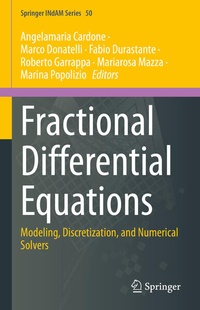
Fractional Differential Equations
Description

The content of the book collects some contributions related to the talks presented during the INdAM Workshop "Fractional Differential Equations: Modelling, Discretization, and Numerical Solvers", held in Rome, Italy, on July 12-14, 2021. All contributions are original and not published elsewhere.
The main topic of the book is fractional calculus, a topic that addresses the study and application of integrals and derivatives of noninteger order. These operators, unlike the classic operators of integer order, are nonlocal operators and are better suited to describe phenomena with memory (with respect to time and/or space). Although the basic ideas of fractional calculus go back over three centuries, only in recent decades there has been a rapid increase in interest in this field of research due not only to the increasing use of fractional calculus in applications in biology, physics, engineering, probability, etc., but also thanks to the availability of new and more powerful numerical tools that allow for an efficient solution of problems that until a few years ago appeared unsolvable. The analytical solution of fractional differential equations (FDEs) appears even more difficult than in the integer case. Hence, numerical analysis plays a decisive role since practically every type of application of fractional calculus requires adequate numerical tools.
The aim of this book is therefore to collect and spread ideas mainly coming from the two communities of numerical analysts operating in this field - the one working on methods for the solution of differential problems and the one working on the numerical linear algebra side - to share knowledge and create synergies. At the same time, the book intends to realize a direct bridge between researchers working on applications and numerical analysts. Indeed, the book collects papers on applications, numerical methods for differential problems of fractional order, and related aspects in numerical linear algebra.The target audience of the book is scholars interested in recent advancements in fractional calculus.
More details
Other editions
Additional editions
Persons
Angelamaria Cardone is an Associate Professor of Numerical Analysis at the Department of Mathematics, University of Salerno, Italy. Her scientific activity is mainly focused on the numerical solution of Volterra integral equations and of differential equations, also of fractional type, and on the development of related mathematical software.
Marco Donatelli is an Associate Professor of Numerical Analysis at the University of Insubria, Italy. His scientific activity is mainly focused on the regularization of inverse problems and numerical linear algebra methods, with special attention to iterative methods for large linear systems arising from the discretization of integral and differential equations.
Fabio Durastante is a Researcher in Numerical Analysis at the Department of Mathematics, University of Pisa, Italy. His scientific activity is mainly focused on numerical linear algebra and its application to the solution of partial differential equations of both integer and fractional order, high-performance computing, and computation of matrix functions.
Roberto Garrappa is an Associate Professor of Numerical Analysis at the Department of Mathematics, University of Bari, Italy. His scientific activity is mainly focused on numerical methods for fractional differential equations and for the computation of special functions in fractional calculus.
Mariarosa Mazza is a Researcher in Numerical Analysis at the University of Insubria, Italy. Her scientific activity is mainly focused on numerical linear algebra problems and related applications, with special attention to iterative methods for discretized partial differential equations, also of fractional type. Other interests include image deblurring and approximation issues.
Marina Popolizio is an Associate Professor of Numerical Analysis at the Polytechnic University of Bari, Italy. Her scientific activity is mainly focused on numerical linear algebra and numerical methods for fractional differential equations, with special attention to the computation of matrix functions.
Content
Chapter 1. A New Diffusive Representation for Fractional Derivatives, Part I: Construction, Implementation and Numerical Examples.- Chapter 2. Exact solutions for the fractional nonlinear Boussinesq equation.- Chapter 3. A numerical procedure for fractional-time-space differential equations with the spectral fractional Laplacian.- Chapter 4. Spectral Analysis of Matrices in B-Spline Galerkin Methods for Riesz Fractional Equations.- Chapter 5.Do the Mittag-Leffler functions preserve the properties of their matrix arguments?.- Chapter 6. On the solutions of the fractional generalized Gierer-Meinhardt Model.- Chapter 7. A convolution-based method for an integro-differential equation in mechanics.- Chapter 8. A MATLAB code for fractional differential equations based on two-step spline collocation methods.
