

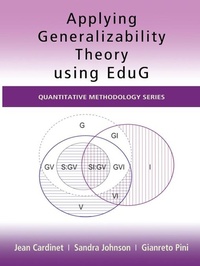
Applying Generalizability Theory using EduG
1st Edition
Published on 4. March 2011
234 pages
978-1-135-24033-2 (ISBN)
Description

Intended to help improve measurement and data collection methods in the behavioral, social, and medical sciences, this book demonstrates an expanded and accessible use of Generalizability Theory (G theory). G theory conceptually models the way in which the reliability of measurement is ascertained. Sources of score variation are identified as potential contributors to measurement error and taken into account accordingly. The authors demonstrate the powerful potential of G theory by showing how to improve the quality of any kind of measurement, regardless of the discipline.
Readers will appreciate the conversational style used to present a comprehensive review of G theory and its application using the freeware EduG. To maximize understanding the authors illustrate all fundamental principles with concrete examples from different fields and contexts. Annotated applications lead students through the main concepts of G theory, while illustrating both the use of EduG and interpretation of its output. Formulas are avoided wherever possible. Exercises with data sets available on the Psychology Press website allow readers to carry out their own analyses to reinforce understanding.
Brief overviews of analysis of variance, estimation, and the statistical error model are provided for review. The procedures involved in carrying out a generalizability study using EduG follow, as well as guidance in the interpretation of results. Real-world applications of G theory to the assessment of depression, managerial ability, attitudes, and writing and mathematical skills are then presented. Next, annotated exercises provide an opportunity for readers to use EduG and interpret its results. The book concludes with a review of the development of G theory and possible new directions of application. Finally, for those with a strong statistical background, the appendixes provide the formulas used by EduG.
Ideal as a supplement for courses on measurement theory and/or generalizability theory taught in departments of psychology, education, medicine, and the social sciences, this text will also appeal to researchers from a variety of fields interested in learning how to apply G theory to their studies.
Readers will appreciate the conversational style used to present a comprehensive review of G theory and its application using the freeware EduG. To maximize understanding the authors illustrate all fundamental principles with concrete examples from different fields and contexts. Annotated applications lead students through the main concepts of G theory, while illustrating both the use of EduG and interpretation of its output. Formulas are avoided wherever possible. Exercises with data sets available on the Psychology Press website allow readers to carry out their own analyses to reinforce understanding.
Brief overviews of analysis of variance, estimation, and the statistical error model are provided for review. The procedures involved in carrying out a generalizability study using EduG follow, as well as guidance in the interpretation of results. Real-world applications of G theory to the assessment of depression, managerial ability, attitudes, and writing and mathematical skills are then presented. Next, annotated exercises provide an opportunity for readers to use EduG and interpret its results. The book concludes with a review of the development of G theory and possible new directions of application. Finally, for those with a strong statistical background, the appendixes provide the formulas used by EduG.
Ideal as a supplement for courses on measurement theory and/or generalizability theory taught in departments of psychology, education, medicine, and the social sciences, this text will also appeal to researchers from a variety of fields interested in learning how to apply G theory to their studies.
Reviews / Votes
"A wonderful book. ... It provides in one place the fruits of twenty-five years of research carried out by its authors. ... An "easy read" ... the conceptual and statistical ideas are presented clearly; they are immediately exemplified in concrete terms. ... I have used a draft of the book in my course on G theory at Stanford and graduate students have universally found the available chapters readable and clear. ... The book comes with outstanding software - EduG. ... It explains the use of this software thoroughly and understandably ... with extensive, concrete examples." - Richard J. Shavelson, Stanford University, from the book's foreword"The interest in generalizability study is supported by the AERA/APA/NCME joint standards. ... The publication of the book and the availability of an easy to use software will increase the interest and the use of generalizability theory. ... Fortunately for all of us, such a software and such a book now exist which will make our task of complying with the joints standards on reliability much easier. ... I will certainly make the purchase of the book compulsory for my advanced courses in measurement." - Dany Laveault, University of Ottawa
"This book provides an excellent introduction to one of the most broadly defined psychometric theories currently in existence. It will clearly serve as a reference text for all researchers and advanced students interested in gaining insight to G theory. The provided easy-to-use EduG statistical computer program to compute all the analyses is a wonderful additional bonus." - George Marcoulides, University of California, Riverside "This book provides an excellent introduction to one of the most broadly defined psychometric theories currently in existence. It will clearly serve as a reference text for all researchers and advanced students interested in gaining insight into G theory. The provided easy-to-use EduG statistical computer program to compute all the analyses is a wonderful additional bonus." - George Marcoulides, University of California - Riverside
More details
Series
Language
English
Place of publication
London
United Kingdom
Publishing group
Taylor & Francis Ltd
Target group
College/higher education
File size
4,42 MB
ISBN-13
978-1-135-24033-2 (9781135240332)
Copyright in bibliographic data and cover images is held by Nielsen Book Services Limited or by the publishers or by their respective licensors: all rights reserved.
Schweitzer Classification
Other editions
Additional editions
Jean Cardinet | Sandra Johnson | Gianreto Pini
Applying Generalizability Theory using EduG
Book
10/2009
1st Edition
Routledge
€206.30
Shipment within 3-4 weeks
Jean Cardinet | Sandra Johnson | Gianreto Pini
Applying Generalizability Theory using EduG
Book
10/2009
1st Edition
Routledge
€65.20
Shipment within 3-4 weeks
Persons
Jean Cardinet is former Head of the IRDP Research Service, an institute created by the Education Departments of French speaking Switzerland to evaluate curriculum innovations introduced from 1970 onwards. He was also Professor of Education ad interim at the University of Fribourg in Switzerland, after having been Head of the Institute of Psychology of the University of Neuchatel and Research Assistant to Prof. Lee J. Cronbach in Champaign, Illinois. He received his Ph.D. in Psychology from the University of Chicago in 1952, with Prof. Thurstone.?
Sandra Johnson is a Director of Assessment Europe, a consultancy company active in the field of educational measurement. She has worked for many years in national assessment in the UK, first as Deputy Technical Director of the UK Government's APU Science Survey Programme and later as Technical Adviser to the Scottish Government, using G theory to guide survey design and assure quality. She is a Chartered Statistician (Royal Statistical Society) and a Fellow of the Association for Educational Assessment - Europe.??
Gianreto Pini has been a key methodological contributor to the theory of generalizability in the Working group Edumetrie of the Swiss Society for Educational Research. Benefiting from his experience of teaching G theory in the Faculty of Psychology and Education, University of Geneva, he coauthored with Daniel Bain the G theory primer Pour evaluer vos evaluations La generalisabilite: mode d'emploi (Geneva Centre for Psycho-Educational Research, 1996), from which this current book originated.
Sandra Johnson is a Director of Assessment Europe, a consultancy company active in the field of educational measurement. She has worked for many years in national assessment in the UK, first as Deputy Technical Director of the UK Government's APU Science Survey Programme and later as Technical Adviser to the Scottish Government, using G theory to guide survey design and assure quality. She is a Chartered Statistician (Royal Statistical Society) and a Fellow of the Association for Educational Assessment - Europe.??
Gianreto Pini has been a key methodological contributor to the theory of generalizability in the Working group Edumetrie of the Swiss Society for Educational Research. Benefiting from his experience of teaching G theory in the Faculty of Psychology and Education, University of Geneva, he coauthored with Daniel Bain the G theory primer Pour evaluer vos evaluations La generalisabilite: mode d'emploi (Geneva Centre for Psycho-Educational Research, 1996), from which this current book originated.
Content
Introduction. 1. What is Generalizability Theory? 2. Generalizability Theory: Concepts and Principles. 3. Using EduG: The Generalizability Theory Software. 4. Applications to the Behavioral and Social Sciences. 5. Practice Exercises. 6. Current Developments and Future Possibilities. Appendixes.
