

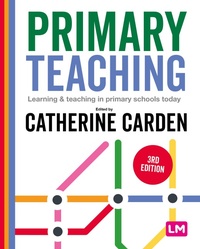
Primary Teaching
Learning and teaching in primary schools today
3rd Edition
Published on 28. March 2026
600 pages
978-1-0362-3871-1 (ISBN)
Description

Primary teaching is challenging and rewarding in equal measure. Schools are diverse and ever-changing communities where children and teachers learn alongside each other. When learning to teach, practical experience in the classroom is essential, as is learning from others and being able to reflect on your own learning and performance. Equally important is the ability to critically evaluate learning and teaching and to look at current practice in schools and in the UK and to question it. In fact, in teacher training, the questions are just as important as the answers:
What is teaching?
How do children learn?
What is pedagogy?
Does curriculum really matter?
Should teachers 'manage' behaviour?
How do I support children with SEND?
What can AI tools do for teachers?
This core text from Learning Matters tackles these questions and more. It poses questions to encourage a re-thinking of the world of schools and learning. It challenges trainee teachers to ask why,to engage with research and to reflect on their own practice and the practice in their placement schools.
Primary Teachingis a core text for trainee teachers.
What is teaching?
How do children learn?
What is pedagogy?
Does curriculum really matter?
Should teachers 'manage' behaviour?
How do I support children with SEND?
What can AI tools do for teachers?
This core text from Learning Matters tackles these questions and more. It poses questions to encourage a re-thinking of the world of schools and learning. It challenges trainee teachers to ask why,to engage with research and to reflect on their own practice and the practice in their placement schools.
Primary Teachingis a core text for trainee teachers.
More details
Series
Edition
Third Edition
Language
English
Place of publication
London
United Kingdom
Publishing group
SAGE Publishing (Digital)
Target group
College/higher education
File size
6,50 MB
ISBN-13
978-1-0362-3871-1 (9781036238711)
Copyright in bibliographic data and cover images is held by Nielsen Book Services Limited or by the publishers or by their respective licensors: all rights reserved.
Schweitzer Classification
Other editions
Additional editions
Book
03/2026
3rd Edition
SAGE Publications Ltd
€147.30
Shipment within 15-20 days
Book
03/2026
3rd Edition
SAGE Publications Ltd
€132.50
Shipment within 15-20 days
Person
Catherine Carden lecturers on the BA in Education Studies (Primary) at the Open University. Catherine is an Independent Education Consultant specialising in educational leadership and in particular people centred leadership, culture and wellbeing. Previous roles have included Director of Learning and Teaching in the Faculty of Arts, Humanities and Education, Director of Primary Initial Teacher Education and a teacher educator at a large HEI. Prior to that, Catherine held teaching and leadership roles within secondary and further education. Catherine's professional and scholarly interests are in teacher education and development, educational leadership, organisatonal culture, coaching and mentoring, and wellbeing and self-care.
Content
Part 1: Understanding primary teaching
1 What is teaching? - Catherine Carden and Virginia Bower
2 What matters in early childhood? - Ioanna Palaiologou
3 How do children learn? - Sean MacBlain
4 What is pedagogy? - Di Swift
5 Diversity, equity and inclusion in schools - Georgia Veness
Part 2: Essential principles for teaching
6 Why is teacher professionalism important? - Glenn Stone
7 What matters in planning? - Deborah Wilkinson and Lorna Earle
8 Does behaviour need 'managing'? - Mark Sackville-Ford
9 What is oracy and why does it matter? - Virginia Bower
10 What is assessment? - Mary Briggs
11 What can teachers do to raise outcomes for children with special educational needs and disabilities? - Jonathan Glazzard
Part 3: Developing skills for teaching
12 How can I work to ensure a positive primary school placement? - Cara Broadhurst
13 My space, your space, our space. Re-thinking the learning environment: is it fit for purpose? - Jon Audian, Julie Wharton and Lisa-Marie Martin
14 How can we build positive relationships with children and parents? - Noel Purdy, Jill Dunn and Diane McClelland
15 Adaptive teaching: smashing through the glass ceiling? - Charlotte Mosey and Jack Bryne Stothard
Part 4: Teaching now
16 Teacher Wellbeing: Are doughnuts in the staffroom enough? - Adrian Bethune and Catherine Carden
17 How can teachers diversify the curriculum to ensure it reflects all of our children? - Aleishia Lewis
18 Techology, AI and primary teaching - Matthew Tragheim
19 Why do teachers need to know about child mental health? - Sarah Adams, Michelle O'Reilly and Khalid Karim
20 What is the true power of reading? - Louise Johns-Shepherd
21 What is sustainability, why is it important and what does it mean for my teaching? - Nicola Kemp and Stephen Scoffham
22 Talk in the classroom: what counts as 'oracy'? - Evan McCormick and Vikki Chadwick
23 Relationship and Sex Education: How does getting to know ourselves, our children and their families create a recipe for an inclusive RSE learning environment? - Bonnie Kerr and Kat Vallely
24 How can our teaching embrace neurodivergent learners? - Jon Rainford
25 Rewilding learning: an opportunity for meaningful inclusion - Sarah Watkins
26 What is coaching and how can I develop coaching approaches in my classroom? - Catherine Carden and Clare Smale
1 What is teaching? - Catherine Carden and Virginia Bower
2 What matters in early childhood? - Ioanna Palaiologou
3 How do children learn? - Sean MacBlain
4 What is pedagogy? - Di Swift
5 Diversity, equity and inclusion in schools - Georgia Veness
Part 2: Essential principles for teaching
6 Why is teacher professionalism important? - Glenn Stone
7 What matters in planning? - Deborah Wilkinson and Lorna Earle
8 Does behaviour need 'managing'? - Mark Sackville-Ford
9 What is oracy and why does it matter? - Virginia Bower
10 What is assessment? - Mary Briggs
11 What can teachers do to raise outcomes for children with special educational needs and disabilities? - Jonathan Glazzard
Part 3: Developing skills for teaching
12 How can I work to ensure a positive primary school placement? - Cara Broadhurst
13 My space, your space, our space. Re-thinking the learning environment: is it fit for purpose? - Jon Audian, Julie Wharton and Lisa-Marie Martin
14 How can we build positive relationships with children and parents? - Noel Purdy, Jill Dunn and Diane McClelland
15 Adaptive teaching: smashing through the glass ceiling? - Charlotte Mosey and Jack Bryne Stothard
Part 4: Teaching now
16 Teacher Wellbeing: Are doughnuts in the staffroom enough? - Adrian Bethune and Catherine Carden
17 How can teachers diversify the curriculum to ensure it reflects all of our children? - Aleishia Lewis
18 Techology, AI and primary teaching - Matthew Tragheim
19 Why do teachers need to know about child mental health? - Sarah Adams, Michelle O'Reilly and Khalid Karim
20 What is the true power of reading? - Louise Johns-Shepherd
21 What is sustainability, why is it important and what does it mean for my teaching? - Nicola Kemp and Stephen Scoffham
22 Talk in the classroom: what counts as 'oracy'? - Evan McCormick and Vikki Chadwick
23 Relationship and Sex Education: How does getting to know ourselves, our children and their families create a recipe for an inclusive RSE learning environment? - Bonnie Kerr and Kat Vallely
24 How can our teaching embrace neurodivergent learners? - Jon Rainford
25 Rewilding learning: an opportunity for meaningful inclusion - Sarah Watkins
26 What is coaching and how can I develop coaching approaches in my classroom? - Catherine Carden and Clare Smale
