

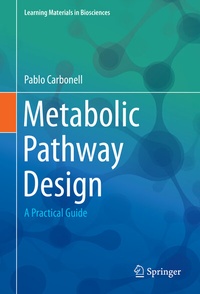
Metabolic Pathway Design
Description

This textbook presents solid tools for in silico engineering biology, offering students a step-by-step guide to mastering the smart design of metabolic pathways. The first part explains the Design-Build-Test-Learn-cycle engineering approach to biology, discussing the basic tools to model biological and chemistry-based systems. Using these basic tools, the second part focuses on various computational protocols for metabolic pathway design, from enzyme selection to pathway discovery and enumeration. In the context of industrial biotechnology, the final part helps readers understand the challenges of scaling up and optimisation. By working with the free programming language Scientific Python, this book provides easily accessible tools for studying and learning the principles of modern in silico metabolic pathway design. Intended for advanced undergraduates and master's students in biotechnology, biomedical engineering, bioinformatics and systems biology students, the introductory sections make it also useful for beginners wanting to learn the basics of scientific coding and find real-world, hands-on examples.
More details
Other editions
Additional editions
Person
Pablo Carbonell is a senior staff scientist at the SynBioChem Centre, Manchester Institute of Biotechnology. His field of research is automated design for metabolic engineering and synthetic biology. Pablo has developed several bioretrosynthesis-based pathway design tools, including RetroPath, XTMS, EcoliTox, Selenzyme for enzyme selection and Promis for protein design. He is interested in applying the principles of machine learning and control engineering to sustainable biological design. He has contributed to the development of several theoretical models for bio-based, bionics systems - from biosensors to robotic exoskeletons.
