

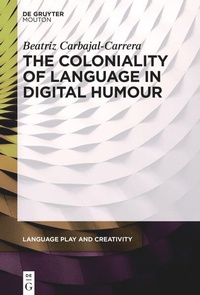
The Coloniality of Language in Digital Humour
Coloniality of Language in Digital Humour
1st Edition
Published on 29. October 2025
VII, 220 pages
978-3-11-163515-6 (ISBN)
Description

Humour has not yet been systematically analysed from a decolonial perspective. This book addresses the coloniality of language in online humour from an interdisciplinary decolonial linguistics approach that places attentional processes at the centre of the analysis. Its chapters contribute to linguistic research with a novel theoretical framework for the analysis of digital humour by foregrounding attentional processes and power relations. The contributions made in its pages stem from the recognition that coloniality is so profoundly embedded in our communicative practices that it often remains unnoticed. For that reason, the book invites the reader to reflect on how we exercise attention.
More details
Series
Language
English
Place of publication
Berlin/Boston
Germany
Publishing group
de Gruyter Mouton
Target group
Professional and scholarly
US School Grade: College Graduate Student
Illustrations
12 b/w and 9 col. ill., 20 b/w tbl.
File size
9,50 MB
ISBN-13
978-3-11-163515-6 (9783111635156)
Schweitzer Classification
Other editions
Additional editions
Beatriz Carbajal-Carrera
The Coloniality of Language in Digital Humour
Coloniality of Language in Digital Humour
E-Book
10/2025
1st Edition
De Gruyter Mouton
€109.95
Available for download
Beatriz Carbajal-Carrera
The Coloniality of Language in Digital Humour
Book
10/2025
1st Edition
De Gruyter Mouton
€109.95
Shipment within 5-7 days
Person
Content
- Intro
- Contents
- List of tables
- List of figures
- Introduction
- 1 The language-coloniality nexus
- 1.1 Introduction
- 1.2 The sneaky coloniality of language
- 1.3 The Spanish language case
- 1.4 Key characteristics
- 1.4.1 Racializing
- Multimodality
- Monolanguaging
- 1.4.2 Violent
- Symbolic violence
- Dehumanizing scripts
- 1.4.3 Legitimized
- The language authority
- Legitimized scripts
- 1.4.4 Hidden
- Filtering
- Subtle dehumanization
- 1.4.5 Unaware
- Blame avoidance
- Denial strategies
- Argumentation strategies
- Legitimation strategies
- Framing strategies
- Representation strategies
- Manipulation strategies
- 1.4.6 Toxic
- CMP domains
- Knowledge domain
- Humanity domain
- Governance domain
- Economy domain
- 1.5 Concluding remarks
- 2 Humour meets decoloniality
- 2.1 DTR: Define the relationship
- 2.2 The Western problematization of humour
- 2.2.1 One term to rule them all
- 2.2.2 Objections to humour
- Historical objections
- Academic objections
- Sociological objections
- Linguistic objections
- 2.3 The defining part of DTR
- 2.4 Humour targets and othering
- 2.5 Humour functions
- 2.5.1 Affiliation/isolation
- 2.5.2 Subversion/reinforcement
- 2.5.3 Mediation/blame avoidance
- 2.6 The context of digital humour
- 2.6.1 Digital genres
- Multimodality
- Mimesis
- Genre remediation
- 2.6.2 Language users
- Participatory culture
- Discursive borders
- Digital personas
- 2.7 Concluding remarks
- 3 A decolonial interrogation of humour theories
- 3.1 Introduction
- 3.2 Decoloniality as a questioning stance
- 3.3 The grammar of decoloniality applied to humour
- 3.4 The pillars of humour
- 3.4.1 Superiority
- Overview and limitations
- Superiority through the grammar of decoloniality
- 3.4.2 Relief
- Overview and limitations
- Relief through the grammar of decoloniality
- 3.4.3 Incongruity
- Overview and limitations
- The semantic script theory of humour
- The general theory of verbal humour
- Incongruity through the grammar of decoloniality
- 3.5 Intention and attention in humour theories
- 3.5.1 Cooperation
- 3.5.2 Relevance
- 3.5.3 The socio-cognitive approach
- 3.5.4 Sociological approaches
- 3.5.5 The decolonial subdimensions of attention
- 3.6 Concluding remarks
- 4 Humour and targets in metapragmatic formulas
- 4.1 Introduction
- 4.2 The metapragmatics of humour
- Outline placeholder
- A focus on formulas
- 4.3 The sociology of knowledge
- 4.4 Methodology
- 4.5 The what and the who in humour
- 4.5.1 Humour in metapragmatic formulas expressing approval
- Communication norms
- Social impact
- Epistemic and social relations
- 4.5.2 Humour in metapragmatic formulas expressing disapproval
- Communication norms
- Social impact
- Epistemic and social relations
- 4.5.3 Targets in metapragmatic formulas expressing approval
- Social identity
- Linguistic identity
- Epistemic and social relations
- 4.5.4 Targets in metapragmatic formulas expressing disapproval
- Social identity
- Linguistic identity
- Epistemic and social relations
- 4.6 Discussion
- 4.7 Concluding remarks
- 5 Eurocentric and pluriversal attention in memes
- 5.1 Introduction
- 5.2 Exoticism and the coloniality of language
- 5.2.1 The representation of humour targets as exotic
- 5.2.2 The exotic representation of otherness: Two visions
- 5.3 Methodology
- 5.3.1 Resuming the decolonial subdimensions of attention
- 5.3.2 Salient concepts in exotic representation
- 5.4 Representations of Nahuan languages and identities in -TL memes
- 5.4.1 Privileged attention and decolonial attention
- 5.4.2 Modernity experience and coloniality experience
- 5.4.3 Eurocentrism and pluriversality
- 5.4.4 Historical salience and emerging salience
- 5.5 Concluding remarks
- 6 Hierarchies among intertextual references
- 6.1 Introduction
- 6.2 Intertextuality in digital humour
- 6.3 Hierarchies and intertextuality
- 6.4 Methodology
- 6.5 Multimodal intertextuality through the colonial matrix of power
- 6.5.1 Knowledge domain
- 6.5.2 Humanity domain
- 6.5.3 Governance domain
- 6.6 Discussion: Nested hierarchies within CMP domains
- Outline placeholder
- The mind/body hierarchy
- The human/object hierarchy
- The familiar/foreign hierarchy
- 6.7 Concluding remarks
- Conclusions
- References
- Subject index
