

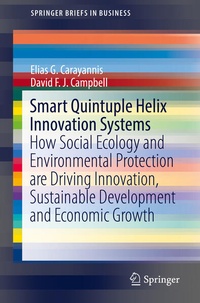
Smart Quintuple Helix Innovation Systems
Description

The Quintuple Helix innovation model focuses on the interactions among five key elements of society: academia, industry, government, culture, and the environment--with particular respect to harnessing knowledge to promote social, political, and economic development. The Quintuple Helix is a powerful theoretical and practical lens for analyzing and understanding such critical and complex ecological and socioeconomic issues as global warming and climate change and their implications for sustainability. The authors provide policy approaches and strategies to help create a balance among the often competing forces of environmental protection, innovation, entrepreneurship, and social and economic growth that will successfully benefit society and protect democratic values.
More details
Other editions
Additional editions
Persons
Elias G. Carayannis is Full Professor of science, technology, innovation, and entrepreneurship, as well as Co-founder and Co-director of the Global and Entrepreneurial Finance Research Institute (GEFRI) and Director of research on science, technology, innovation and entrepreneurship, European Union Research Center (EURC), at the School of Business of the George Washington University in Washington, D.C. Carayannis' teaching and research activities focus on the areas of strategic government-university-industry R&D partnerships, technology road-mapping, technology transfer and commercialization, international science and technology policy, technological entrepreneurship, and regional economic development.
David F. J. Campbell is Associate Professor (Privatdozent) in Political Science at the University of Vienna; a Faculty Member at the Center for Educational Management and Higher Education Development, Department for Continuing Education Research and Educational Management, at Danube University Krems; a Quality Expert at the University of Applied Arts in Vienna; and a Researcher (Senior Scientist) with the Alpen-Adria-University of Klagenfurt.
