

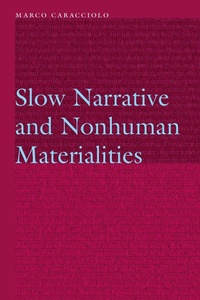
Slow Narrative and Nonhuman Materialities
1st Edition
Published on 1. March 2022
264 pages
978-1-4962-3088-1 (ISBN)
Description

Winner of the 2024 Barbara Perkins and George Perkins Prize
Slow Narrative and Nonhuman Materialities investigates how the experience of slowness in contemporary narrative practices can create a vision of interconnectedness between human communities and the nonhuman world. Here, slowness is not a matter of measurable time but a transformative experience for audiences of contemporary narratives engaging with the ecological crisis. While climate change is a scientific abstraction, the imagination of slowness turns it into a deeply embodied and affective experience. Marco Caracciolo explores the value of slowness in dialogue with a wide range of narratives in various media, from prose fiction to comic books to video games. He argues that we need patience and an eye for complex patterns in order to recognize the multiple threads that link human communities and the slow-moving processes of climate and geological history. Decelerating attention offers important insight into human societies' relations with the nonhuman materialities of Earth's physical landscapes, ecosystems, and atmosphere.
Caracciolo centers the experiential effects of narrative and offers a range of theoretically grounded readings that complement the formal language of narrative theory. These close readings demonstrate that slowness is not a matter of measurable time but a "thickening" of attention that reveals the deeply multithreaded nature of reality. The importance of this realization cannot be overstated: through an investment in the here and now of experience, slow narrative can help us manage the uncertainty of living in an era marked by dramatically shifting climate patterns.
Slow Narrative and Nonhuman Materialities investigates how the experience of slowness in contemporary narrative practices can create a vision of interconnectedness between human communities and the nonhuman world. Here, slowness is not a matter of measurable time but a transformative experience for audiences of contemporary narratives engaging with the ecological crisis. While climate change is a scientific abstraction, the imagination of slowness turns it into a deeply embodied and affective experience. Marco Caracciolo explores the value of slowness in dialogue with a wide range of narratives in various media, from prose fiction to comic books to video games. He argues that we need patience and an eye for complex patterns in order to recognize the multiple threads that link human communities and the slow-moving processes of climate and geological history. Decelerating attention offers important insight into human societies' relations with the nonhuman materialities of Earth's physical landscapes, ecosystems, and atmosphere.
Caracciolo centers the experiential effects of narrative and offers a range of theoretically grounded readings that complement the formal language of narrative theory. These close readings demonstrate that slowness is not a matter of measurable time but a "thickening" of attention that reveals the deeply multithreaded nature of reality. The importance of this realization cannot be overstated: through an investment in the here and now of experience, slow narrative can help us manage the uncertainty of living in an era marked by dramatically shifting climate patterns.
Reviews / Votes
"Slow Narrative and Nonhuman Materialities makes a convincing appeal for the potential of slow narrative in regard to the ecological imagination that is needed to (en)counter the contemporary ecological crises. With his multifaceted and innovative work, Caracciolo adds to reconceptualizations of the study of narrative in the environmental humanities."-Dorothea Sawon, KULT-online "Slow Narrative and Nonhuman Materialities makes an important contribution to the linked fields of ecocriticism, contemporary cultural works, narratology, and new materialisms. . . . To make his case Caracciolo lays out the debates in these fields with sometimes startling clarity. He has a wonderful knack for the economic distillation of complex arguments-and his book exhibits a wide and deft knowledge of the fields he addresses."-Barbara Leckie, author of Open Houses: Poverty, the Novel, and the Architectural Idea in Nineteenth-Century BritainMore details
Series
Language
English
Place of publication
Lincoln
United States
Target group
Professional and scholarly
Illustrations
2 photographs, 15 illustrations, index
File size
12,12 MB
ISBN-13
978-1-4962-3088-1 (9781496230881)
Copyright in bibliographic data and cover images is held by Nielsen Book Services Limited or by the publishers or by their respective licensors: all rights reserved.
Schweitzer Classification
Other editions
Additional editions
Marco Caracciolo
Slow Narrative and Nonhuman Materialities
Book
03/2022
University of Nebraska Press
€79.52
Shipment within 15-20 days
Person
Marco Caracciolo is an associate professor of English and literary theory at Ghent University in Belgium. He is the author of Strange Narrators in Contemporary Fiction: Explorations in Readers' Engagement with Characters (Nebraska, 2016) and Narrating the Mesh: Form and Story in the Anthropocene.
Content
List of Illustrations
Acknowledgments
Introduction: Decelerating Story
1. Immersion for Slow Audiences
2. The Pace and Place of Qualia
3. Ontocatalogs and Nonhuman Materiality
4. Narrative, Philosophy, and Essayistic Attractions
5. Textural Patterns in Multimodal Narrative
6. Visual Narrative and the Narramorphism of Matter
7. Radical Environmental Storytelling in Video Games
Coda: Slow Retreat
Notes
References
Index
Acknowledgments
Introduction: Decelerating Story
1. Immersion for Slow Audiences
2. The Pace and Place of Qualia
3. Ontocatalogs and Nonhuman Materiality
4. Narrative, Philosophy, and Essayistic Attractions
5. Textural Patterns in Multimodal Narrative
6. Visual Narrative and the Narramorphism of Matter
7. Radical Environmental Storytelling in Video Games
Coda: Slow Retreat
Notes
References
Index
