
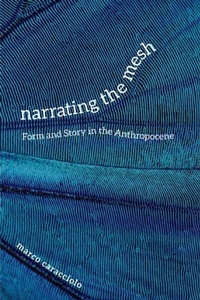
Narrating the Mesh
Description
Alles über E-Books | Antworten auf Fragen rund um E-Books, Kopierschutz und Dateiformate finden Sie in unserem Info- & Hilfebereich.
A hierarchical model of human societies' relations with the natural world is at the root of today's climate crisis; Narrating the Mesh contends that narrative form is instrumental in countering this ideology. Drawing inspiration from Timothy Morton's concept of the "mesh" as a metaphor for the human-nonhuman relationship in the face of climate change, Marco Caracciolo investigates how narratives in genres such as the novel and the short story employ formal devices to effectively channel the entanglement of human communities and nonhuman phenomena.
How can narrative undermine linearity in order to reject notions of unlimited technological progress and economic growth? What does it mean to say that nonhuman materials and processes-from contaminated landscapes to natural evolution-can become characters in stories? And, conversely, how can narrative trace the rising awareness of climate change in the thick of human characters' mental activities? These are some of the questions Narrating the Mesh addresses by engaging with contemporary works by Ted Chiang, Emily St. John Mandel, Richard Powers, Jeff VanderMeer, Jeanette Winterson, and many others. Entering interdisciplinary debates on narrative and the Anthropocene, this book explores how stories can bridge the gap between scientific models of the climate and the human-scale world of everyday experience, powerfully illustrating the complexity of the ecological crisis at multiple levels.
All prices
More details
Other editions
Additional editions
Person
Marco Caracciolo is Associate Professor of English and Literary Theory at Ghent University (Belgium) and author of four books, most recently Embodiment and the Cosmic Perspective in Twentieth-Century Fiction.
Content
Introduction: Narrative and Interlocking Forms
1. Complex Narrative in the Anthropocene
2. The Form of the Butterfly
3. Negative Strategies and Nonlinear Temporality in Postapocalyptic Fiction
4. Five Ways of Looking at Nonhuman Actants
5. Minding the Anthropocene
6. Metaphorical Patterns in Anthropocene Fiction
7. Metaphor, Scale, and the Value of Conceptual Trouble
Coda: Thinking beyond Literary Form
Notes
Works Cited
Index

System requirements
File format: ePUB
Copy protection: Adobe-DRM (Digital Rights Management)
System requirements:
- Computer (Windows; MacOS X; Linux): Install the free reader Adobe Digital Editions prior to download (see eBook Help).
- Tablet/smartphone (Android; iOS): Install the free app Adobe Digital Editions or the app PocketBook before downloading (see eBook Help).
- E-reader: Bookeen, Kobo, Pocketbook, Sony, Tolino and many more (not Kindle).
The file format ePub works well for novels and non-fiction books – i.e., „flowing” text without complex layout. On an e-reader or smartphone, line and page breaks automatically adjust to fit the small displays.
This eBook uses Adobe-DRM, a „hard” copy protection. If the necessary requirements are not met, unfortunately you will not be able to open the eBook. You will therefore need to prepare your reading hardware before downloading.
Please note: We strongly recommend that you authorise using your personal Adobe ID after installation of any reading software.
For more information, see our ebook Help page.
File format: PDF
Copy-Protection: Adobe-DRM (Digital Rights Management)
System requirements:
- Computer (Windows; MacOS X; Linux): Install the free reader Adobe Digital Editions prior to download (see eBook Help).
- Tablet/smartphone (Android; iOS): Install the free app Adobe Digital Editions or the app PocketBook before downloading (see eBook Help).
- E-reader: Bookeen, Kobo, Pocketbook, Sony, Tolino and many more (only limited: Kindle).
The file format PDF always displays a book page identically on any hardware. This makes PDF suitable for complex layouts such as those used in textbooks and reference books (images, tables, columns, footnotes). Unfortunately, on the small screens of e-readers or smartphones, PDFs are rather annoying, requiring too much scrolling.
This eBook uses Adobe-DRM, a „hard” copy protection. If the necessary requirements are not met, unfortunately you will not be able to open the eBook. You will therefore need to prepare your reading hardware before downloading.
Please note: We strongly recommend that you authorise using your personal Adobe ID after installation of any reading software.
For more information, see our eBook Help page.
File format: ePUB
Copy protection: without DRM (Digital Rights Management)
System requirements:
- Computer (Windows; MacOS X; Linux): Use a reader that can handle the file format ePUB, such as Adobe Digital Editions or FBReader – both free (see eBook Help).
- Tablet/Smartphone (Android; iOS): Install the free app Adobe Digital Editions or the app PocketBook (see eBook Help).
- E-reader: Bookeen, Kobo, Pocketbook, Sony, Tolino and many more (not Kindle).
The file format ePUB works well for novels and non-fiction books – i.e., 'flowing' text without complex layout. On an e-reader or smartphone, line and page breaks automatically adjust to fit the small displays.
This eBook does not use copy protection or Digital Rights Management
For more information, see our eBook Help page.
