

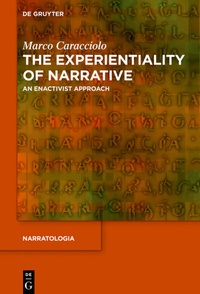
The Experientiality of Narrative
Description

Recent developments in cognitive narrative theory have called attention to readers' active participation in making sense of narrative. However, while most psychologically inspired models address interpreters' subpersonal (i.e., unconscious) responses, the experiential level of their engagement with narrative remains relatively undertheorized. Building on theories of experience and embodiment within today's "second-generation" cognitive science, and opening a dialogue with so-called "enactivist" philosophy, this book sets out to explore how narrative experiences arise from the interaction between textual cues and readers' past experiences. Caracciolo's study offers a phenomenologically inspired account of narrative, spanning a wide gamut of responses such as the embodied dynamic of imagining a fictional world, empathetic perspective-taking in relating to characters, and "higher-order" evaluations and interpretations. Only by placing a premium on how such modes of engagement are intertwined in experience, Caracciolo argues, can we do justice to narrative's psychological and existential impact on our lives. These insights are illustrated through close readings of literary texts ranging from Émile Zola's Germinal to José Saramago's Blindness .
More details
Other editions
Additional editions
Person
Content
- Intro
- Contents
- 0 Introduction
- 0.1 Out of Which Hat
- 0.2 Why Experience, and Why This Book
- 0.3 Why This Book Is Not an Empirical Study
- 0.4 Cognitive Science: A Thumbnail Sketch
- 0.4.1 From Computational Models to Enactivism
- 0.4.2 Conceptual Thought and Embodiment
- 0.4.3 The Self, Folk Psychology, and Phenomenology
- 0.5 Outline of Chapters
- Part I: Notes for a Theory of Experientiality
- 1 Not So Easy: Representation, Experience, Expression
- 1.1 From Representation to Expression
- 1.2 On Characters' Experiences
- 1.3 Expressive Devices
- 2 The Existential Burn: Storytelling and the Background
- 2.1 The Network of Experientiality
- 2.2 Focus on the Experiential Background
- 2.2.3 Opening Moves
- 2.2.3 Mapping the Background
- 2.2.3 Narrative and the Background
- 3 Experience, Interaction, and Play in Julio Cortázar's Hopscotch
- 3.1 Dewey and Winnicott on Experience
- 3.2 A Third Possibility
- 3.3 Other Paths: Beyond Vertical Transcendence
- 3.4 Bringing the Strands Together
- Part II: From Experiential Traces to Fictional Consciousnesses
- 4 Blind Reading: Bodily and Perceptual Responses to Narrative
- 4.1 The Enactivist Theory of Experience
- 4.2 Enacting Narrative Space
- 4.3 Enacting Characters' Bodily-Perceptual Experiences
- 4.4 Enacting Qualia Through Metaphorical Language
- 5 Fictional Consciousnesses: From Attribution to Enactment
- 5.1 Consciousness-Attribution
- 5.2 Enacting Benjy: A Slow-Motion Analysis
- 5.3 Consciousness-Enactment
- 5.3.1 What Is Consciousness-Enactment?
- 5.3.2 Triggers of Consciousness-Enactment
- 5.3.3 Mental Simulation as the Cognitive Basis for Consciousness- Enactment
- 6 Fictional Consciousnesses: Self-Narratives and Intersubjectivity
- 6.1 Narrative Selves?
- 6.2 Focus on Self-Narratives
- 6.3 Engaging with Characters: Between Primary and Secondary Intersubjectivity
- 6.4 Readers and Characters in Ian McEwan's On Chesil Beach: A Case Study
- Part III: Embodied Engagements and Their Effects
- 7 Embodiment, Virtuality, and Meaning in Readers' Reconstruction of Narrative Space
- 7.1 From Mental Simulation to Fictionalization
- 7.2 Fictional Anchors: Forster's Deputy Focalizor and "Strict" Focalization
- 7.3 Virtual Presences: "Empty Center" and Aperspectival Texts
- 7.4 A Scale of Fictionalization
- 7.5 The Embodied Self and Beckett's Company
- 8 Mental Myopia: Narrative Patterns and Experiential Texture in Vladimir Nabokov's The Defense
- 8.1 From Chess Consciousness to Experiential Blindness
- 8.2 The Moves of His Life
- 8.3 Beyond?
- 8.4 Three Functions of Narrative: Overreading The Defense
- 9 Conclusion: Where to Go from Here?
- Works Cited
- Index
