

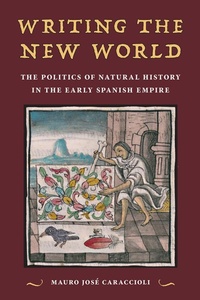
Writing the New World
Description

This book is freely available in an open access edition thanks to TOME (Toward an Open Monograph Ecosystem)?a collaboration of the Association of American Universities, the Association of University Presses, and the Association of Research Libraries?and the generous support of Virginia Tech.
International Studies Association Theory Section Best Book Award
Finalist, Environmental Humanities Category, ACLS Open Access Book Prize and Arcadia Open Access Publishing Award
In Writing the New World, Mauro Caraccioli examines the natural history writings of early Spanish missionaries, using these texts to argue that colonial Latin America was fundamental in the development of modern political thought. Revealing their narrative context, religious ideals, and political implications, Caraccioli shows how these sixteenth-century works promoted a distinct genre of philosophical wonder in service of an emerging colonial social order.
Caraccioli discusses narrative techniques employed by well-known figures such as Gonzalo Fernández de Oviedo and Bartolomé de Las Casas as well as less-studied authors including Bernardino de Sahagún, Francisco Hernández, and José de Acosta. More than mere catalogues of the natural wonders of the New World, these writings advocate mining and molding untapped landscapes, detailing the possibilities for extracting not just resources from the land but also new moral values from indigenous communities. Analyzing the intersections between politics, science, and faith that surface in these accounts, Caraccioli shows how the portrayal of nature served the ends of imperial domination.
Integrating the fields of political theory, environmental history, Latin American literature, and religious studies, this book showcases Spain's role in the intellectual formation of modernity and Latin America's place as the crucible for the Scientific Revolution. Its insights are also relevant to debates about the interplay between politics and environmental studies in the Global South today.
More details
Other editions
Additional editions
Person
Content
- Cover
- Half Title
- Title
- Copyright
- Dedication
- Contents
- List of Illustrations
- Acknowledgments
- Opening: Of Nature and Other Demons
- 1. Narratives of Conquest and the Conquest of Narrative
- 2. Oviedo, Las Casas, and the Difference That Made Nature
- 3. The Anthropolitics of Bernardino de Sahagún
- 4. The Imperial Renaissance of Francisco Hernández
- 5. José de Acosta and the Ends of Empire
- Epilogue: Toward a Natural History of Colonial Domination
- Notes
- Bibliography
- Index
- A
- B
- C
- D
- E
- F
- G
- H
- I
- J
- K
- L
- M
- N
- O
- P
- R
- S
- T
- U
- V
- W
- X
- Y
