

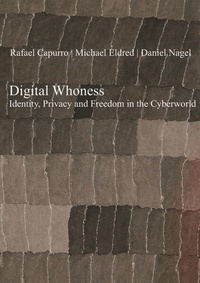
Digital Whoness
Identity, Privacy and Freedom in the Cyberworld
1st Edition
Published on 2. May 2013
310 pages
978-3-11-032042-8 (ISBN)
Description

The first aim is to provide well-articulated concepts by thinking through elementary phenomena of today's world, focusing on privacy and the digital, to clarify who we are in the cyberworld - hence a phenomenology of digital whoness. The second aim is to engage critically, hermeneutically with older and current literature on privacy, including in today's emerging cyberworld. Phenomenological results include concepts of i) self-identity through interplay with the world, ii) personal privacy in contradistinction to the privacy of private property, iii) the cyberworld as an artificial, digital dimension in order to discuss iv) what freedom in the cyberworld can mean, whilst not neglecting v) intercultural aspects and vi) the EU context.
More details
Other editions
Additional editions
Rafael Capurro | Michael Eldred | Daniel Nagel
Digital Whoness
Identity, Privacy and Freedom in the Cyberworld
Book
12/2012
1st Edition
De Gruyter
€124.95
Shipment within 7-9 days
Content
1 - Acknowledgement [Seite 13]
2 - 0 Introduction [Seite 15]
2.1 - 0.1 The significance of a phenomenology of whoness as the startingpoint for discussing the question concerning privacy and freedom in the internet [Seite 17]
2.2 - 0.2 A provisional stocktaking of the discussion in information ethics on privacy and freedom in the internet age [Seite 19]
2.3 - 0.3 Course of the investigation [Seite 21]
3 - 1 Phenomenology of whoness: identity, privacy, trust and freedom [Seite 25]
3.1 - 1.1 The trace of whoness starts with the Greeks [Seite 25]
3.2 - 1.2 Selfhood as an identification with reflections from the world [Seite 28]
3.3 - 1.3 Values, ethos, ethics [Seite 33]
3.4 - 1.4 The question concerning rights: personal privacy, trust and intimacy [Seite 37]
3.5 - 1.5 The private individual, liberty, private property (Locke) [Seite 42]
3.6 - 1.6 The private individual and private property as a mode of reified sociation: the gainful game (classical political economy, Marx) [Seite 48]
3.7 - 1.7 Trust as the gainful game's element and the privacy of private property [Seite 54]
3.8 - 1.8 Justice and state protection of privacy [Seite 59]
3.9 - 1.9 Kant's free autonomous subject and privatio in the use of reason [Seite 65]
3.10 - 1.10 Privacy as protection of individual autonomy - On Rössler's The Value of Privacy [Seite 71]
3.11 - 1.11 Arendt on whoness in the world [Seite 85]
3.11.1 - 1.11.1 Arendt's discovery of the plurality of whos in The Human Condition [Seite 85]
3.11.2 - 1.11.2 The question concerning whoness as the key question of social ontology [Seite 90]
3.11.3 - 1.11.3 The untenability of the distinction between labour, work and action [Seite 98]
3.11.4 - 1.11.4 Whoness and the gainful game [Seite 104]
3.11.5 - 1.11.5 Public and private realms? [Seite 107]
3.12 - 1.12 Recapitulation and outlook [Seite 111]
4 - 2 Digital ontology [Seite 113]
4.1 - 2.1 From the abstraction from physical beings to their digital representation [Seite 114]
4.2 - 2.2 Mathematical access to the movement of physical beings [Seite 116]
4.3 - 2.3 The mathematical conception of linear, continuous time [Seite 119]
4.4 - 2.4 Outsourcing of the arithmologos as digital code [Seite 120]
4.5 - 2.5 The parallel cyberworld that fits like a glove [Seite 122]
4.5.1 - 2.5.1 Cyberspace [Seite 128]
4.5.2 - 2.5.2 Cybertime [Seite 129]
5 - 3 Digital whoness in connection with privacy, publicness and freedom [Seite 133]
5.1 - 3.1 Digital identity - a number? [Seite 133]
5.2 - 3.2 Digital privacy: personal freedom to reveal and conceal [Seite 138]
5.3 - 3.3 Protection of private property in the cyberworld [Seite 141]
5.4 - 3.4 Cyber-publicness [Seite 149]
5.5 - 3.5 Freedom in the cyberworld [Seite 155]
5.5.1 - 3.5.1 The cyberworld frees itself first of all [Seite 155]
5.5.2 - 3.5.2 The gainful game unleashes its freedom in the cyberworld [Seite 160]
5.5.3 - 3.5.3 Human freedom in the cyberworld [Seite 162]
5.6 - 3.6 Assessing Tavani's review of theories and issues concerning personal privacy [Seite 163]
5.7 - 3.7 An appraisal of Nissenbaum's Privacy in Context [Seite 174]
5.8 - 3.8 Floridi's metaphysics of the threefold-encapsulated subject in a world conceived as infosphere [Seite 184]
5.8.1 - 3.8.1 The purported "informational nature of personal identity" [Seite 184]
5.8.2 - 3.8.2 Floridi's purportedly "ontological interpretation of informational privacy" [Seite 198]
5.9 - 3.9 On Charles Ess' appraisal of Floridi's information ethics [Seite 203]
5.9.1 - 3.9.1 Informational ontology [Seite 205]
5.9.2 - 3.9.2 Informational privacy [Seite 207]
5.9.3 - 3.9.3 Getting over the subject-object split [Seite 210]
5.10 - 3.10 Beavers' response to an objection by Floridi to AI by reverting to Husserlian subjectivist phenomenology [Seite 211]
6 - 4 Intercultural aspects of digitally mediated whoness, privacy and freedom [Seite 217]
6.1 - 4.1 Privacy and publicness from an intercultural viewpoint [Seite 217]
6.2 - 4.2 The Far East [Seite 219]
6.2.1 - 4.2.1 Japan [Seite 219]
6.2.2 - 4.2.2 Thailand [Seite 224]
6.2.3 - 4.2.3 China [Seite 227]
6.3 - 4.3 Latin America [Seite 230]
6.4 - 4.4 Africa [Seite 236]
6.5 - 4.5 Conclusion [Seite 238]
7 - 5 Cyberworld, privacy and the EU [Seite 241]
7.1 - 5.1 European integration, freedom, economics [Seite 241]
7.2 - 5.2 The European Convention for the Protection of Human Rights and Fundamental Freedoms [Seite 245]
7.3 - 5.3 The International Covenant on Civil and Political Rights [Seite 249]
7.4 - 5.4 The Council of Europe Resolution on the protection of the privacy of individuals vis-à-vis electronic data banks in the private and public sectors [Seite 251]
7.5 - 5.5 The Convention for the Protection of Individuals with regard to Automatic Processing of Personal Data and the OECD Guidelines on the Protection of Privacy and Transborder Flows of Personal Data [Seite 254]
7.6 - 5.6 Directive 95/46/EC [Seite 259]
7.7 - 5.7 Directive 2002/58/EC [Seite 271]
7.8 - 5.8 Communication (2010) 609 [Seite 275]
7.9 - 5.9 Draft Regulation COM (2012) 11 final [Seite 278]
7.10 - 5.10 Conclusion - a watertight approach? [Seite 282]
8 - 6 Brave new cyberworld [Seite 287]
8.1 - 6.1 What's coming [Seite 287]
8.2 - 6.2 e-Commerce [Seite 289]
8.3 - 6.3 Forgetfulness [Seite 293]
9 - 7 Bibliography [Seite 295]
10 - 8 Name index [Seite 313]
2 - 0 Introduction [Seite 15]
2.1 - 0.1 The significance of a phenomenology of whoness as the startingpoint for discussing the question concerning privacy and freedom in the internet [Seite 17]
2.2 - 0.2 A provisional stocktaking of the discussion in information ethics on privacy and freedom in the internet age [Seite 19]
2.3 - 0.3 Course of the investigation [Seite 21]
3 - 1 Phenomenology of whoness: identity, privacy, trust and freedom [Seite 25]
3.1 - 1.1 The trace of whoness starts with the Greeks [Seite 25]
3.2 - 1.2 Selfhood as an identification with reflections from the world [Seite 28]
3.3 - 1.3 Values, ethos, ethics [Seite 33]
3.4 - 1.4 The question concerning rights: personal privacy, trust and intimacy [Seite 37]
3.5 - 1.5 The private individual, liberty, private property (Locke) [Seite 42]
3.6 - 1.6 The private individual and private property as a mode of reified sociation: the gainful game (classical political economy, Marx) [Seite 48]
3.7 - 1.7 Trust as the gainful game's element and the privacy of private property [Seite 54]
3.8 - 1.8 Justice and state protection of privacy [Seite 59]
3.9 - 1.9 Kant's free autonomous subject and privatio in the use of reason [Seite 65]
3.10 - 1.10 Privacy as protection of individual autonomy - On Rössler's The Value of Privacy [Seite 71]
3.11 - 1.11 Arendt on whoness in the world [Seite 85]
3.11.1 - 1.11.1 Arendt's discovery of the plurality of whos in The Human Condition [Seite 85]
3.11.2 - 1.11.2 The question concerning whoness as the key question of social ontology [Seite 90]
3.11.3 - 1.11.3 The untenability of the distinction between labour, work and action [Seite 98]
3.11.4 - 1.11.4 Whoness and the gainful game [Seite 104]
3.11.5 - 1.11.5 Public and private realms? [Seite 107]
3.12 - 1.12 Recapitulation and outlook [Seite 111]
4 - 2 Digital ontology [Seite 113]
4.1 - 2.1 From the abstraction from physical beings to their digital representation [Seite 114]
4.2 - 2.2 Mathematical access to the movement of physical beings [Seite 116]
4.3 - 2.3 The mathematical conception of linear, continuous time [Seite 119]
4.4 - 2.4 Outsourcing of the arithmologos as digital code [Seite 120]
4.5 - 2.5 The parallel cyberworld that fits like a glove [Seite 122]
4.5.1 - 2.5.1 Cyberspace [Seite 128]
4.5.2 - 2.5.2 Cybertime [Seite 129]
5 - 3 Digital whoness in connection with privacy, publicness and freedom [Seite 133]
5.1 - 3.1 Digital identity - a number? [Seite 133]
5.2 - 3.2 Digital privacy: personal freedom to reveal and conceal [Seite 138]
5.3 - 3.3 Protection of private property in the cyberworld [Seite 141]
5.4 - 3.4 Cyber-publicness [Seite 149]
5.5 - 3.5 Freedom in the cyberworld [Seite 155]
5.5.1 - 3.5.1 The cyberworld frees itself first of all [Seite 155]
5.5.2 - 3.5.2 The gainful game unleashes its freedom in the cyberworld [Seite 160]
5.5.3 - 3.5.3 Human freedom in the cyberworld [Seite 162]
5.6 - 3.6 Assessing Tavani's review of theories and issues concerning personal privacy [Seite 163]
5.7 - 3.7 An appraisal of Nissenbaum's Privacy in Context [Seite 174]
5.8 - 3.8 Floridi's metaphysics of the threefold-encapsulated subject in a world conceived as infosphere [Seite 184]
5.8.1 - 3.8.1 The purported "informational nature of personal identity" [Seite 184]
5.8.2 - 3.8.2 Floridi's purportedly "ontological interpretation of informational privacy" [Seite 198]
5.9 - 3.9 On Charles Ess' appraisal of Floridi's information ethics [Seite 203]
5.9.1 - 3.9.1 Informational ontology [Seite 205]
5.9.2 - 3.9.2 Informational privacy [Seite 207]
5.9.3 - 3.9.3 Getting over the subject-object split [Seite 210]
5.10 - 3.10 Beavers' response to an objection by Floridi to AI by reverting to Husserlian subjectivist phenomenology [Seite 211]
6 - 4 Intercultural aspects of digitally mediated whoness, privacy and freedom [Seite 217]
6.1 - 4.1 Privacy and publicness from an intercultural viewpoint [Seite 217]
6.2 - 4.2 The Far East [Seite 219]
6.2.1 - 4.2.1 Japan [Seite 219]
6.2.2 - 4.2.2 Thailand [Seite 224]
6.2.3 - 4.2.3 China [Seite 227]
6.3 - 4.3 Latin America [Seite 230]
6.4 - 4.4 Africa [Seite 236]
6.5 - 4.5 Conclusion [Seite 238]
7 - 5 Cyberworld, privacy and the EU [Seite 241]
7.1 - 5.1 European integration, freedom, economics [Seite 241]
7.2 - 5.2 The European Convention for the Protection of Human Rights and Fundamental Freedoms [Seite 245]
7.3 - 5.3 The International Covenant on Civil and Political Rights [Seite 249]
7.4 - 5.4 The Council of Europe Resolution on the protection of the privacy of individuals vis-à-vis electronic data banks in the private and public sectors [Seite 251]
7.5 - 5.5 The Convention for the Protection of Individuals with regard to Automatic Processing of Personal Data and the OECD Guidelines on the Protection of Privacy and Transborder Flows of Personal Data [Seite 254]
7.6 - 5.6 Directive 95/46/EC [Seite 259]
7.7 - 5.7 Directive 2002/58/EC [Seite 271]
7.8 - 5.8 Communication (2010) 609 [Seite 275]
7.9 - 5.9 Draft Regulation COM (2012) 11 final [Seite 278]
7.10 - 5.10 Conclusion - a watertight approach? [Seite 282]
8 - 6 Brave new cyberworld [Seite 287]
8.1 - 6.1 What's coming [Seite 287]
8.2 - 6.2 e-Commerce [Seite 289]
8.3 - 6.3 Forgetfulness [Seite 293]
9 - 7 Bibliography [Seite 295]
10 - 8 Name index [Seite 313]
