

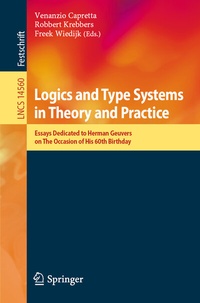
Logics and Type Systems in Theory and Practice
Description

This Festschrift, dedicated to Herman Geuvers on the occasion of his 60th birthday, contains papers written by many of his closest collaborators.
Herman Geuvers is a full professor at Radboud University Nijmegen and holds a part-time professorship at Eindhoven University of Technology. He received his PhD from Radboud University in 1993 and he was promoted to full professor in Computer Assisted Reasoning in 2006. Prof. Geuvers is an internationally renowned researcher in the field of proof assistants, logic in computer science, lambda calculus, and type theory. He has been a steering committee chair of the TYPES and FSCD conferences, chair of related EU Cost Action projects, and program chair or editor of related conferences and special issues in the area of computer science logic. He is a successful, generous and inspiring advisor and educator. He has been director of education and director of research of the Computer Science Institute at Radboud University Nijmegen, and he is currently chair of the examination board of computer science and chair of the board of the Institute for Programming Research and Algorithmics, a Dutch national inter-university research school.
The contributions in this volume reflect Prof. Geuvers' main research interests.
More details
Other editions
Additional editions
Content
- Intro
- Preface
- List of Expert Reviewers
- Contents
- Sequential Value Passing Yields a Kleene Theorem for Processes
- 1 Introduction
- 2 Preliminaries
- 3 Regular Expressions
- 4 Signals and Conditions
- 5 Sequencing
- 6 Pushdown Processes
- 7 Conclusion
- References
- YACC: Yet Another Church Calculus
- 1 Introduction
- 2 Syntax of TIC
- 3 Type Reconstruction
- 4 Operational Semantics of TIC
- 5 Relations with Intersection Type Assignment Systems
- 6 Related Works and Conclusion
- References
- Safe Smooth Paths Between Straight Line Obstacles
- 1 Introduction
- 2 A Combination of Algorithms
- 3 Producing a Sequence of Events
- 4 Producing Cells
- 5 Making a Broken Line Trajectory Between Two Points
- 6 Making a Smooth Trajectory
- 7 Exploiting the Program and Visual Feedback
- 8 Future Work
- 9 Related Work
- 10 Conclusion
- References
- Learning Guided Automated Reasoning: A Brief Survey
- 1 Introduction
- 2 Early History
- 3 Characterization of Mathematical Knowledge
- 3.1 Syntactic Features
- 3.2 ENIGMA Syntactic Features
- 3.3 More Semantic Features
- 3.4 Characterization Using Neural Networks
- 4 Premise Selection
- 4.1 k-Nearest Neighbors (k-NN)
- 4.2 Naive Bayes
- 4.3 Decision Trees
- 4.4 Neural Methods
- 5 Guidance of Saturation-Based ATPs
- 6 Guidance of Tableaux and Instantiation-Based ATPs
- 7 Tactic Based ITP Guidance
- 7.1 Overview
- 7.2 Advantages of Tactic-Based ITP Guidance
- 7.3 Challenges in Tactic-Based ITP Guidance
- 8 Related Symbolic Classification Problems
- 9 Conclusion
- References
- Approximation Fixpoint Theory in Coq
- 1 Introduction
- 2 Ordinals and Lattices
- 3 Approximators and Fixpoints
- 4 An Example: Propositional Logic Programming
- 5 Related Work
- 6 Conclusions
- References
- Constructing Morphisms for Arithmetic Subsequences of Fibonacci
- 1 Introduction
- 2 Preliminaries and Main Result
- 3 Fibonacci Numbers
- 4 Fibonacci Morphism
- 5 Proof of the Theorem
- 6 Examples
- 7 Further Remarks
- References
- A Variation of Reynolds-Hurkens Paradox
- 1 Introduction
- 2 Some Paradoxes in Minimal Higher-Order Logic
- 2.1 A Variation of Russell's Paradox
- 2.2 A Refinement
- 3 An Encoding in U-
- 3.1 Weak Representation of Data Type
- 3.2 Some Variations
- 4 Computational Behavior
- 4.1 Family of Looping Combinators
- 4.2 Definitions and Head Linear Reduction
- 5 Conclusion
- References
- Between Brackets
- 1 Introduction
- 1.1 Constants Between Matching Brackets
- 1.2 Matching Brackets Between Constants
- 1.3 Two Brackets Between Constants
- 2 Strings and Terms
- 3 Context-Free Languages Representing Terms
- 3.1 Languages for Terms
- 3.2 Notations
- 3.3 Polish Notations
- 4 Circular Embedded Trees
- 4.1 Dual Structure
- 4.2 Dual and Weak Dual Graphs
- 4.3 Squaregraphs
- 5 Conclusion
- References
- Some Probabilistic Riddles and Some Logical Solutions
- 1 Introduction
- 2 Preliminaries
- 3 Hard Conditional Probability Problem
- 4 Probability of Second Girl Child
- 5 Tricky Probability Interview Puzzle
- 6 Life or Death
- 7 Paradox Probability Puzzle
- 8 Tricky Problem on Probability
- References
- It's All a Game
- 1 Introduction
- 2 Preliminaries
- 2.1 Bisimulation Games
- 2.2 Apartness
- 3 From Bisimulation Games to Apartness and Back
- 3.1 Spoiler-Strategies Constructed from Apartness Proofs
- 3.2 Spoiler-Strategy Induced Deductive Proofs of Apartness
- 4 Conclusions and Future Work
- References
- Multisets and Distributions
- 1 Introduction
- 2 The Distribution and Multiset Monads
- 3 Lists and Distributions
- 3.1 A Distributive Law L:LFFL
- 3.2 The Parikh Map #:LM
- 3.3 A Distributive Law M:MFFM
- 4 A General Result
- 5 Conclusion
- A Extra Proofs
- A.1 L:LFFL Is a Distributive Law
- A.2 Conditions of Theorem 3
- References
- Minimal Depth Distinguishing Formulas Without Until for Branching Bisimulation
- 1 Introduction
- 2 Preliminaries
- 3 A Hennessy-Milner Theorem
- 4 Computing Minimal Depth Distinguishing Formulas
- 4.1 Implementation Details and Example
- References
- Relating Apartness and Branching Bisimulation Games
- 1 Introduction
- 2 Strong Bisimilarity
- 3 Branching Bisimilarity
- 4 Future Work
- References
- Fixed Point Theorems in Computability Theory
- 1 Introduction
- 2 The Second Recursion Theorem
- 3 Partial Combinatory Algebra
- 4 The Theory of Numberings
- 5 Overview
- 6 Fixed Point Free Functions and Arslanov's Completeness Criterion
- 7 Further Generalizations
- 8 Effectiveness and Other Remarks
- References
- A New Perspective on Conformance Testing Based on Apartness
- 1 Introduction
- 2 Partial Mealy Machines and Apartness
- 3 Main Result
- 4 Deriving Previous k-Completeness Results
- 5 Conclusions and Future Work
- References
- The Interval Domain in Homotopy Type Theory
- 1 Introduction
- 2 Preliminaries on Domain Theory
- 2.1 (Continuous) DCPOs
- 2.2 Scott Topology and Apartness
- 2.3 Strongly Maximal Elements
- 3 The Interval Domain
- 4 Strong Maximality and Locatedness
- 5 Real Arithmetic
- 6 Arithmetic Laws
- 7 Conclusions and Related Work
- References
- Characterizing Morphic Sequences
- 1 Introduction
- 2 Notation and Preliminaries
- 3 Tree Structures of Morphic Sequences
- 4 Morphic Sequences Characterized by Automata
- 5 Morphic Sequences Characterized by Subsequences
- 6 Morphic Sequences Characterized by Rational Infinite Terms
- 7 Morphic Sequences Characterized by Infinitary Rewriting
- 8 Conclusions
- References
- Author Index
