

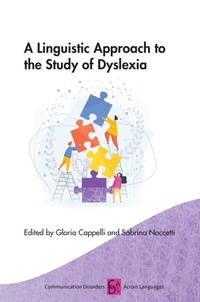
A Linguistic Approach to the Study of Dyslexia
Published on 19. August 2022
358 pages
978-1-80041-598-0 (ISBN)
Description

This volume contributes to the growing body of research on developmental dyslexia, focusing on the disorder's behavioural manifestations at different levels of the language system. It is organised into three sections that cover the three main vantage points from which the effects of dyslexia on communication can be observed: neuropsychology, linguistics and the perspective of educators. Together, the chapters provide an insightful overview of the ways in which dyslexia impacts different components of language, including lexical and pragmatic abilities, and present data from experimental and applied research, with suggestions for the application of research-based data in both innovative and traditional language teaching, ways to rehabilitate reading dysfunctions, as well as teacher training. The book will be essential reading for researchers and students investigating dyslexia, as well as foreign language teachers and professionals who work on the rehabilitation of linguistic performance dysfunctions in people with dyslexia.
Reviews / Votes
What is the contribution of linguistics to the study of dyslexia? This is the question that this book tries to answer, bringing together quality research papers and original experimental reports in a must-read volume that offers food for thought to scholars, educators, careers, and clinicians alike. * Marcella Bertuccelli Papi, University of Pisa, Italy * This is a great resource, offering insights into the precise parts of language that may be impacted by developmental dyslexia, while also attempting to identify plausible causes for such issues and forecasting the route of linguistic development. It provides unique perspectives of interest to a wide, international audience including both practitioners and researchers. * Stefania M. Maci, University of Bergamo, Italy * This excellent collection provides novel insights into the effects of dyslexia on second language learning and the linguistic challenges of dyslexic individuals from different first language backgrounds. It is an ideal resource for researchers in the fields of first and second language acquisition, bi- and multilingualism and language disorders, as well as for teachers of additional languages and language teacher educators. * Judit Kormos, Lancaster University, UK *More details
Series
Language
English
Place of publication
Bristol
United Kingdom
Target group
College/higher education
Product notice
Reflowable
ISBN-13
978-1-80041-598-0 (9781800415980)
Copyright in bibliographic data and cover images is held by Nielsen Book Services Limited or by the publishers or by their respective licensors: all rights reserved.
Schweitzer Classification
Other editions
Additional editions
Gloria Cappelli | Sabrina Noccetti
A Linguistic Approach to the Study of Dyslexia
Book
05/2025
Multilingual Matters
€57.70
Shipment within 10-20 days
Gloria Cappelli | Sabrina Noccetti
A Linguistic Approach to the Study of Dyslexia
Book
08/2022
Multilingual Matters
€185.80
Shipment within 10-20 days
Persons
Gloria Cappelli is Associate Professor of English Linguistics at the University of Pisa, Italy. She serves on the editorial board of several journals and book series including Education, Language and Communication Studies, Insights, The English Bookshelf and Multimodality of Communication.
Sabrina Noccetti is Assistant Professor of English Linguistics at the University of Pisa, Italy. Her research interests include language learning, dyslexia, morphology, semantics and pragmatics.
Sabrina Noccetti is Assistant Professor of English Linguistics at the University of Pisa, Italy. Her research interests include language learning, dyslexia, morphology, semantics and pragmatics.
Content
Gloria Cappelli and Sabrina Noccetti: Introduction
Part 1: Psychological and Neurobiological Foundations of Language Skills in People with Dyslexia
Chapter 1. Enrico Ghidoni: The Neurobiological Basis of Language Skills and Dyslexia
Chapter 2. Claudia Casalini, Daniela Brizzolara, Anna Maria Chilosi, Filippo Gasperini and Chiara Pecini: Late Effects of Early Language Delay on Complex Language and Literacy Abilities: A Clinical Approach to Dyslexia in
Subjects with a Previous Language Impairment
Chapter 3. Filippo Gasperini: Foreign Language Learning Difficulties in Developmental Dyslexia: A Narrative Review of the Existing Evidence
Part 2: Theoretical and Experimental Linguistic Research on Dyslexia
Chapter 4. Marijan Palmovic, Ana Matic, Mirta Zelenika Zeba, Melita Kovacevic: Phonological and Lexical Effects on Reading in Dyslexia
Chapter 5. Cristina Burani: Morphemes as Reading and Spelling Units in Developmental Dyslexia
Chapter 6. Rachel Berthiaume, Amelie Bourcier and Daniel Daigle: Morphological Knowledge in French-speaking Children with Dyslexia
Chapter 7. Giovanna Marotta: Developmental Dyslexia and Morphosyntactic Competence in Italian Young Adults
Chapter 8. Anna Cardinaletti, Elisa Piccoli and Francesca Volpato: Dyslexia and Syntactic Deficits: Overview and a Case Study of Language Training
Chapter 9. Gloria Cappelli: The Impact of Dyslexia on Lexico-Semantic Skills: An Overview
Chapter 10. Gloria Cappelli, Sabrina Noccetti, Nicoletta Simi, Giorgio Arcara and Valentina Bambini: Dyslexia and Pragmatic Skills
Part 3: Applied Linguistic Research and Dyslexia
Chapter 11. Sabrina Noccetti: Visual and Auditory Stimuli for Teaching EFL Vocabulary to Learners with Dyslexia
Chapter 12. Francesca Santulli and Melissa Scagnelli: Reading as a Multi-Layer Activity: Training Strategies at Text Level
Chapter 13. Rossella Iovino: Teaching Latin to Dyslexic Learners: A Methodological Proposal
Chapter 14. Joanna Nijakowska: Foreign Language Teacher Training and Preparedness to Teach Learners with Dyslexia
Index
Part 1: Psychological and Neurobiological Foundations of Language Skills in People with Dyslexia
Chapter 1. Enrico Ghidoni: The Neurobiological Basis of Language Skills and Dyslexia
Chapter 2. Claudia Casalini, Daniela Brizzolara, Anna Maria Chilosi, Filippo Gasperini and Chiara Pecini: Late Effects of Early Language Delay on Complex Language and Literacy Abilities: A Clinical Approach to Dyslexia in
Subjects with a Previous Language Impairment
Chapter 3. Filippo Gasperini: Foreign Language Learning Difficulties in Developmental Dyslexia: A Narrative Review of the Existing Evidence
Part 2: Theoretical and Experimental Linguistic Research on Dyslexia
Chapter 4. Marijan Palmovic, Ana Matic, Mirta Zelenika Zeba, Melita Kovacevic: Phonological and Lexical Effects on Reading in Dyslexia
Chapter 5. Cristina Burani: Morphemes as Reading and Spelling Units in Developmental Dyslexia
Chapter 6. Rachel Berthiaume, Amelie Bourcier and Daniel Daigle: Morphological Knowledge in French-speaking Children with Dyslexia
Chapter 7. Giovanna Marotta: Developmental Dyslexia and Morphosyntactic Competence in Italian Young Adults
Chapter 8. Anna Cardinaletti, Elisa Piccoli and Francesca Volpato: Dyslexia and Syntactic Deficits: Overview and a Case Study of Language Training
Chapter 9. Gloria Cappelli: The Impact of Dyslexia on Lexico-Semantic Skills: An Overview
Chapter 10. Gloria Cappelli, Sabrina Noccetti, Nicoletta Simi, Giorgio Arcara and Valentina Bambini: Dyslexia and Pragmatic Skills
Part 3: Applied Linguistic Research and Dyslexia
Chapter 11. Sabrina Noccetti: Visual and Auditory Stimuli for Teaching EFL Vocabulary to Learners with Dyslexia
Chapter 12. Francesca Santulli and Melissa Scagnelli: Reading as a Multi-Layer Activity: Training Strategies at Text Level
Chapter 13. Rossella Iovino: Teaching Latin to Dyslexic Learners: A Methodological Proposal
Chapter 14. Joanna Nijakowska: Foreign Language Teacher Training and Preparedness to Teach Learners with Dyslexia
Index
