

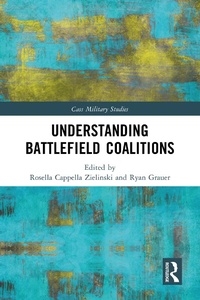
Understanding Battlefield Coalitions
1st Edition
Published on 11. September 2023
272 pages
978-1-000-95347-3 (ISBN)
Description

This book improves our understanding of battlefield coalitions, providing novel theoretical and empirical insight into their nature and capabilities, as well as the military and political consequences of their combat operations.
The volume provides the first dataset of battlefield coalitions, uses primary sources to understand how non-state actors of varying types form such groupings, reports interviews with policymakers illuminating North Atlantic Treaty Organization operations, and uses cases studies of various wars waged throughout the nineteenth, twentieth, and twenty-first centuries to understand how other such collectives have operated. Part I introduces battlefield coalitions as an object of study, demonstrating how they are distinct from other wartime collectives. Using a novel dataset of actors fighting in 492 battles during interstate wars waged between 1900 and 2003, it provides, for the first time, a comprehensive portrait of the universe of battlefield coalitions. Part II explores processes and dynamics involved in the formation of battlefield coalitions, addressing how potential coalition members prepare for future battles in peacetime (as well as the consequences of such preparations) and the dynamics of mission design. Part III focuses on how battlefield coalitions are organised and fight when combat ensues, notably their decision-making rules and practices, command structures, and learning capacities. Part IV addresses three curious tendencies observed in the operations of battlefield coalitions: partners under-providing effort in combat, rebels and terrorist networks persisting in cooperation even when their interests diverge, and members defecting from the collective. Part V concludes with a chapter outlining for future researchers what we know about battlefield coalitions and what remains to be understood.
This book will be of much interest to students of military and strategic studies, defence studies and International Relations.
The volume provides the first dataset of battlefield coalitions, uses primary sources to understand how non-state actors of varying types form such groupings, reports interviews with policymakers illuminating North Atlantic Treaty Organization operations, and uses cases studies of various wars waged throughout the nineteenth, twentieth, and twenty-first centuries to understand how other such collectives have operated. Part I introduces battlefield coalitions as an object of study, demonstrating how they are distinct from other wartime collectives. Using a novel dataset of actors fighting in 492 battles during interstate wars waged between 1900 and 2003, it provides, for the first time, a comprehensive portrait of the universe of battlefield coalitions. Part II explores processes and dynamics involved in the formation of battlefield coalitions, addressing how potential coalition members prepare for future battles in peacetime (as well as the consequences of such preparations) and the dynamics of mission design. Part III focuses on how battlefield coalitions are organised and fight when combat ensues, notably their decision-making rules and practices, command structures, and learning capacities. Part IV addresses three curious tendencies observed in the operations of battlefield coalitions: partners under-providing effort in combat, rebels and terrorist networks persisting in cooperation even when their interests diverge, and members defecting from the collective. Part V concludes with a chapter outlining for future researchers what we know about battlefield coalitions and what remains to be understood.
This book will be of much interest to students of military and strategic studies, defence studies and International Relations.
Reviews / Votes
'Many wars are fought by alliances and coalitions, yet we have very little systematic study of how such groupings fight together on the battlefield. Cappella Zielinski and Grauer amass a terrific team of analysts to ask and answer important questions about how wartime cooperation works or fails on the ground.'Stephen Saideman, Carleton University, Canada
'Understanding Battlefield Coalitions
is an impressive effort to consider the political and operational challenges of an increasingly common aspect of war-fighting. This theoretically and empirically rich collection of studies improves our understanding of modern warfare and sets an agenda for future research.'
Brett Ashley Leeds, Rice University, USA
More details
Series
Edition
1. Auflage
Language
English
Place of publication
London
United Kingdom
Publishing group
Taylor & Francis Ltd
Target group
College/higher education
Professional and scholarly
Illustrations
6 Tables, black and white; 8 Line drawings, black and white; 8 Illustrations, black and white
ISBN-13
978-1-000-95347-3 (9781000953473)
Copyright in bibliographic data and cover images is held by Nielsen Book Services Limited or by the publishers or by their respective licensors: all rights reserved.
Schweitzer Classification
Other editions
Additional editions
Rosella Cappella Zielinski | Ryan Grauer
Understanding Battlefield Coalitions
Book
12/2024
1st Edition
Routledge
€63.50
Shipment within 10-20 days
Rosella Cappella Zielinski | Ryan Grauer
Understanding Battlefield Coalitions
Book
09/2023
1st Edition
Routledge
€206.60
Shipment within 10-20 days
Persons
Rosella Cappella Zielinski is an Associate Professor of Political Science, Boston University, USA. She is the author of How States Pay for Wars (2016).
Ryan Grauer is an Associate Professor of International Affairs, Graduate School of Public and International Affairs, University of Pittsburgh, USA. He is the author of Commanding Military Power (2016).
Ryan Grauer is an Associate Professor of International Affairs, Graduate School of Public and International Affairs, University of Pittsburgh, USA. He is the author of Commanding Military Power (2016).
Content
Part I: Introducing Battlefield Coalitions 1. Battlefield Coalitions: Preparation, Organisation, Execution 2. A Century of Coalitions in Battle: Incidence, Composition, and Performance, 1900-2003 Part II: Preparation 3. Exercising Escalation: Do Multinational Military Exercises Provoke Interstate Security Crises? 4. When the Coalition Determines the Mission: NATO's Detour in Libya Part III: Organisation 5. Battlefield Coalitions as International Institutions: A Conceptual Framework 6. Command and Military Effectiveness in Rebel and Hybrid Battlefield Coalitions 7. Learning from Losing: How Defeat Shapes Coalition Dynamics in Wartime Part IV: Execution 8. Regime Type, War Aims, and Coalition Member Effort in Combat 9. Why Rebels Rely on Terrorists: The Persistence of the Taliban--al-Qaeda Battlefield Coalition in Afghanistan 10. Coalitions and Wartime Diplomacy: Speaking with One Voice Part V: Looking Ahead 11. Next Steps in the Study of Battlefield Coalitions
