

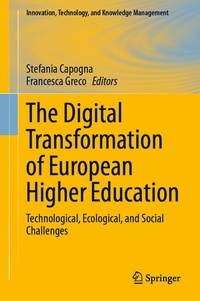
The Digital Transformation of European Higher Education
Description

This volume analyzes e-learning in European higher education, focusing on the technological, ecological, and social challenges of digital transformation. Started pre-pandemic and a result of an ECOLHE project funded by the European Union's Erasmus+ programme, the book discusses the impact of this global crisis, as well as the need for universities to integrate information and communications technology (ICT) in teaching and learning.
The book presents multiple national case studies and examines how European universities adopt ICT for Lifelong Learning (LLL), uphold quality standards, and foster teachers' professional growth. It further sheds light on the translation of e-learning ideals into practical realities within academic institutions.
From enhancing digital skills to refining teaching methodologies, the book offers valuable insights for educators, administrators, and policymakers alike. The multidisciplinary approach includes theoretical frameworks, pilot training initiatives, and strategic recommendations, all aimed at strengthening higher education's digital infrastructure. Navigating the challenges of digitalization, the book offers solutions for how European universities can remain resilient against the evolving demands of the modern world.
More details
Other editions
Additional editions
Persons
Stefania Capogna is an Associate Professor at Link Campus University, Rome, Italy, as well as the founder and Scientific Director of the Digital Technologies Education & Society Research Centre at Link Campus University, and the academic Journal Quaderni di Comunità. She is a regular consultant for the Italian National Agency for University Evaluation and Research (ANVUR). Capogna's research focuses on education systems, public policies, and organizational development, also concerning digital technologies.
Francesca Greco is a tenure track Assistant Professor at the Department of Languages and Literatures, Communication, Education and Society, University of Udine, Italy, where she teaches public relations theories and techniques, as well as communication advertising and new media. Greco is a member of the international scienfic board of JADT (Journée International d'Analyse Textuelle) and an expert in digital media communication, cultural processes, big data, computational sociology, and natural language processing. She developed a socio-cultural profiling method, emotional text mining, which won awards in Italy and France.
Content
Chapter 1. Introduction.- Part 1: ECOLHE: the Main Project Results.- Chapter 2. Building the EHEA Through the "translation" Perspective.- Chapter 3. Digital Transformation in Europe.- Chapter 4. Digital Development Culture in Europe.- Chapter 5. Students' Perspective of Digital Technologies in Higher Education.- Chapter 6. Online Training Model for Improving Teachers in He: Challenges, Criticalities, Possibilities.- Chapter 7. Gamification as a Strategy to Increase Student Engagement in Higher Education: Exploring Teachers' Perspectives.- Chapter 8. The Symbiotic Learning Paradigm (SLP): Teacher Competencies, Methods & Approaches in Higher Education.- Chapter 9. Conclusion of the Project Findings.- Part 2: Recommendation and Guidelines for Academic Bodies.- Chapter 10. Digital Transformation and Digital Pedagogy- Quality of Learning and Teaching in EHEA.- Chapter 11. Suggestions for Academic Bodies.- Chapter 12. Networking and Cooperation in Promoting Quality Standards Through Internationalization.- Chapter 13. Conclusion.
