

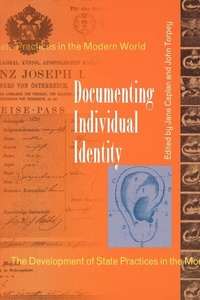
Documenting Individual Identity
The Development of State Practices in the Modern World
1st Edition
Published on 5. November 2018
432 pages
978-0-691-18685-6 (ISBN)
Description

This book addresses one of the least studied yet most pervasive aspects of modern life--the techniques and mechanisms by which official agencies certify individual identity. From passports and identity cards to labor registration and alien documentation, from fingerprinting to much-debated contemporary issues such as DNA-typing, body surveillance, and the catastrophic results of colonial-era identity documentation in postcolonial Rwanda, Documenting Individual Identity offers the most comprehensive historical overview of this fascinating topic ever published.
The nineteen essays in this volume represent the collaborative effort of historians, sociologists, historians of science, political scientists, economists, and specialists in international relations. Together they cover a period from the emergence of systematic practices of written identification in early modern Europe through to the present day, and a geographic range that includes Europe, the Soviet Union, North and South America, and Africa. While the book is attuned to the nefarious possibilities of states' increasing capacity to identify individuals, it recognizes that these same techniques also certify citizens' eligibility for significant positive rights, such as welfare benefits and voting.
Unprecedented in subject and scope, Documenting Individual Identity promises to shape a whole new field of research that crosses disciplinary boundaries and is of broad public and academic significance. In addition to the editors, the contributors are Valentin Groebner, Gérard Noiriel, Charles Steinwedel, Marc Garcelon, Jon Agar, Martine Kaluszynski, Peter Becker, Anne Joseph, Kristin Ruggiero, Andrea Geselle, Andreas Fahrmeier, Leo Lucassen, Pamela Sankar, David Lyon, Gary Marx, Dita Vogel, and Timothy Longman.
The nineteen essays in this volume represent the collaborative effort of historians, sociologists, historians of science, political scientists, economists, and specialists in international relations. Together they cover a period from the emergence of systematic practices of written identification in early modern Europe through to the present day, and a geographic range that includes Europe, the Soviet Union, North and South America, and Africa. While the book is attuned to the nefarious possibilities of states' increasing capacity to identify individuals, it recognizes that these same techniques also certify citizens' eligibility for significant positive rights, such as welfare benefits and voting.
Unprecedented in subject and scope, Documenting Individual Identity promises to shape a whole new field of research that crosses disciplinary boundaries and is of broad public and academic significance. In addition to the editors, the contributors are Valentin Groebner, Gérard Noiriel, Charles Steinwedel, Marc Garcelon, Jon Agar, Martine Kaluszynski, Peter Becker, Anne Joseph, Kristin Ruggiero, Andrea Geselle, Andreas Fahrmeier, Leo Lucassen, Pamela Sankar, David Lyon, Gary Marx, Dita Vogel, and Timothy Longman.
More details
Other editions
Additional editions
Jane Caplan | John Torpey
Documenting Individual Identity
The Development of State Practices in the Modern World
Book
12/2001
Princeton University Press
€84.18
Article exhausted; check different version

Jane Caplan | John Torpey
Documenting Individual Identity
The Development of State Practices in the Modern World
Book
12/2001
Princeton University Press
€51.30
Article not available at the moment
Persons
Jane Caplan is Marjorie Walter Goodhart Professor of European History at Bryn Mawr College. Her most recent publications include the collections Written on the Body: The Tattoo in European and American History (Princeton) and Nazism, Fascism, and the Working Class: Essays by Tim Mason. John Torpey is Associate Professor of Sociology and European Studies at the University of British Columbia in Vancouver. He is the author of The Invention of the Passport: Surveillance, Citizenship, and the State and Intellectuals, Socialism, and Dissent: The East German Opposition and Its Legacy.
Content
- Cover
- Title Page
- Copyright Page
- Contents
- Acknowledgments
- Introduction: Jane Coplan and John Torpey
- PART ONE: CREATING APPARATUSES OF IDENTIFICATION
- 1. Describing the Person, Reading the Signs in Late Medieval and Renaissance Europe: Identity Papers, Vested Figures, and the Limits of Identification, 1400-1600
- 2. The Identification of the Citizen: The Birth of Republican Civil Status in France
- 3. "This or That Particular Person": Protocols of Identification in Nineteenth-Century Europe
- 4. Making Social Groups, One Person at a Time: The Identification of Individuals by Estate, Religious Confession, and Ethnicity in Late Imperial Russia
- 5. Colonizing the Subject: The Genealogy and Legacy of the Soviet Internal Passport
- 6. Modern Horrors: British Identity and Identity Cards
- PART TWO: IDENTIFICATION PRACTICES AND POLICING
- 7. Republican Identity: Bertillonage as Government Technique
- 8. The Standardized Gaze: The Standardization of the Search Warrant in Nineteenth-Century Germany
- 9. Anthropometry, the Police Expert, and the Deptford Murders: The Contested Introduction of Fingerprinting for the Identifi. cation of Criminals in Late Victorian and Edwardian Britain
- 10. Fingerprinting and the Argentine Plan for Universal Identification in the Late Nineteenth and Early Twentieth Centuries
- PART THREE: IDENTIFICATION AND CONTROL OF MOVEMENT
- 11. Domenica Saba Takes to the Road: Origins and Development of a Modern Passport System in Lombardy-Veneto
- 12. Governments and Forgers: Passports in Nineteenth-Century Europe
- 13. A Many-Headed Monster: The Evolution of the Passport System in the Netherlands and Germany in the Long Nineteenth Century
- 14. The Great War and the Birth of the Modern Passport System
- PART FOUR: CONTEMPORARY ISSUES IN IDENTIFICATION
- 15. DNA-Typing: Galton's Eugenic Dream Realized?
- 16. Under My Skin: From Identification Papers to Body Surveillance
- 17. Identity and Anonymity: Some Conceptual Distinctions and Issues for Research
- 18. Identifiying Unauthorized Foreign Workers in the German Labor Market
- 19. Identity Cards, Ethnic Self-Perception, and Genocide in Rwanda
- Bibliography
- Notes on Contributors
- Index
