

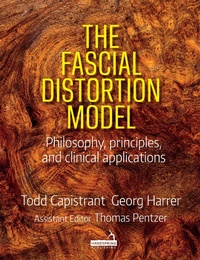
The Fascial Distortion Model
Philosophy, Principles and Clinical Applications
Published on 19. January 2021
272 pages
978-1-912085-57-6 (ISBN)
Description

The Fascial Distortion Model (FDM) was introduced by the American physician Stephen Typaldos (1957-2006). In this model all injuries and other conditions causing pain or disability are seen as arising from specific distortions of the connective tissue.
This highly illustrated and very practical text and manual covers in detail the theoretical framework of the model, and approaches to manual therapy treatment based on an understanding of the FDM. The authors systematically cover all disorders likely to be encountered by the therapist, and provide comprehensive guidance about when it is appropriate to use FDM and how best to employ these approaches in treatment.
The book is therefore of interest and value to all practitioners who want to understand the FDM and to incorporate its techniques into their therapeutic practice. This is also a comprehensive textbook and manual for anyone studying on FDM courses and for specific qualifications.
This highly illustrated and very practical text and manual covers in detail the theoretical framework of the model, and approaches to manual therapy treatment based on an understanding of the FDM. The authors systematically cover all disorders likely to be encountered by the therapist, and provide comprehensive guidance about when it is appropriate to use FDM and how best to employ these approaches in treatment.
The book is therefore of interest and value to all practitioners who want to understand the FDM and to incorporate its techniques into their therapeutic practice. This is also a comprehensive textbook and manual for anyone studying on FDM courses and for specific qualifications.
More details
Edition
Digital original
Language
English
Place of publication
London
United Kingdom
Publishing group
Jessica Kingsley Publishers
Target group
College/higher education
Professional and scholarly
Illustrations
About 600 color drawings and photographs
File size
70,22 MB
ISBN-13
978-1-912085-57-6 (9781912085576)
Copyright in bibliographic data and cover images is held by Nielsen Book Services Limited or by the publishers or by their respective licensors: all rights reserved.
Schweitzer Classification
Other editions
Additional editions
Todd Capistrant | Georg Harrer | Thomas Pentzer
The Fascial Distortion Model
Philosophy, Principles and Clinical Applications
Book
01/2021
Handspring Publishing Limited
€60.00
Shipment within 3-4 weeks
Persons
Dr Capistrant is a graduate of Des Moines University where he earned both his DO and MHA degrees. He has been active in the Fascial Distortion Model (FDM) since 2006 when he first experienced at first hand this approach to treatment. He has served many roles on the board of the American Fascial Distortion Model Association (AFDMA) and is completing a two-term period as the organization's President. Dr Capistrant became an instructor of the FDM in 2010 and since then has conducted courses throughout the United States and internationally. He is a member of the Fascial Distortion Model Global Organization (FDMGO) and was one of the original signatories to the charter documents that created that organization. Dr Capistrant authored an introductory book called "Why Does it Hurt?" that introduces FDM to anyone interested in learning the basics about this modality. In 2021 he was awarded a diploma in sports medicine from the International Olympic Committee.
Dr Capistrant currently practices full-time Osteopathic Manipulative Medicine in Fairbanks, Alaska with Foundation Health Partners Tanana Valley Clinic. He was the founding member of a vibrant OMM department that has grown to six members and now includes a hospital practice. He credits the success of this department to the universal implementation of FDM by all the practitioners in the group.
Dr Georg Harrer holds a doctorate from the Medical Faculty of the University of Vienna; is a specialist in anesthetics and intensive care, and a general practitioner. In addition to his medical studies, he completed a postgraduate training in osteopathy at the Vienna School of Osteopathy (WSO). In 1997 he met Stephen Typaldos when the latter was invited by the WSO to hold one of his first ever Fascial Distortion Model (FDM) courses outside the USA. The concept of FDM fascinated Dr Harrer and so he visited Dr Typaldos in his clinic in Bangor, Maine the following year. From this initial contact there developed a lasting personal friendship between the two, and this provided the setting for detailed and continuing discussions on FDM and patient care. Dr. Harrer assisted in numerous FDM courses in Europe and helped translate the third edition of Typaldos' FDM book into German. In 2001 Dr Typaldos accredited him as a teacher FDM. Over the years Dr Harrer has given hundreds of FDM seminars - mainly in Europe, but also in Africa and the USA. In 2006 he founded the European FDM Association (EFDMA) and became its first President. In 2011 he was President of the 5th FDM World Congress in Vienna. Dr Harrer is a board member of FDM-GO, the Global FDM Association.
Dr Harrer has written contributions on the subject of FDM for several textbooks in the field of osteopathy and fascia. In addition to his international teaching activities, Dr. Harrer runs a medical practice, specializing in FDM, in Vienna, Austria.
Dr Capistrant currently practices full-time Osteopathic Manipulative Medicine in Fairbanks, Alaska with Foundation Health Partners Tanana Valley Clinic. He was the founding member of a vibrant OMM department that has grown to six members and now includes a hospital practice. He credits the success of this department to the universal implementation of FDM by all the practitioners in the group.
Dr Georg Harrer holds a doctorate from the Medical Faculty of the University of Vienna; is a specialist in anesthetics and intensive care, and a general practitioner. In addition to his medical studies, he completed a postgraduate training in osteopathy at the Vienna School of Osteopathy (WSO). In 1997 he met Stephen Typaldos when the latter was invited by the WSO to hold one of his first ever Fascial Distortion Model (FDM) courses outside the USA. The concept of FDM fascinated Dr Harrer and so he visited Dr Typaldos in his clinic in Bangor, Maine the following year. From this initial contact there developed a lasting personal friendship between the two, and this provided the setting for detailed and continuing discussions on FDM and patient care. Dr. Harrer assisted in numerous FDM courses in Europe and helped translate the third edition of Typaldos' FDM book into German. In 2001 Dr Typaldos accredited him as a teacher FDM. Over the years Dr Harrer has given hundreds of FDM seminars - mainly in Europe, but also in Africa and the USA. In 2006 he founded the European FDM Association (EFDMA) and became its first President. In 2011 he was President of the 5th FDM World Congress in Vienna. Dr Harrer is a board member of FDM-GO, the Global FDM Association.
Dr Harrer has written contributions on the subject of FDM for several textbooks in the field of osteopathy and fascia. In addition to his international teaching activities, Dr. Harrer runs a medical practice, specializing in FDM, in Vienna, Austria.
Content
Preface
Acknowledgements
List of abbreviations
What is the Fascial Distortion Model?
Conceptual Basis for the Fascial Distortion Model
The Distortions
Diagnostics
The Fascial Matrix
Common Somatic Complaints
Cervical Region
Thoracic Region
Lumbar Spine
Pelvis and Sacrum
Shoulder
Hand
Elbow
Wrist
Lower Extremities
Knee
Hip
Foot
Inversion
References and bibliography
Index
Acknowledgements
List of abbreviations
What is the Fascial Distortion Model?
Conceptual Basis for the Fascial Distortion Model
The Distortions
Diagnostics
The Fascial Matrix
Common Somatic Complaints
Cervical Region
Thoracic Region
Lumbar Spine
Pelvis and Sacrum
Shoulder
Hand
Elbow
Wrist
Lower Extremities
Knee
Hip
Foot
Inversion
References and bibliography
Index
