

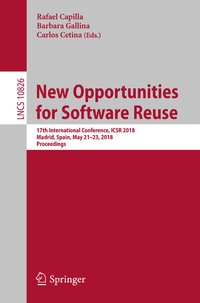
New Opportunities for Software Reuse
17th International Conference, ICSR 2018, Madrid, Spain, May 21-23, 2018, Proceedings
Published on 9. May 2018
XVIII, 181 pages
978-3-319-90421-4 (ISBN)
Description

This book constitutes the refereed proceedings of the 17th International Conference on Software Reuse, ICSR 2018, held in Madrid, Spain, in May 2018.
The 9 revised full papers and 2 short papers presented were carefully reviewed and selected from 29 submissions. The papers are organized in the following topical sections: variability management; hierarchies and reuse measures; dependencies and traceability; and software product lines, features and reuse of code rewriters.
The 9 revised full papers and 2 short papers presented were carefully reviewed and selected from 29 submissions. The papers are organized in the following topical sections: variability management; hierarchies and reuse measures; dependencies and traceability; and software product lines, features and reuse of code rewriters.
More details
Other editions
Additional editions
Rafael Capilla | Barbara Gallina | Carlos Cetina
New Opportunities for Software Reuse
17th International Conference, ICSR 2018, Madrid, Spain, May 21-23, 2018, Proceedings
Book
04/2018
Springer
€128.39
Shipment within 10-15 days
Content
- Intro
- Foreword
- Organization
- Abstracts of the Keynote Talks
- New Opportunities for Reuse in an Uncertain World
- The Challenging Future of Open Data Reuse
- Reuse in (re)certification of Systems
- Managing Variability with Feature Models (Tutorial)
- Contents
- Variability Management
- Variability Management in Safety-Critical Software Product Line Engineering
- Abstract
- 1 Introduction
- 2 Product and Usage Context Variation and Their Impact
- 2.1 Tiriba Flight Control Product Line
- 2.2 The Impact of Variation on SPL Design
- 2.3 The Impact of Variation on SPL Dependability Analysis
- 3 DEPendable-SPLE
- 3.1 DEPendable-SPLE: Domain Engineering
- 3.2 DEPendable-SPLE: Application Engineering
- 4 Related Work
- 5 Conclusion
- Acknowledgments
- References
- Towards Estimating and Predicting User Perception on Software Product Variants
- 1 Introduction
- 2 Related Work
- 3 Introducing SPL-Based Generative Art
- 4 Motivations and Problem Statement
- 5 Approach
- 5.1 Phase 1: Data Set Creation Through Evolution
- 5.2 Phase 2: Ranking Computation
- 6 Case Study Results
- 7 Evaluation
- 8 Threats to Validity
- 9 Conclusion
- References
- Hierarchies and Reuse Measures
- Reusability Index: A Measure for Assessing Software Assets Reusability
- Abstract
- 1 Introduction
- 2 Related Work
- 3 Proposed Reusability Index
- 3.1 Reuse Factors
- 3.2 Reuse Metrics
- 3.3 Calculation of REI
- 4 Case Study Design
- 5 Results
- 5.1 RQ1 - Correlation, Consistency, Predictive and Discriminative Power of REI Cases and Units of Analysis
- 5.2 RQ2 - Reliability of the REI
- 6 Discussion
- 7 Threats to Validity
- 8 Conclusions
- Acknowledgement
- References
- A Hybrid Approach for Tag Hierarchy Construction
- Abstract
- 1 Introduction
- 2 Related Work
- 3 Hybrid Hierarchy Construction Method
- 3.1 Overview of Our Approach
- 3.2 Unsupervised Hierarchy Building
- 3.3 Hierarchy Optimization
- 4 Experiment Design
- 4.1 Research Questions
- 4.2 Experimental Setting
- 4.3 Evaluation Metrics
- 5 Results and Discussions
- 5.1 RQ1: Does Domain Knowledge Promote the Tag Hierarchy?
- 5.2 RQ2: Does Our Approach Work More Accurately Than Others'?
- 5.3 Case Study
- 5.4 Threats to Validity
- 6 Conclusion and Future Work
- Acknowledgement
- References
- Top-Down Evaluation of Reusable Goal Models
- 1 Introduction
- 2 Background on Goal Modeling
- 3 Top-Down Evaluation of Goal Models
- 3.1 Goal Prioritization with Thresholds
- 3.2 The Lazy Recursive Algorithm in Top-Down Evaluation
- 4 Top-Down Evaluation in Reuse Hierarchies
- 5 Proof-of-Concept Implementation
- 6 Related Work
- 7 Conclusions and Future Work
- References
- Dependencies and Traceability
- An Empirical Analysis of Technical Lag in npm Package Dependencies
- 1 Introduction
- 2 Dataset and Background
- 2.1 Semantic Versioning and Dependency Constraints
- 3 Measuring Technical Lag
- 4 Results
- 5 Discussion
- 6 Related Work
- 7 Threats to Validity
- 8 Conclusion
- References
- On-Demand Automated Traceability Maintenance and Evolution
- 1 Introduction
- 2 Related Work
- 3 Building a Case-Based Reasoner for Traceability Maintenance and Evolution
- 3.1 Case Representation of Software Traceability
- 3.2 Similarity Assessment and Retrieval of Stored Traceability Cases
- 3.3 Reuse and Adaptation of Traceability Links at the Architectural Level
- 3.4 Revision and Retention of Traceability Links
- 4 Case Study
- 5 Experimental Evaluation
- 6 Conclusions and Future Work
- References
- Assuring Virtual PLC in the Context of SysML Models
- 1 Introduction
- 2 Background and Related Work
- 2.1 Virtual PLC
- 2.2 SysML-Safety Analysis Integration
- 2.3 NLP and IR-Based Traceability
- 3 Experimental Setup
- 3.1 Subject System
- 3.2 Natural Language Processing (NLP)
- 3.3 Evaluation Metrics
- 4 Results and Analysis
- 4.1 Results
- 4.2 Threats to Validity
- 5 Discussion
- 6 Conclusion
- References
- Software Product Lines, Features and Reuse of Code Rewriters
- Guiding Clone-and-Own When Creating Unplanned Products from a Software Product Line
- 1 Introduction
- 2 Approach Overview
- 2.1 SPL Definition and Correlations
- 2.2 Product Configuration and Derivation
- 3 Experiments and Limitations
- 4 Related Work
- 5 Conclusion and Future Work
- References
- Supporting Product Line Adoption by Combining Syntactic and Textual Feature Extraction
- 1 Introduction
- 2 Feature Extraction and Abstraction of Magic Applications
- 2.1 Product Line Adoption in a Clone-and-Own Environment
- 2.2 Feature Extraction Approach
- 2.3 The Structure of a Magic Application
- 3 Feature Extraction Experiments
- 3.1 Feature Extraction Using (task) Call Dependency
- 3.2 Textual Similarity
- 3.3 Combined Technique
- 4 Discussion
- 5 Related Work
- 6 Conclusions
- References
- A Delta-Oriented Approach to Support the Safe Reuse of Black-Box Code Rewriters
- 1 Introduction
- 2 Background and Challenges
- 2.1 Using Coccinelle to Patch the Linux Kernel
- 2.2 Using Spoon to Fix Anti-patterns in Android Applications
- 2.3 Challenges Associated to Rewriting Rules Reuse
- 3 Using Deltas to Isolate Rule Applications (C1)
- 4 Detecting Syntactic and Semantic Conflicts (C2)
- 4.1 Syntactic Conflicts as Overlapping Deltas
- 4.2 Semantic Conflicts as Postcondition Violations
- 5 Implementation and Validation
- 6 Related Work
- 7 Conclusions and Perspectives
- References
- Author Index
