

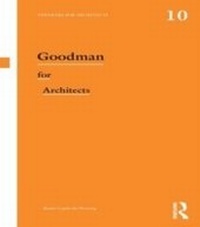
Goodman for Architects
1st Edition
Published on 15. October 2013
144 pages
978-1-134-66054-4 (ISBN)
Description

American philosopher Nelson Goodman (1906-1998) was one of the foremost analytical thinkers of the twentieth century, with groundbreaking contributions in the fields of logic, philosophy of science, epistemology, and aesthetics. This book is an introduction to the aspects of Goodman's philosophy which have been the most influential among architects and architectural theorists.
Goodman specifically discussed architecture in his major work on aesthetics, The Languages of Art: An Approach to a Theory of Symbols (1968), and in two essays "How Buildings Mean" (1985), and "On Capturing Cities" (1991). His main philosophical notions in Ways of Worldmaking (1978) also apply well to architecture. Goodman's thought is particularly attractive because of its constructive aspect: there is not a given and immutable world, but both knowledge and reality are constantly built and rebuilt. Whereas other theories, such as deconstruction, implicitly entail an undoing of modern precepts, Goodman's conception of world-making offers a positive, constructive way to understand how a plural reality is made and remade.
Goodman's approach to architecture is not only relevant thinking in providing new insights to understanding the built environment, but serves also as an illustration of analytical thinking in architecture. This book shows that the methods, concepts, and ways of arguing characteristic of analytical philosophy are helpful tools to examine buildings in a novel and fruitful way and they will certainly enhance the architect's critical skills when designing and thinking about architecture.
Goodman specifically discussed architecture in his major work on aesthetics, The Languages of Art: An Approach to a Theory of Symbols (1968), and in two essays "How Buildings Mean" (1985), and "On Capturing Cities" (1991). His main philosophical notions in Ways of Worldmaking (1978) also apply well to architecture. Goodman's thought is particularly attractive because of its constructive aspect: there is not a given and immutable world, but both knowledge and reality are constantly built and rebuilt. Whereas other theories, such as deconstruction, implicitly entail an undoing of modern precepts, Goodman's conception of world-making offers a positive, constructive way to understand how a plural reality is made and remade.
Goodman's approach to architecture is not only relevant thinking in providing new insights to understanding the built environment, but serves also as an illustration of analytical thinking in architecture. This book shows that the methods, concepts, and ways of arguing characteristic of analytical philosophy are helpful tools to examine buildings in a novel and fruitful way and they will certainly enhance the architect's critical skills when designing and thinking about architecture.
More details
Series
Language
English
Place of publication
London
United Kingdom
Publishing group
Taylor & Francis Ltd
Target group
College/higher education
Professional and scholarly
Illustrations
12 s/w Photographien bzw. Rasterbilder, 1 s/w Zeichnung
1 Line drawings, black and white; 12 Halftones, black and white
File size
3,70 MB
ISBN-13
978-1-134-66054-4 (9781134660544)
Copyright in bibliographic data and cover images is held by Nielsen Book Services Limited or by the publishers or by their respective licensors: all rights reserved.
Schweitzer Classification
Other editions
Additional editions
Remei Capdevila-Werning
Goodman for Architects
Book
10/2013
1st Edition
Routledge
€205.50
Shipment within 15-20 days
Remei Capdevila-Werning
Goodman for Architects
Book
10/2013
1st Edition
Routledge
€53.20
Shipment within 15-20 days
Person
Remei Capdevila-Werning wrote her dissertation on Goodman and architecture and is a postdoctoral researcher at the Universitat Autonoma de Barcelona, Spain.
Content
1. Introduction 2. When is Architecture? 3. Buildings as Symbols 4. Identity of Architectural Works 5. Buildings as Ways of Worldmaking Further Reading Bibliography Index
