

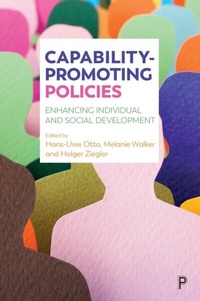
Capability-Promoting Policies
Enhancing Individual and Social Development
Policy Press
1st Edition
Published on 8. November 2017
336 pages
978-1-4473-3432-3 (ISBN)
Description

How can unjust societies be overcome with a better distribution of opportunities to flourish? How can human development be revitalised in countries where social welfare is being questioned? In short, how can human development be fostered in practice? These are some of the important questions asked in this volume through analysis of existing policies and conceptualisations of coherent and systematic strategies for human development policies at the local, national and international level.
International contributors innovatively combine the hitherto unpaired perspectives of the capability approach and the tradition of critical social policy with empirical examples using case studies from South-Africa, Asia, Australia, Europe and North and South America. The result is a call for a new, feasible approach towards more socially balanced, democratic and innovative capability-promoting policy activities, models and programmes that reduce social and human suffering to promote an enhanced social quality of current societies around the world.
International contributors innovatively combine the hitherto unpaired perspectives of the capability approach and the tradition of critical social policy with empirical examples using case studies from South-Africa, Asia, Australia, Europe and North and South America. The result is a call for a new, feasible approach towards more socially balanced, democratic and innovative capability-promoting policy activities, models and programmes that reduce social and human suffering to promote an enhanced social quality of current societies around the world.
Reviews / Votes
"this well-researched volume can function as a model for any author who might wish to research capabilities-enhancing policies in other social policy fields." Citizen's Income "The capability approach has the remarkable ability to bring thinkers from substantially different places in this world together - and so does this book." Rene Lehwess-Litzmann, Soziologisches Forschungsinstitut Goettingen an der Georg-August-Universitaet (SOFI), Germany "This book represents a sound picture of the current understanding and use of the Capability Approach. The book deserves a wide readership - academics, students, practitioners and policy makers." Niels Rosendal Jensen, Danish School of Education (EDU), Aarhus University, DenmarkMore details
Edition
First Edition
Language
English
Place of publication
Bristol
United Kingdom
Publishing group
Bristol University Press
Target group
Professional and scholarly
Illustrations
12 s/w Abbildungen, 17 s/w Tabellen
17 Tables, black and white; 12 Illustrations, black and white
ISBN-13
978-1-4473-3432-3 (9781447334323)
DOI
https://doi.org/10.51952/9781447334323
Copyright in bibliographic data and cover images is held by Nielsen Book Services Limited or by the publishers or by their respective licensors: all rights reserved.
Schweitzer Classification
Other editions
Additional editions
Capability-Promoting Policies
Enhancing Individual and Social Development
Book
11/2017
1st Edition
Policy Press
€109.80
Shipment within 15-20 days
Capability-Promoting Policies
Enhancing Individual and Social Development
E-Book
11/2017
1st Edition
Policy Press
€54.99
Available for download
Persons
Hans-Uwe Otto is Senior Research Professor and Director of the Bielefeld Center for Education and Capability Research at Bielefeld University. In addition, he is Adjunct Professor at the School of Social Policy and Practice at the University of Pennsylvania, Philadelphia and Guest Professor at Shanghai University.
Professor Melanie Walker joined the University of the Free State in February 2012 as Senior Research Professor in Higher Education and Human Development. In 2013 she was appointed as NRF Chair in Higher Education and Human Development. She is an Al-rated NRF researcher.
Holger Ziegler is Professor for Social Work at the Faculty of Educational Science (specialising in professional theory, social justice research, and impact research) at Bielefeld University and Co-Director of the Bielefeld Center for Education and Capability Research.
Professor Melanie Walker joined the University of the Free State in February 2012 as Senior Research Professor in Higher Education and Human Development. In 2013 she was appointed as NRF Chair in Higher Education and Human Development. She is an Al-rated NRF researcher.
Holger Ziegler is Professor for Social Work at the Faculty of Educational Science (specialising in professional theory, social justice research, and impact research) at Bielefeld University and Co-Director of the Bielefeld Center for Education and Capability Research.
Content
Introduction: Human development, capabilities and the ethics of policy ~ Hans-Uwe Otto, Melanie Walker and Holger Ziegler
Part 1: Conceptual challenges
What political liberalism and the welfare state left behind: chance and gratitude ~ Reiko Gotoh
The capability approach, agency and sustainable development ~ Elise Klein and Paola Ballon
Public policy: from welfare to empowerment of women in India ~ Indira Mahendravada
The contribution to human development of social policies in the Central American integration system ~ Guillermo Bornemann-Martinez, Pedro Caldentey and Emilio J. Morales-Fernandes
Part 2: Modalities of structure and civil society
A framework for urban integration: the case of Buenos Aires ~ Severine Deneulin, Eduardo Lepore, Ann Mitchell and Ana Lourdes Suarez
Culture, equity and social wellbeing in New York City ~ Mark J. Stern and Susan C. Seifert
The third sector and capability-promoting policies ~ Giuseppe Acconcia, Enrica Chiappero-Martinetti and Paolo R. Graziano
Informal workers and human development in South Africa ~ Ina Conradie
Part 3: Children, youth and education;
The capability approach: what can it offer child protection policy and practice in England? ~ Brid Featherstone and Anna Gupta
The capability approach and a child standpoint ~ Sharon Bessell
Capabilities and the challenge to inclusive schooling ~ Franziska Felder
Early childhood educational curricula: implications of the capability approach ~ Antoanneta Potsi
Education for all? Providing capabilities for young people with special needs ~ Christian Christrup Kjeldsen
The instrumental values of education in the Southern Cone ~ Xavier Rambla
Conclusion: What is to be done about capability-promoting policies? ~ Hans-Uwe Otto, Melanie Walker and Holger Ziegler
Part 1: Conceptual challenges
What political liberalism and the welfare state left behind: chance and gratitude ~ Reiko Gotoh
The capability approach, agency and sustainable development ~ Elise Klein and Paola Ballon
Public policy: from welfare to empowerment of women in India ~ Indira Mahendravada
The contribution to human development of social policies in the Central American integration system ~ Guillermo Bornemann-Martinez, Pedro Caldentey and Emilio J. Morales-Fernandes
Part 2: Modalities of structure and civil society
A framework for urban integration: the case of Buenos Aires ~ Severine Deneulin, Eduardo Lepore, Ann Mitchell and Ana Lourdes Suarez
Culture, equity and social wellbeing in New York City ~ Mark J. Stern and Susan C. Seifert
The third sector and capability-promoting policies ~ Giuseppe Acconcia, Enrica Chiappero-Martinetti and Paolo R. Graziano
Informal workers and human development in South Africa ~ Ina Conradie
Part 3: Children, youth and education;
The capability approach: what can it offer child protection policy and practice in England? ~ Brid Featherstone and Anna Gupta
The capability approach and a child standpoint ~ Sharon Bessell
Capabilities and the challenge to inclusive schooling ~ Franziska Felder
Early childhood educational curricula: implications of the capability approach ~ Antoanneta Potsi
Education for all? Providing capabilities for young people with special needs ~ Christian Christrup Kjeldsen
The instrumental values of education in the Southern Cone ~ Xavier Rambla
Conclusion: What is to be done about capability-promoting policies? ~ Hans-Uwe Otto, Melanie Walker and Holger Ziegler
