

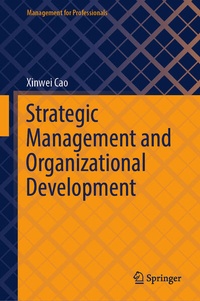
Strategic Management and Organizational Development
Description

This book offers a systematic analysis of key business challenges, including risk mitigation through first principles thinking, the transformation of traditional manufacturing, the impact of genetic bias on strategy, and the relationship between urbanization and individual success. By recognizing patterns, leveraging proven models, and fostering adaptability, companies can better navigate disruptions and achieve sustainable growth. This book serves as a valuable resource for those looking to refine their strategic thinking and organizational development skills.
What sets this book apart is its interdisciplinary approach, integrating evolutionary theory, economics, and management strategies to provide a deeper understanding of market competition and business adaptation. It offers a practical framework for navigating today's dynamic business landscape, making it an essential resource for professionals, entrepreneurs, and students alike.
This book not only delivers key insights into surviving and thriving in hyper-competitive markets but also serves as a valuable guide for anyone looking to refine their strategic decision-making and organizational development skills.
More details
Other editions
Additional editions
Person
Xinwei Cao received the bachelor's degree from Shandong University, China, in 2009, the master's degree from Tongji University, China, in 2012, and the Ph.D. degree from Fudan University, China, in 2017, all in management. She is currently a full Professor with School of Business, Jiangnan University, China. Her research interests include operational management, winner-take-all dynamics, portfolio management, computational and quantitative finance, and financial market.
Content
Follow the Proven Path to Reduce Risks.- Is Apple a Manufacturing Company?.- Bias in Genetics and Product Strategy Planning.- Leveraging Development: From the Small County Town to Modern Shanghai's Rise.- Talent is Changeable, Mission Remains: How the Butterfly Migration Principle Helps Businesses Achieve Long-Term Development.- Feedback vs. Pure Environmental Impact: Why Feedback Determines the Final Outcome.- Agile Management: The Secret Weapon to Boost Project Success Rate.- Win with Few, Overcome with Weak.- From the "Ecological Niche" to Individual Employment and Corporate Governance.- Dare to Be Latter.- Unequal Yet Successful: Decoding the Invisible Rules Behind Commercial Transactions.- Viewing Business Growth Through "Barter".- The Wealth Code in Technological Leapfrogs.- The Underlying Logic of Business: Mastering Information Gaps, Scaling Replication, and Business Intuition.- From Rise to Decline: How Businesses Respond to Market Cycles.
