

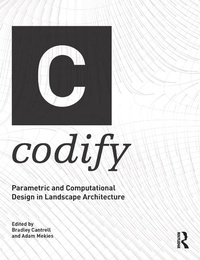
Codify
Parametric and Computational Design in Landscape Architecture
1st Edition
Published on 1. May 2018
310 pages
978-1-317-29907-3 (ISBN)
Description

Codify: Parametric and Computational Design in Landscape Architecture provides a series of essays that explore what it means to use, modify and create computational tools in a contemporary design environment. Landscape architecture has a long history of innovation in the areas of computation and media, particularly in how the discipline represents, analyses, and constructs complex systems. This curated volume spans academic and professional projects to form a snapshot of digital practices that aim to show how computation is a tool that goes beyond methods of representation and media. The book is organized in four sections; syntax, perception, employ, and prospective. The essays are written by leading academics and professionals and the sections examine the role of computational tools in landscape architecture through case studies, historical accounts, theoretical arguments, and nascent propositions.
Reviews / Votes
'Codify is the long-awaited book for landscape architects bridging professional practice with data driven design. Filled with case studies that include scripting and digital analysis, to the implementation of smart algorithms, and custom applications, all leading to new methods of organizing, understanding and quantifying data that allow for smarter, sustainable landscape architecture. This book represents the future of a profession that will be dominated by high quality, automated, readily available remote sensing information and provides direction for how landscapes will be designed, built and managed in the future by both humans and smart applications.'Daniel Tal, Landscape Architect, USA
'Do electronic trees dream of photosynthesis? Artificial intelligence, robots, virtual reality, video games, coding, big data, cybernetic design... This volume is destined to become the bible for landscape architects and environmental designers looking for inspiration on how to integrate technology in every aspect of design from coding and programming to construction administration and post-occupancy evaluation. Within these pages, educators, practitioners, and futurists examine the exciting application and potential for computation to shape the built environment and the direction of landscape architectural education.'
Chip Sullivan, ASLA, Professor, UC Berkeley, USA
'As Sanford Kwinter once noted, "no computer on earth can match the processing power of even the most simple natural system, be it of water molecules on a warm rock, a rudimentary enzyme system, or the movement of leaves in the wind." And yet, it is compelling to see computational tools and techniques applied to natural and designed systems alike. Codify provides a cogent and richly illustrated view into the current state of such electro-numeric techniques in landscape architecture.'
Kiel Moe, Associate Professor of Architecture, Harvard GSD, USA
'Codify offers a definitive framework for the next generation of computational landscape processes - ranging in scope from models and mappings, to material behavior and sensing. The authors deftly reframe the landscape medium as the subject of digital innovation, expanding our definition of the technosphere into new and unforeseen geographical dimensions. At this frontier, ecology, technology, urbanization, and environmental management, collapse into a single sector of human ingenuity and invention currently known as landscape. Codify convincingly argues that Landscape Architecture is uniquely positioned to define this sector of technology, and in the process redefine itself.'
Richard L. Hindle, University of California, Berkeley, USA
More details
Edition
1. Auflage
Language
English
Place of publication
London
United Kingdom
Publishing group
Taylor & Francis Ltd
Target group
College/higher education
Product notice
Reflowable
Illustrations
162 s/w Abbildungen, 2 s/w Tabellen, 99 s/w Photographien bzw. Rasterbilder, 63 s/w Zeichnungen
2 Tables, black and white; 63 Line drawings, black and white; 99 Halftones, black and white; 162 Illustrations, black and white
ISBN-13
978-1-317-29907-3 (9781317299073)
Copyright in bibliographic data and cover images is held by Nielsen Book Services Limited or by the publishers or by their respective licensors: all rights reserved.
Schweitzer Classification
Other editions
Additional editions
Book
05/2018
1st Edition
Routledge
€72.07
Shipment within 10-20 days
Book
05/2018
1st Edition
Routledge
€267.85
Shipment within 10-20 days
Persons
Bradley Cantrell is a landscape architect and scholar whose work focuses on the role of computation and media in environmental and ecological design. He is currently Professor and Chair of the Department of Landscape Architecture at the University of Virginia School of Architecture and has held academic appointments at the Harvard Graduate School of Design, The Rhode Island School of Design, and the Louisiana State University Robert Reich School of Landscape Architecture. His work in coastal and riverine landscapes form a series of methodologies that develop modes of modeling, simulation, and embedded computation that express and engage the complexity of overlapping physical, cultural, and economic systems.
Adam Mekies is a licensed landscape architect and planner at Design Workshop in Aspen, Colorado, where he leads many of the firm's computational and interactive technologies in the construction of the public and private realm. He received his Bachelor of Landscape Architecture from Iowa State University, and has applied his interests in advanced construction modeling and computational technology to design projects across the country and overseas. He is the recipient of multiple ASLA design and research awards for his work in community design and implementation of interactive and parametric technologies.
Adam Mekies is a licensed landscape architect and planner at Design Workshop in Aspen, Colorado, where he leads many of the firm's computational and interactive technologies in the construction of the public and private realm. He received his Bachelor of Landscape Architecture from Iowa State University, and has applied his interests in advanced construction modeling and computational technology to design projects across the country and overseas. He is the recipient of multiple ASLA design and research awards for his work in community design and implementation of interactive and parametric technologies.
Content
00.00 . About Code, Christophe Girot
00.01 . Coding Landscape, Bradley Cantrell and Adam Mekies
Syntax
01.00 . Computation in Practice | An Inquiry Into the Business of Computational Design, Paralabs
01.01 . Generative Modeling and the Making of Landscape, Chris Reed
01.02 . 21st Century Learning, Pete Evans
01.03 . The Parametric Park, David Fletcher
01.04 . Big Data for Small Places: Systematizing the functional use of complex and sizeable data sets in daily practice, Elizabeth Christoforetti, Will Cohen, Yonatan Cohen, Stephen Rife, Jia Zhang
01.05 . Turing Landscapes, Stephen Ervin
Perception
02.00 . Landscape Models of the Scientific Imaginary-a visual textual precis, Justine Holzman
02.01 . Computational and Research-Driven Design Methodologies: an enquiry into atmosphere, Jillian Wallis and Heike Rahmann
02.02 . Agent Based Models to Reveal Underlying Landscape Structure, Joseph Claghorn
02.03 . Open Source Mapping + App Development, Chris Seeger
02.04 . From Solution Space to Interface: 6 Actions for Landscape Infrastructure Design, Alexander Robinson and Brian Davis
Employ
03.00 . The Role of Query and Convergence in Next Generation Tool Sets, Anthony Frausto-Robledo
03.01 . Coding Behavior: The Agency of Material in Landscape Architecture, Brian Osborn
03.02 . Beyond Heuristic Design, Brian Phelps
03.03 . The New Maker Culture: Computation and Participation in Design, Andrea Hansen Philips
03.04 . Code Matters: Consequent Digital Tool Making, James Melsom and Luis Fraguada
Prospective
04.00 . Technology, Evolution, and An Ecology of Cities, Kurt Culbertson
04.01 . The Witness, David Fletcher
04.02 . From Documents to Directives: Experimental Fast Matter, Craig Reschke
04.03 . Towards Sentience, Leif Estrada
04.04 . Design for a Mind with Many Bodies, Ricardo Jnani Gonzalez
00.01 . Coding Landscape, Bradley Cantrell and Adam Mekies
Syntax
01.00 . Computation in Practice | An Inquiry Into the Business of Computational Design, Paralabs
01.01 . Generative Modeling and the Making of Landscape, Chris Reed
01.02 . 21st Century Learning, Pete Evans
01.03 . The Parametric Park, David Fletcher
01.04 . Big Data for Small Places: Systematizing the functional use of complex and sizeable data sets in daily practice, Elizabeth Christoforetti, Will Cohen, Yonatan Cohen, Stephen Rife, Jia Zhang
01.05 . Turing Landscapes, Stephen Ervin
Perception
02.00 . Landscape Models of the Scientific Imaginary-a visual textual precis, Justine Holzman
02.01 . Computational and Research-Driven Design Methodologies: an enquiry into atmosphere, Jillian Wallis and Heike Rahmann
02.02 . Agent Based Models to Reveal Underlying Landscape Structure, Joseph Claghorn
02.03 . Open Source Mapping + App Development, Chris Seeger
02.04 . From Solution Space to Interface: 6 Actions for Landscape Infrastructure Design, Alexander Robinson and Brian Davis
Employ
03.00 . The Role of Query and Convergence in Next Generation Tool Sets, Anthony Frausto-Robledo
03.01 . Coding Behavior: The Agency of Material in Landscape Architecture, Brian Osborn
03.02 . Beyond Heuristic Design, Brian Phelps
03.03 . The New Maker Culture: Computation and Participation in Design, Andrea Hansen Philips
03.04 . Code Matters: Consequent Digital Tool Making, James Melsom and Luis Fraguada
Prospective
04.00 . Technology, Evolution, and An Ecology of Cities, Kurt Culbertson
04.01 . The Witness, David Fletcher
04.02 . From Documents to Directives: Experimental Fast Matter, Craig Reschke
04.03 . Towards Sentience, Leif Estrada
04.04 . Design for a Mind with Many Bodies, Ricardo Jnani Gonzalez
