

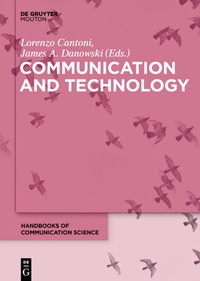
Communication and Technology
Description

The primary goal of the Communication and Technology volume (5th within the series "Handbooks of Communication Science") is to provide the reader with a comprehensive compilation of key scholarly literature, identifying theoretical issues, emerging concepts, current research, specialized methods, and directions for future investigations. The internet and web have become the backbone of many new communication technologies, often transforming older communication media, through digitization, to make them compatible with the net. Accordingly, this volume focuses on internet/web technologies. The essays cover various infrastructure technologies, ranging from different kinds of hard-wired elements to a range of wireless technologies such as WiFi, mobile telephony, and satellite technologies. Audio/visual communication is discussed with reference to large-format motion pictures, medium-sized television and video formats, and the small-screen mobile smartphone. There is also coverage of audio-only media, such as radio, music, and voice telephony; text media, in such venues as online newspapers, blogs, discussion forums and mobile texting; and multi-media technologies, such as games and virtual reality.
More details
Other editions
Additional editions
Persons
Content
- Intro
- Preface to Handbooks of Communication Science series
- Contents
- Introduction
- Communication technologies: An itinerary
- I. The history of communication technologies
- 1. From orality to newspaper wire services: Conceptualizing a medium
- 2. Point-to-point: telecommunications networks from the optical telegraph to the mobile telephone
- 3. Cinema and technology: From painting to photography and cinema, up to digital motion pictures in theatres and on the net
- 4. Recorded music
- 5. Communication in video games: From players to player communities
- 6. Hypermedia, internet and the web
- 7. Virtuality: VR as metamedia and herald of our future realities
- 8. Virtual communities and social networks
- 9. Web 2.0 and 3.0
- II. Communication technologies and their enviroment
- 10. ICTs and the dialectics of development
- 11. Information quality and information overload: The promises and perils of the information age
- 12. User experience and usability
- 13. Impact of new media: A corrective
- 14. Research methods on the Internet
- 15. Digital Natives, New Millennium Learners and Generation Y, does age matter? Data and reflection from the higher education context
- 16. Mobile media and communication
- 17. Legal issues in a networked world
- 18. Ethical issues in Internet communication
- III. Communication technologies and new practices of communication in the information and communication society
- 19. Commerce
- 20. Workplace relationships: Telework, worklife balance, social support, negative features, and individual/organizational outcomes
- 21. Marketing and public relations
- 22. From electronic governance to policydriven electronic governance - evolution of technology use in government
- 23. Technology and terrorism: Media symbiosis and the "dark side" of the web
- 24. Religion
- 25. Learning
- 26. Communication technology and health: The advent of ehealth applications
- 27. New media in travel and tourism communication: Toward a new paradigm
- 28. Journalism: From delivering information to engaging citizen dialogue
- 29. Libraries in the digital age: Technologies, innovation, shared resources and new responsibilities
- 30. The sciences are discursive constructs: The communication perspective as an empirical philosophy of science
- Biographical sketches
- Subject index
