

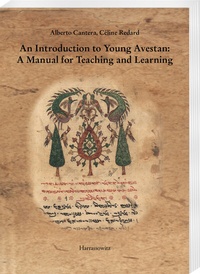
An Introduction to Young Avestan: A Manual for Teaching and Learning
Translated from French into English by Richard Tahmaseb Niroumand
1st Edition
Published on 6. December 2023
XVI, 458 pages
978-3-447-39472-7 (ISBN)
Description

Avestan is the sacred language of the Zoroastrians in which they perform most of their rituals. It is known only from its use in the rituals of modern Zoroastrians and the manuscripts reproducing these rituals since the 13th century. Although sure dates cannot be provided, it is very likely that the creation of the liturgical corpus extended from the end of the 2nd millennium BCE until the end of the Achaemenid period (4th cent. BCE). This corpus includes texts in at least three linguistic layers (Old, Middle and Young Avestan). The present manual aims to provide a tool for facilitating the teaching of Young Avestan but keeps in mind also the possibility of self-learning since Avestan is not well-represented in the actual academic landscape. It includes a progressive presentation of the complex phonetic evolutions that are very characteristic of the Avestan language as a consequence of the evolution of the recitation until its fixation (6th cent. CE) and also of the Avestan grammar, complemented with exercises including samples of original texts of increasing difficulty. In each lesson, one text is reproduced in a manuscript, introducing the students to the direct work with manuscripts.
All prices
More details
Other editions
Additional editions
Alberto Cantera | Céline Redard
An Introduction to Young Avestan: A Manual for Teaching and Learning
Translated from French into English by Richard Tahmaseb Niroumand
Book
12/2023
Harrassowitz Verlag
€69.00
Available immediately
Persons
Content
- Cover
- Title Pages
- Contents
- Introduction to the English version
- Introduction
- Bibliography and fundamental tools
- Lesson 1
- 1.1 What is the Avestan language?
- 1.2 The Avestan alphabet
- 1.3 Ahuric and Daevic vocabulary
- 1.4 Vocabulary
- 1.5 Exercises
- Lesson 2
- 2.1 Morphological Categories
- 2.2 Declensions of a-Stems (ALF § 87, IA § 19.1)
- 2.3 The verb "to be"
- 2.4 Coordination particles (IA § 38.2)
- 2.5 Vocabulary
- 2.6 Exercises
- Lesson 3
- 3.1 declensions of non-apophonic a-stems (ALF § 88, IA § 19.2)
- 3.2 Present stems
- 3.3 Syntax of causative verbs (VAV 141 SS)
- 3.4 Vocabulary
- 3.5 Exercises
- Lesson 4
- 4.1 Vocalism I. General phenomena affecting vocalism
- 4.2 The apophony (= Ablaut) (ALF § 43, IA § 13.2)
- 4.3 The declension of a-stems: The apophonic a-stems (ALF § 89, IA § 19.2)
- 4.4 The past tense: The imperfect and the injunctive (OAV. 227-249)
- 4.5 Compounds
- 4.6 Vocabulary
- 4.7 Exercises
- Lesson 5
- 5.1 vocalism II. The vowel a
- 5.2 Personal pronouns (ALF § 112-116, IA § 22.1)
- 5.3 Syntax of personal pronouns
- 5.4 Vocabulary
- 5.5 Exercises
- Lesson 6
- 6.1 Vocalism III. The vowel a
- 6.2 Relative, interrogative and indefinite pronouns
- 6.3 Syntax of the relative pronoun
- 6.4 The middle voice
- 6.5 Vocabulary
- 6.6 Exercises
- Lesson 7
- 7.1 Vocalism III. The vowels i, i, u, u (ALF § 41)
- 7.2 The declension of i-stems I (ALF § 95, IA § 19.5)
- 7.3 The passive
- 7.4 Passive syntax
- 7.5 Vocabulary
- 7.6 Exercises
- Lesson 8
- 8.1 Vocalism IV. The diphthongs (IA § 10)
- 8.2 The declension of i-stems II (ALF § 95-96, IA § 19.5)
- 8.3 Root-nouns in -i (NRA III.H-30)
- 8.4 The comparative and superlative (IA § 20.1)
- 8.5 The secondary endings of the middle voice (VAV 228-235)
- 8.6 Syntax of Cases I: nominative, vocative (IA § 36.1)
- 8.7 Vocabulary
- 8.8 Exercises
- Lesson 9
- 9.1 The laryngeals (ALF § 44-45)
- 9.2 i-stems
- 9.3 The demonstratives
- 9.4 The athematic present I: The present root and imperfect (VAV 199-217, 227-234)
- 9.5 Syntax of cases II: Accusative (IA § 36.1)
- 9.6 Vocabulary
- 9.7 Exercises
- Lesson 10
- 10.1 Consonantism I
- 10.2 Pronominal adjectives: aniia- "other", vispa- "all" (ALF § 123, IA § 20.2)
- 10.3 Athematic present II
- 10.4 Syntax of cases III: The ablative (IA § 36.2)
- 10.5 Vocabulary
- 10.6 Exercises
- Lesson 11
- 11.1 Consonantism II. The labials
- 11.2 Phonetic phenomena affecting u-stems
- 11.3 The u-stems (ALF § 93, IA § 19.5)
- 11.4 The u-stems (ALF § 92, IA § 19.4)
- 11.5 The subjunctive (VAV 250-291)
- 11.6 Syntax of cases IV. The genitive and the dative (IA § 36.2-3)
- 11.7 Vocabulary
- 11.8 Exercises
- Lesson 12
- 12.1 The declension of consonantal stems I: Root-nouns (ALF § 97, 99-102, IA § 18.1)
- 12.2 The optative (VAv 292-297)
- 12.3 Syntax of cases V: The instrumental (IA § 36.3)
- 12.4 Vocabulary
- 12.5 Exercises
- Lesson 13
- 13.1 Consonantism III. Dentals (ALF § 64)
- 13.2 declension of consonantal stems II: Dental stems (ALF § 100, 105, IA § 18.13)
- 13.3 The imperative (VAV 314318, IA § 30.1c, 37.5)
- 13.4 Syntax of cases VI: The locative (IA § 36.3)
- 13.5 Vocabulary
- 13.6 Exercises
- Lesson 14
- 14.1 Consonantism IV. Nasals (ALF § 15, IA § 11.3)
- 14.2 Nasal stems
- 14.3 The aorist (VAV 353-383, ALF § 187-202, IA § 27)
- 14.4 Prepositions and preverbs (IA § 23)
- 14.5 Vocabulary
- 14.6 Exercises
- Lesson 15
- 15.1 consonantism V. The sibilants (ALF § 69-79, IA § 11.19-31)
- 15.2 ah-stems (ALF § 109, IA § 18.7)
- 15.3 The perfect (VAV 400-425, ALF § 203-210, IA § 28, 32.6)
- 15.4 The negation (VAv 244, 274, 314, 318, IA § 39)
- 15.5 Vocabulary
- 15.6 Exercises
- Lesson 16
- 16.1 consonantism VI. Liquids (ALF § 56-58)
- 16.2 Stems in -ar and stems in -r /-n
- 16.3 Future tense (VAV 160)
- 16.4 Adverbial subordinate clauses introduced by a conjunction (Purpose, consequence, concession, comparison)
- 16.5 Vocabulary
- 16.6 Exercises
- Lesson 17
- 17.1 Numbers
- 17.2 Participles
- 17.3 Infinitives (ALF § 211, IA § 33, VAV 338 SS)
- 17.4 Conditional and temporal clauses
- 17.5 Vocabulary
- 17.6 Exercises
- Avestan - English Glossary
- Overview tables
