

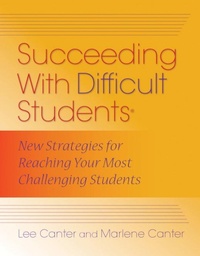
Succeeding With Difficult Students
New Strategies for Reaching Your Most Challenging Students
1st Edition
Published on 5. September 2011
136 pages
978-1-936765-72-0 (ISBN)
Description

Turn your students' lives around and reduce your own stress with practical techniques that focus on building positive relationships and shaping constructive classroom behavior. This book offers strategies for meeting the needs of difficult students and teaching lifelong interpersonal skills. Learn to identify when and why a student misbehaves, and develop a behavior plan based on the student's special needs.
More details
Other editions
Additional editions
Lee Canter | Marlene Canter
Succeeding with Difficult Students
New Strategies for Reaching Your Most Challenging Students
Book
01/2011
Solution Tree
€46.00
Shipment within 3-4 weeks
Content
- Intro
- Table of Contents
- Acknowledgments
- Introduction
- Section 1: Reaching Out to Difficult Students
- Chapter One: Who Are Difficult Students
- Chapter Two: Building Trust
- Chapter Three: Proactive vs. Reactive Responses
- Chapter Four: Establishing Positive Relationships With Difficult Students
- Section 2: Meeting the Special Needs of Difficult Students
- Chapter Five: Identifying the Primary Needs of Difficult Students
- Chapter Six: Teaching Appropriate Behavior
- Chapter Seven: Providing Positive Support
- Chapter Eight: Redirecting Nondisruptive Off-Task Behavior
- Chapter Nine: Decreasing Disruptive Behavior
- Chapter Ten: Diffusing Confrontations
- Section 4: Additional Strategies
- Chapter Twelve: Individualized Behavior Plans
- Conclusion
- Recommended Reading and Bibliography
- About the Authors
